
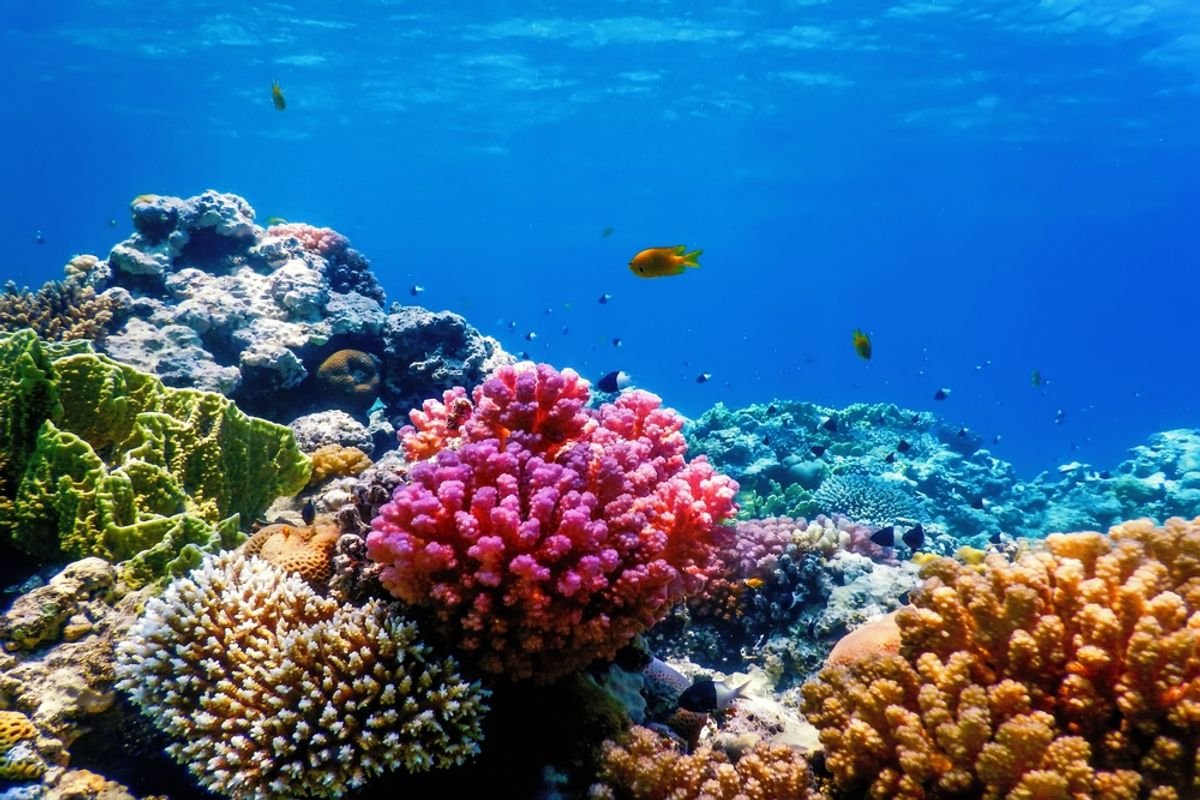
Coral Reefs Do More Than Build Habitat — They Organize Microbial Life

Each day, coral reefs quietly reshape the microscopic world drifting just above them. As daylight fades and returns, the smallest ocean organisms — bacteria, algae, and single-celled predators — appear and disappear in a steady cycle that repeats every 24 hours.
A new study, published in Science Advances, shows that coral reefs don’t merely host marine life; they actively organize nearby microbial communities in time. By driving predictable daily shifts in which microbes dominate the water, reefs influence how nutrients circulate and how energy moves through the surrounding ecosystem.
“We found that the reef is not just passively surrounded by microbes,” said study coauthor Miguel J. Frada, in a press release. “It actively structures microbial life in time, creating daily patterns that repeat across seasons and influence how energy and nutrients move through the ecosystem.”
Read More: The Great Barrier Reef Experiences Largest Annual Decline in Nearly 40 Years
Revealing How Coral Reefs Shape Nearby Waters
To capture these rhythms, researchers focused on waters above a coral reef in the northern Gulf of Aqaba in the Red Sea. They compared microbial communities over the reef with those in nearby open waters, sampling every six hours during both winter and summer.
The team combined genetic analyses, flow cytometry, imaging tools, and ecological measurements to follow microbial populations at unusually fine time scales. That approach revealed rapid, repeating changes in bacteria, microalgae, and microscopic predators — fluctuations that would likely go unnoticed with less frequent sampling.
Across seasons, the same daily patterns kept resurfacing, underscoring that when samples are collected can matter just as much as where they are taken when studying reef-associated microbes.
Why Bacteria Drop by Day and Microbial Predators Rise at Night
One of the most consistent signals was a sharp contrast between reef waters and nearby open ocean. Above the reef, bacteria and microalgae were consistently less abundant, suggesting that reef organisms actively remove microbes through grazing, filtering, and other biological interactions.
After sunset, the balance shifted again. Numbers of heterotrophic protists — microscopic organisms that feed on bacteria — rose sharply at night, in some cases by nearly 80 percent. The timing points to predation as a key force driving daily microbial turnover around reefs.
These opposing trends show that reefs shape microbial communities not only by who lives nearby, but also by when different groups flourish or decline.
Coral-Associated Microbes Follow a Daily Rhythm
Microbes closely associated with corals exhibited distinct daily patterns as well. Signals associated with Symbiodiniaceae — microorganisms best known for their close partnership with corals — increased and declined on a daily schedule in reef waters.
Rather than remaining fixed within corals, these patterns suggest ongoing daily exchange or turnover between corals and the surrounding water, likely linked to changing light conditions and shifts in coral activity through the day.
“These daily microbial rhythms were as strong as, and sometimes stronger than, seasonal differences,” said lead author Herdís G. R. Steinsdóttir. “This shows that time of day is a critical factor when studying reef-associated microbial communities.”
By revealing how coral reefs regulate microscopic life on a daily schedule, the study highlights a largely invisible layer of reef functioning. Because microbial communities respond quickly to environmental change, tracking their daily rhythms could offer a sensitive way to monitor how reefs are functioning — and how they may be changing — in a warming ocean.
Read More: Seismic Activity Shakes Up Microbes Deep Under Yellowstone Lake
Article Sources
Our writers at Discovermagazine.com use peer-reviewed studies and high-quality sources for our articles, and our editors review for scientific accuracy and editorial standards. Review the sources used below for this article: