
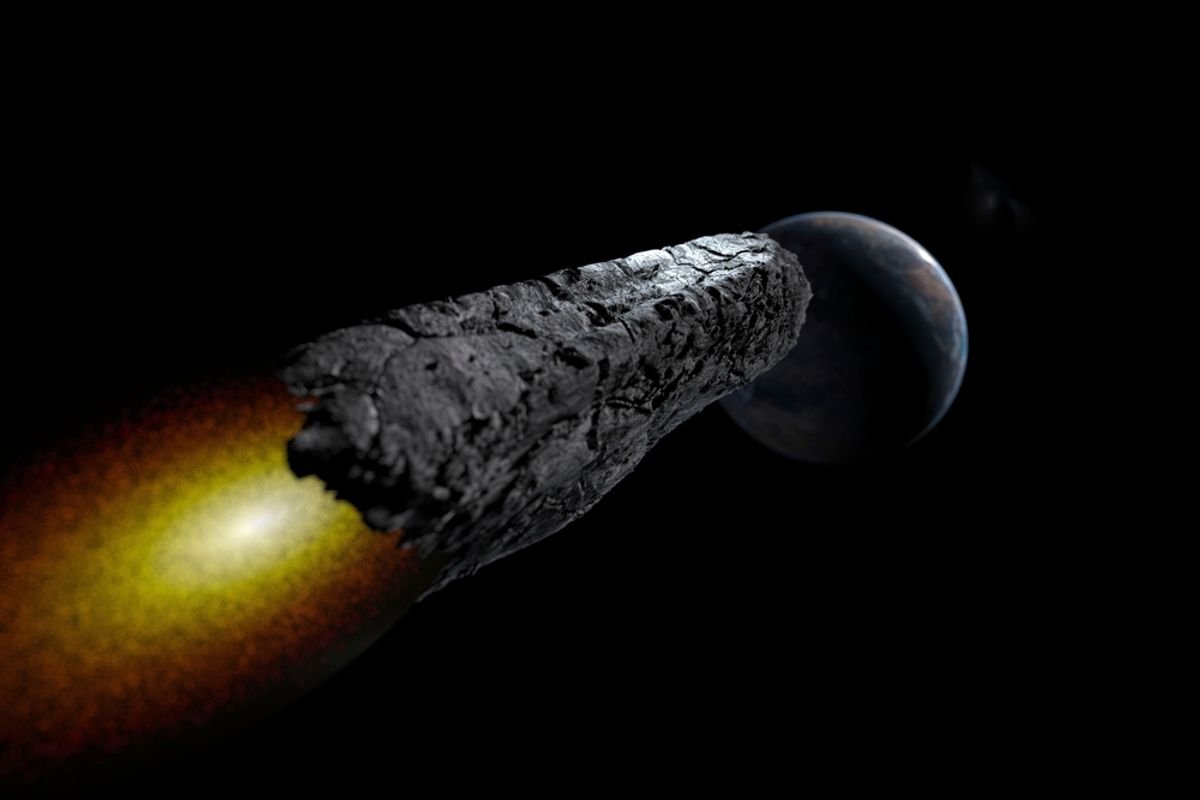
Comet 3I/ATLAS Flaunts Bright Halo and Tail in New Image Taken by Jupiter-Bound Spacecraft
Although comet 3I/ATLAS has come and gone, it will remain an influential research subject for the foreseeable future. As the interstellar comet passed the sun and Earth in late 2025, several spacecraft studied its behavior and composition. Since then, a steady stream of data has been returning to Earth-based scientists, who are trying to interpret the mysterious nature of 3I/ATLAS.
The latest glimpse of 3I/ATLAS has just arrived, revealing the comet’s trajectory just one week after it made its closest approach to the sun on October 29-30, 2025. An image taken by the European Space Agency’s Jupiter Icy Moons Explorer (Juice) shows the telltale features of 3I/ATLAS, including its tail and coat of gas. Similar images that are now in the hands of ESA scientists may soon clarify what made 3I/ATLAS different from typical comets.
Read More: Other ATLAS Comet Appears Fragmented After Close Encounter with The Sun
A Snapshot of Comet 3I/ATLAS

Comet 3I/ATLAS imaged from Juice — a mission on its way to explore Jupiter’s icy moons.
(Image Credit: ESA/Juice/JANUS/CC BY-SA 3.0 IGO)
Throughout the latter half of 2025, Comet 3I/ATLAS piqued the curiosity of scientists and the general public alike. The comet’s journey inspired a whirlwind of studies and theories that sought to answer many questions; everyone wondered where the interstellar visitor came from and desperately wanted to know what it was doing in our Solar System.
Scientists were quick to assure people that 3I/ATLAS was no threat to Earth, confirming that it was just a comet, and nothing more. They monitored the comet’s route until it eventually made its closest approach to Earth on December 19, 2025, at about 270 million km (168 million miles) from our planet.
Multiple spacecraft observed and captured images of 3I/ATLAS as it hurtled through space. The latest image from Juice, taken on November 6, 2025, has helped ESA scientists understand how the comet was moving in relation to the sun.
At the top left corner of the image, two arrows indicate the direction in which the comet was moving (blue) and the relative direction of the sun (yellow), according to a statement.
Poring Over Data From Juice
The ESA’s Juice spacecraft was launched in April 2023 on a mission to explore Jupiter and its three large ocean-bearing moons (Ganymede, Callisto, and Europa). But as luck would have it, the spacecraft has also managed to gather key details on 3I/ATLAS.
The image from November was taken by JANUS, a multicolor optical camera on Juice. At the time the image was captured, Juice was about 66 million km (41 million miles) away from 3I/ATLAS.
The image shows 3I/ATLAS enveloped in its coma, a bright cloud of gas and icy dust emitted by the comet’s nucleus. A tail extending away from the comet is also visible.
According to the ESA, JANUS took more than 120 images of 3I/ATLAS, which are now being examined by scientists. The images are joined by data that Juice collected with four additional science instruments: MAJIS (Moons and Jupiter Imaging Spectrometer), SWI (the Sub-millimeter Wave Instrument), PEP (Particle Environment Package), and UVS (a UV imaging spectrograph).
The Unresolved Secrets of 3I/ATLAS
Data collected by Juice was recently transmitted back to Earth; the spacecraft had to use a smaller medium-gain antenna to send it, since its main high-gain antenna was already serving as a heat shield.
Research teams at ESA will analyze the Juice data and images to understand 3I/ATLAS and its features. So far, the comet’s behavior seems like that of a normal comet, according to the ESA.
However, the composition of 3I/ATLAS is a different story; scientists previously found that the comet contains an abundance of nickel, but no iron, according to a 2025 pre-print report in the Astrophysical Journal Letters. In addition, the carbon dioxide-to-water ratio in its coma is exceptionally high, according to a separate pre-print report in the Astrophysical Journal Letters. Further studies on these traits could shed light on where and how 3I/ATLAS formed.
More answers will come in late March, when all of the instrument teams at the ESA will convene to go over their findings.
Read More: New Images of Comet 3I/ATLAS Reveal “How Magical the Universe Could Be”
Article Sources
Our writers at Discovermagazine.com use peer-reviewed studies and high-quality sources for our articles, and our editors review for scientific accuracy and editorial standards. Review the sources used below for this article: