
Color-Changing Material That Mimics Octopus Skin Could Be Used for Robotics

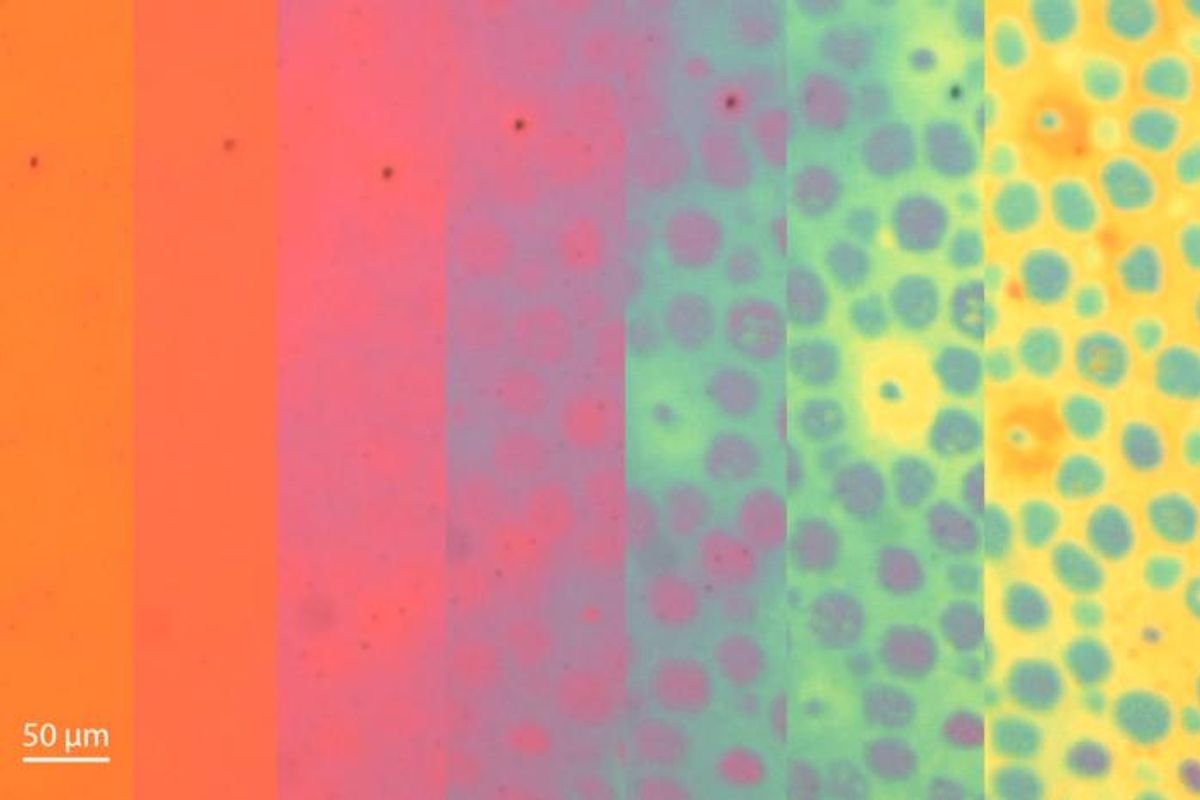
Octopuses have the incredible ability to quickly change and adapt their skin to camouflage themselves in their surroundings — an ability researchers have been working to adapt to synthetic materials. In a recent study published in Nature, researchers revealed a new material that has the ability to rapidly swell into different colors, textures, and patterns at a resolution finer than a human hair.
“Textures are crucial to the way we experience objects, both in how they look and how they feel,” said Siddharth Doshi, a doctoral student in materials science and engineering at Stanford and first author on the paper, in a press release. “These animals can physically change their bodies at close to the micron scale, and now we can dynamically control the topography of a material — and the visual properties linked to it — at this same scale.”
This new research could lead to improved camouflage for both humans and certain robotic systems, as well as more dynamic displays for wearable technology. The research team thinks it’s also possible that this new material could open new doors in nanophotonics — the control and manipulation of light at the nanometer, which could help improve encryption, electronics, and biology.
Read More: Shark Skin and Cicada Wings Inspire New Antimicrobial Cutting Boards
Octopus Inspires New Synthetic Material
For the study, the team employed electron-beam lithography — a patterning technique commonly used in semiconductor manufacturing — and combined it with a polymer film that swells upon water absorption.
As the researchers fired electron beams at the polymer, they could manipulate swelling in specific regions of the material. As a result, they created detailed patterns that were revealed only when the polymer film was wet.
The team was initially surprised by these results. In previous research, Doshi scanned nanostructures on a polymer film using an electron microscope — a technique that employs electron beams to generate a high-resolution image. However, instead of discarding these film samples, Doshi recycled them and found that, when scanned again in the electron microscope, previously imaged areas behaved differently and even changed color.
“We realized that we could use these electron beams to control topography at very fine scales,” Doshi said. “It was definitely serendipitous.”
This electron-beam patterning is so accurate that the researchers created a nanoscale model of El Capitan in Yosemite National Park. Depending on the amount of water added to the film, they could also determine how to induce light scattering, thereby manipulating the film to appear matte or glossy. To return the film to normal, the team applied an alcohol-based solvent to remove the water. Once dry, the film was completely flat.
“There’s just no other system that can be this soft and swellable, and that you can pattern at the nanoscale,” said Nicholas Melosh, a professor of materials science and engineering and a senior author on the paper, in the press release. “You can imagine all kinds of different applications.”
Adaptable Material for the Future
While there is still much to learn about this material, researchers can manually alter the film’s color and texture. They may not be as quick or as accurate as an octopus, but they are getting closer.
“We want to be able to control this with neural networks — basically an AI-based system — that could compare the skin and its background, then automatically modulate it to match in real time, without human intervention,” Doshi said.
In addition to its use in camouflage, the team believes it could be applied to certain bioengineering research and robotics.
“Small changes in the properties of soft materials over micron distances are finally possible, which will open up all sorts of possibilities,” Melosh said. “I think there are a lot of exciting things coming up.”
Read More: Octopuses Change Color in Milliseconds, Even Though They Are Colorblind
Article Sources
Our writers at Discovermagazine.com use peer-reviewed studies and high-quality sources for our articles, and our editors review for scientific accuracy and editorial standards. Review the sources used below for this article: