
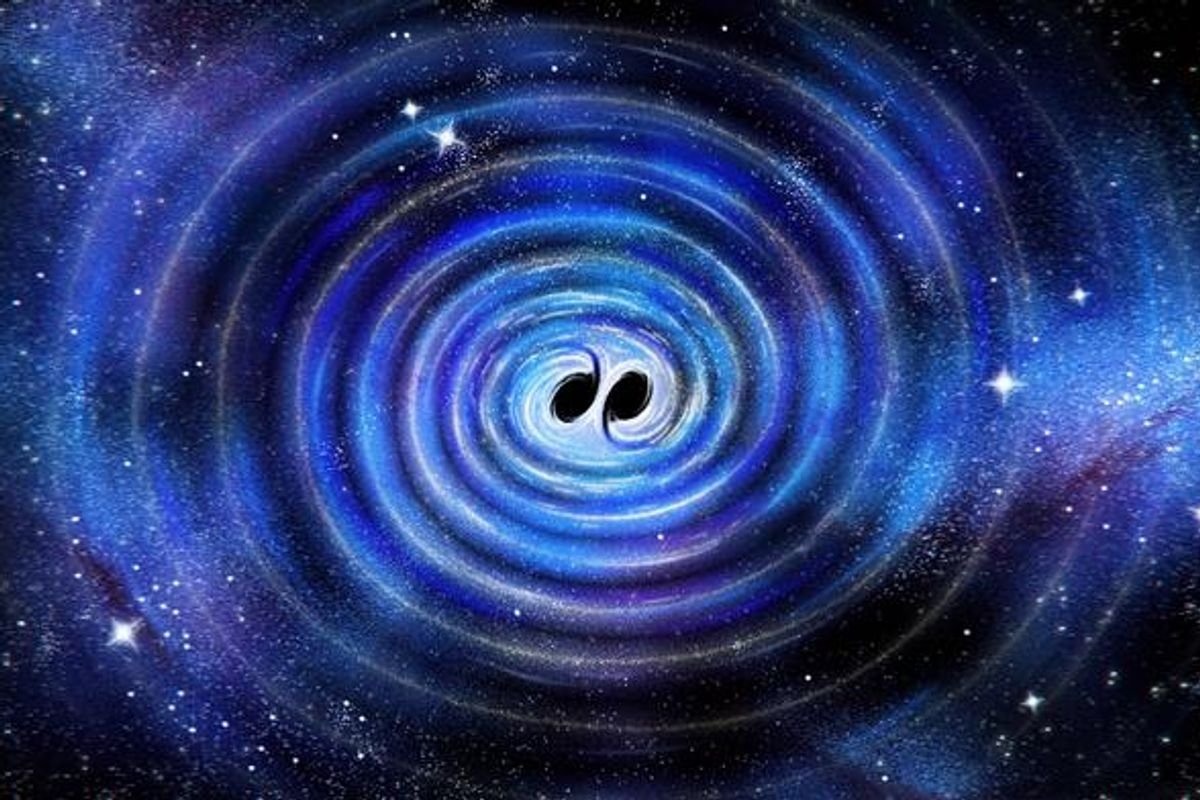
Colliding Black Holes Emitted a Massive Ringing, Confirming Predictions from Hawking and Einstein

The tiny wavering of laser beams has confirmed that black holes emit a massive, ringing energy as they collide.
“It’s the most powerful event in the universe, because in a fifth of a second you pulverize the equivalent of three entire suns and turn them into energy,” says Max Isi, an astronomer at Columbia University and the Simons Foundation, a nonprofit dedicated to funding science.
These detections have helped hundreds of scientists test fundamental theories proposed by Albert Einstein and Stephen Hawking about relativity and black holes.
“This process follows a very important tenet of what we think black holes should be doing,” Isi says.
Read More: Here’s What Would Happen If You Walked Through a Black Hole
A Ringing Black Hole
The discoveries were made thanks to the Laser Interferometer Gravitational-wave Observatory (LIGO), which is actually two different facilities in Washington state and Louisiana. Both facilities are in remote areas, isolated from noise. In the U.S., they operate by shooting lasers at a beam splitter, powered by quantum optics, which redirects them in L shapes. The split beams travel down passages where they hit mirrors spaced about 2.5 miles (4 kilometers) apart.
If no gravitational waves are present, no light comes through at the other side. However, as gravitational waves move through them, one will get momentarily and measurably shorter than the other.
In 2015, scientists at the LIGO facilities first detected a kind of ringing signal that would be made by the collision of two black holes.
“Not 10 years later, we are seeing them almost every other day, which is astounding,” Isi says.
Eventually, on January 14, 2025, scientists at the facilities detected the clearest signal they’d seen yet of colliding black holes. It was closer than the others, about one billion light-years away.
In a study published recently in Physical Review Letters, Isi and his collaborators described how this wavering signal related to the theories of Hawking and Roy Kerr, another physicist who worked on black hole theory. The study involved nearly 1,000 authors from LIGO and two complementary facilities — the Kamioka Gravitational Wave Detector (KAGRA) and the Virgo interferometer in Italy.
What Is A Ringing Black Hole?
Black holes have massive amounts of energy. When they smash together, the space and time around them are distorted, generating ripples that reverberate similarly to the sound waves created by a ringing bell.
These are expressed in gravitational waves that have a very specific pitch and duration that scientists have become adept at detecting in facilities like LIGO, KAGRA, and Virgo. The same way that sound waves might tell listeners something about the size of a bell, gravitational waves can tell scientists something about the properties of whatever emitted them.
According to Kerr, black holes are simple objects that can be described by mass and spin alone. The analysis of the ringing of these gravitational waves has provided strong evidence that this is the case, Isi and his colleagues argue.
Based on the interruption of the lasers at these facilities, researchers have detected the two black holes that existed before the collision in January 2025, as well as the larger black hole left after they came together. And all of this happens in roughly a fifth of a second, followed by a ringing that lasts about 10 milliseconds.
“These black holes seem to be consistent with what we see in the theory,” Isi says.
Proving Einstein and Hawking’s Theories
Einstein never directly predicted the existence of black holes, but other scientists used his general theory of relativity to predict their existence.
Hawking, meanwhile, believed that black holes could only ever grow in size. This basically meant the area inside their event horizons — the frontier at which no light entering could return — would only ever increase.
Hawking himself believed that the detection of the mergers of black holes that began in LIGO in 2015 might eventually confirm his theory, but he died in 2018. In subsequent years, methods of measurement had improved. Then, on January 14, 2025, when the signal of a relatively close black hole collision hit Earth, Isi and his colleagues could confirm it.
In that event, the two black holes that collided each had the mass of about 33 suns. When they combined, the new black hole had the mass of about 63 suns — the mass of roughly three suns it lost was what was emitted in the ringing gravitational waves, Isi says.
Hawking’s area law is also related to the second law of thermodynamics, which states that entropy — basically disorder — will always increase if left alone. Isi says that in black holes, the area inside the event horizon is actually a measure of disorder, showing how both Hawking’s area law and the second law of thermodynamics are related.
Read More: This is What a Black Hole Sounds Like
Article Sources
Our writers at Discovermagazine.com use peer-reviewed studies and high-quality sources for our articles, and our editors review for scientific accuracy and editorial standards. Review the sources used below for this article: