
Chimpanzees Have a Violent Reputation — But They Aren’t More Aggressive Than Bonobos

For years, chimpanzees and bonobos have been used as a kind of evolutionary mirror for human nature. Chimpanzees are often portrayed as violent and territorial, while bonobos are known for their peaceful and cooperative societies. But that contrast may be oversimplified.
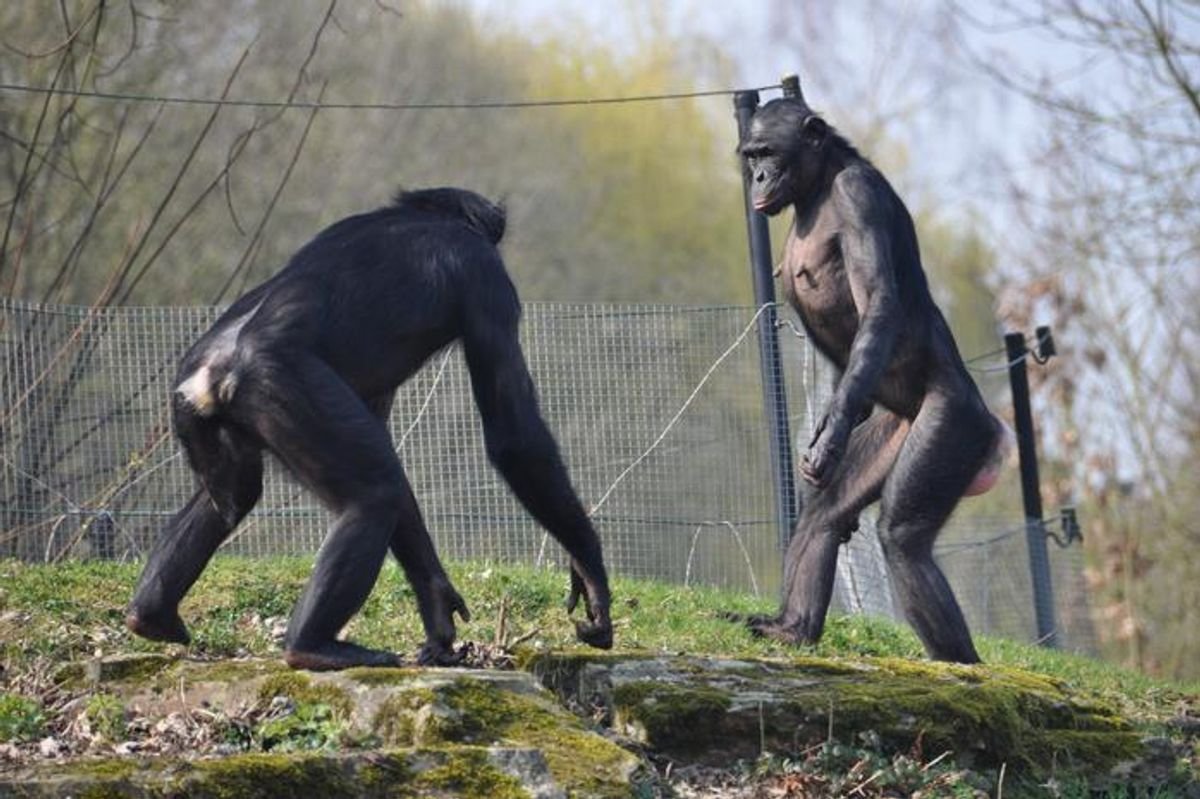
Researchers analyzing aggressive behavior across 22 zoo-housed groups of chimpanzees and bonobos found no meaningful difference in overall aggression between the two species, according to research published in Science Advances. Instead, the difference lies in how aggression is distributed within their social groups.
“Some see in them a reflection of our nature,” said co-author Emile Bryon in a press release. “Aggressive and war-minded like chimpanzees, or peaceful like bonobos. The truth is that, evolutionarily speaking, we are equally related to both species. And the dichotomy between aggressive chimpanzees and peaceful bonobos might be less clear than previously thought.”
Read More: Wild Chimpanzees May Be Consuming Two Alcoholic Drinks a Day
Chimpanzee and Bonobo Fighting Patterns
While the overall level of aggression was similar, the researchers did find an important difference in who tends to initiate it.
“In chimpanzees, aggression mainly comes from males and is directed at everyone. In bonobos, aggression comes from everyone but is mostly directed at males,” Bryon explained.
That pattern reflects the different social dynamics of the two species. Chimpanzee societies are dominated by males, who often compete intensely with one another and assert control over other group members. Bonobo societies, by contrast, are structured around female alliances that can collectively dominate males.
As a result, male bonobos rarely direct aggression toward females and instead tend to target other males.
Chimpanzees’ Violent Reputation
In the wild, chimpanzees have been observed engaging in violent encounters with neighboring groups, sometimes described as war-like raids. Researchers have also documented cases of infanticide, in which infants from rival groups are killed — behaviors that helped cement the view that chimpanzees are the more aggressive of the two species.
But newer observations have begun to complicate that picture. Some recent studies have found higher aggression among chimpanzee males, while others have reported the opposite pattern, with bonobo males displaying more aggression.
Rethinking the “Self-Domestication” Idea
One explanation scientists have proposed for bonobos’ reputation as peaceful apes is known as the self-domestication hypothesis. Chimpanzees and bonobos live in different ecological environments separated by the Congo River. Chimpanzee habitats tend to have more competition for food and greater pressure from predators, while bonobo habitats appear more stable.
Under the self-domestication hypothesis, these calmer conditions may have allowed female bonobos to form coalitions that gave them greater social power. Over time, females may have favored less aggressive males as partners, gradually selecting for more tolerant behavior. But the new study raises questions about that explanation.
“Neither our results nor the most recent findings from the wild do support the predictions from the self-domestication hypothesis in bonobos. Bonobo males are not markedly less aggressive than chimpanzee males,” said Bryon.
Instead, the researchers found that aggression levels varied widely between individual groups, regardless of species. Some groups were relatively peaceful, while others were far more aggressive. Studying great apes in zoos allowed researchers to compare behavior under similar environmental conditions, helping isolate differences between species.
“The overlap in aggressive behaviors we have observed in zoos provides valuable insight,” Bryon said. “Future studies in wild populations will help confirm whether they show the same patterns and differences in aggression.”
Understanding those patterns could ultimately help researchers better interpret the evolutionary roots of aggression in humans — and why the simple story of violent chimpanzees and peaceful bonobos may never have been quite right.
Read More: Chimps, Like Humans, Break Down Complex Tasks into Smaller Pieces
Article Sources
Our writers at Discovermagazine.com use peer-reviewed studies and high-quality sources for our articles, and our editors review for scientific accuracy and editorial standards. Review the sources used below for this article: