
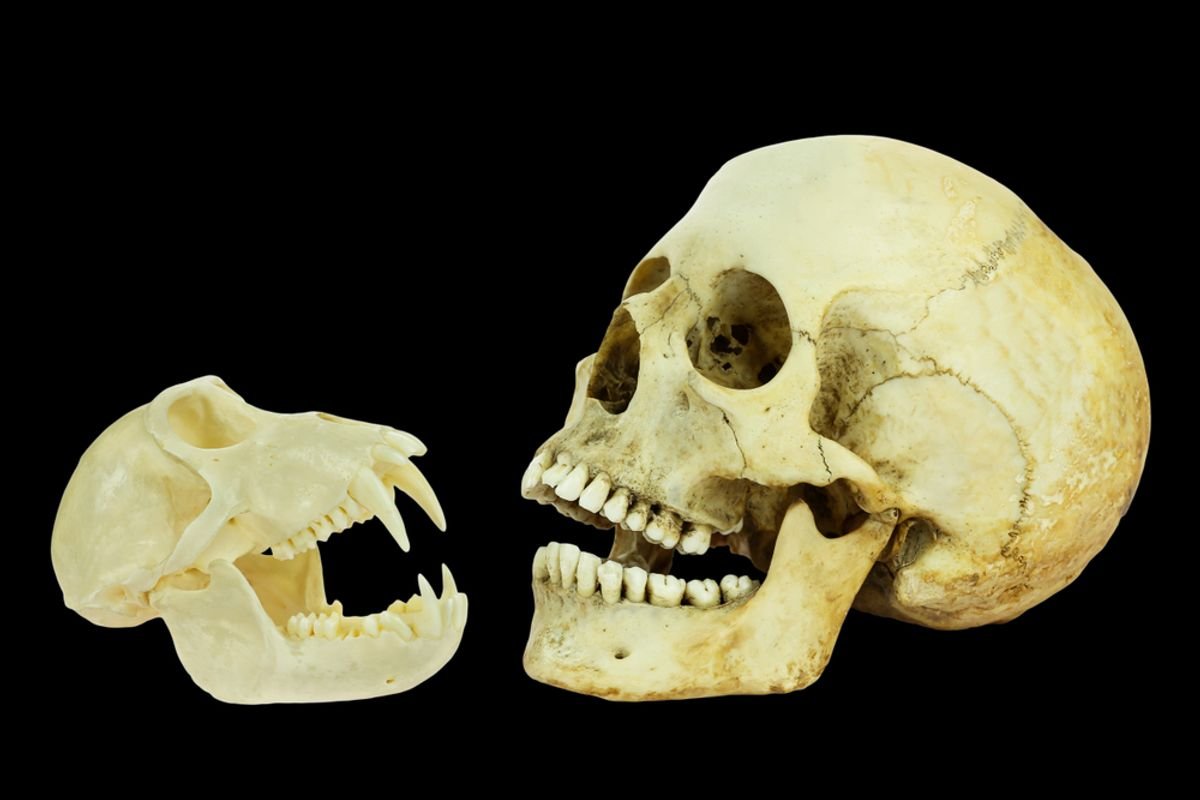
Changes in Diet May Have Led to Humans Having Smoother Skulls

When a child is born, their brain is only a fraction of the size that it will one day grow to be. As many caretakers will recall, an infant’s skull is flexible and made of bone and fibrous material called sutures — colloquially known as soft spots. Smooth and flexible, a newborn’s skull is a masterpiece in evolution, allowing for the brain to grow and develop unlike any other animal.
Zeray Alemseged, a paleoanthropologist in the Department of Organismal Biology and Anatomy at the University of Chicago, explains that human skulls have given our species an evolutionary advantage over others.
“Since we diverged from our cousins, the chimpanzees, around 7 million years ago, the hominid skull has changed dramatically,” Alemseged told Discover.
Read More: Viking Skulls Reveal the Ancient People Were Hardy, but Not Healthy
Why the Human Skull is Smooth
Over the course of history, evolution has changed how humans look. The brain case, or the part of the skull that surrounds the brain, has expanded to make more room for it. The face has shortened, while the ridges and cranial structures that attach heavy chewing muscles have disappeared as our need to eat tough meat has dissipated.
Attachments for powerful neck muscles, which were important for our primate ancestors, have also been dramatically reduced over millions of years.
“In addition to the above mentioned reasons, the human skull is smooth because during the course of evolution, we lost many of the ridges and crests that were attachments for heavy chewing [muscles],” said Alemseged. He adds that the human skull’s main role today is to host our exceptionally large brain, supporting the historically expanded brain case.
Protecting Our Brains
Human skull structure enables our brains to grow rapidly after birth. When born, the brain is about one-quarter to one-third its full size, doubling within the first year of life. By our fifth birthday, the brain will be around 90 percent of its adult size. Having a smooth braincase could facilitate the brain’s growth after birth, Alemseged told Discover. Because infants are born with unfused skull bones connected by “soft spots,” or fontanelles, their skulls make room for this rapid growth.
This smoothness of the skull results from structural integrity and provides a uniform protective shell for the brain. According to the Cleveland Clinic, sutures separate the main bones that make up the skull, allowing the brain room to grow.
When it’s reached its full size, the sutures join bones together like a quilt to form solid bone. Five major sutures form the skull, like the coronal suture, which stretches horizontally from ear to ear. The lambdoid suture runs horizontally to join a portion of the back of the skull, while the metopic suture connects the frontal bone to the forehead. A vertical suture, sagittal, runs down the top of the skull and, finally, the squamous suture connects the bones above the ears.
Human Skull Development Vs Ape Skull Development
How an infant human’s skull develops is different from that of apes. Although the human skull has 22 bones in adulthood, at birth, there are many more separate elements, making it particularly large relative to other parts of the body. Adult apes and gorillas also generally have the same number of skull bones, but that’s largely where the similarities end.
“The human skull is a primate skull, and the overall configuration and components of the bones are similar to what is seen in apes,” Alemseged said. “However, the human skull departs from that of apes as the result of the exceptionally large brain, gracile jaws, and tiny face, which renders the human skull globular. In that sense, the human skull is so conspicuously different from that of other primates.”
Unlike humans, great apes have what Alemseged described as a heavily built, highly jutting face, with an even ratio between facial size and braincase size. The human face, on the other hand, is tucked beneath the braincase, so reduced that according to Alemseged, “we are almost face-less” when compared to great apes. At least in terms of size.
Read More: Echolocation Shapes a Bat’s Skull to Match Specific Frequencies
Article Sources
Our writers at Discovermagazine.com use peer-reviewed studies and high-quality sources for our articles, and our editors review for scientific accuracy and editorial standards. Review the sources used below for this article: