
Cats May Eat Grass to Clear Hairballs, Like Unclogging a Drain

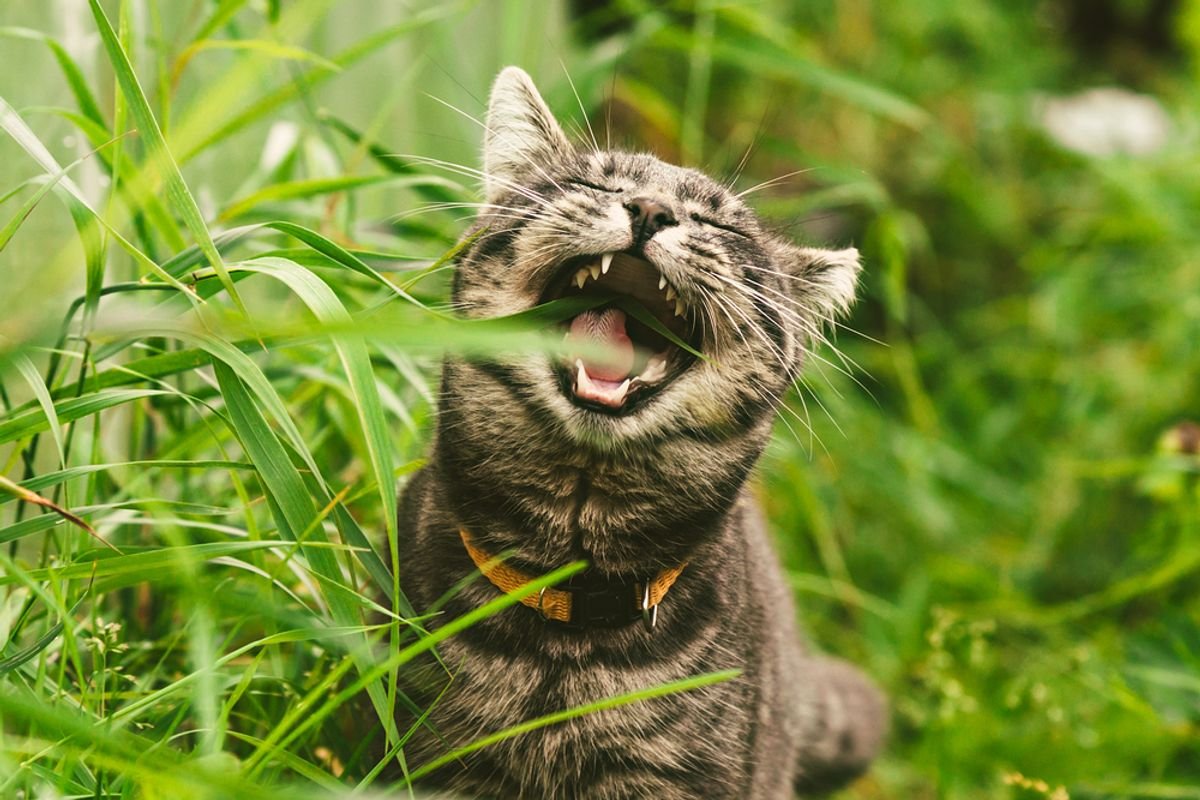
Cat owners know the quirks of feline housemates all too well. Committing to a cat means watching firsthand some behaviors that at first glance seem repulsive or just plain odd. For example, stumbling upon regurgitated furballs or catching our carnivorous pets happily munching on grass or houseplants.
According to a new study published in the Journal of Veterinary Behavior, those two habits might actually be connected. Researchers from High Point University in North Carolina hypothesize that cats eat certain grasses to help dislodge intestinal hairballs thanks to the plants’ jagged surfaces.
Using high-resolution microscopy on hairballs collected from their own cats, the scientists found that blades of grass can intertwine with strands of fur in a way that resembles unclogging a drain. The finding hints at how cats may be using their environment almost like a tool to manage one of the inevitable side effects of their grooming.
Eating Grass to Remove Parasites
Although a common practice, it’s not clear exactly why cats eat grass, but it’s long been suspected that cats chew on grass to expel parasites, like intestinal worms. There’s some logic to this: wolves have been found to pass roundworms wrapped in grasses, and civet (carnivorous mammals living in Africa and Asia) droppings often contain more worms when grass is present.
Even primates, such as chimpanzees and bonobos, appear to select specific plants to rid themselves of tapeworms and nematodes — supporting the idea of self-medication in animals.
If grass can help sweep worms out the back end, could its rough surfaces also help cats eject furballs through the front? The High Point University team suspected as much, but proving it meant getting a microscopic look at the plant material inside actual hairballs.
Read More: Cat Whiskers Help Them Navigate and Can Tell Us How a Cat’s Feeling
Spiky Grass Is Perfect to Dislodge Hairballs
To test the idea, the team examined hairballs “donated” by two indoor–outdoor cats owned by one of the scientists. Six samples were clipped apart, coated in gold for conductivity, and examined under a scanning electron microscope (SEM).
What they saw were sharp details invisible to the naked eye: jagged plant edges and tiny spikelike projections called trichomes, which stuck out like microscopic prongs. These structures were perfectly sized to snag strands of cat hair that are two to 20 times longer than the width of a single hair. The resemblance was striking to cellulose fibers already added to some commercial pet foods to help mitigate hairballs.
Parasites, however, were another story. Roundworms and tapeworms are up to 60 times larger than these plant structures, far too big to be trapped the same way. Genetic analysis revealed that most of the plant matter came from common backyard grasses and hardy houseplants like spiderwort. All the plants shared one thing in common: rough surfaces at the microscopic level, seeming like cats deliberately choose the scratchiest plants available.
In every sample, hairs were visibly entangled with these spiky plant fibers, which is clear evidence that the mechanism works.
Expanding Experiments to Cats’ Poop
The findings suggest that cats may be repurposing a plant’s natural defense features for their own benefit. It’s yet another example of how animals use plants in ways that go far beyond calories or nutrition.
That said, the study leaves some big questions open. For example, if grass is mainly a tool against hairballs, why do dogs, who rarely suffer from them, also eat grass?
Future experiments might solidify the hair-evacuation theory, but the research team is also curious whether grass could help move fur out the other end. To test that, they’ve even been saving their cats’ poop, waiting for the next round of experiments.
Read More: Why Does My Cat Lick or Bite Me So Much With That Sand-Paper Tongue?
Article Sources
Our writers at Discovermagazine.com use peer-reviewed studies and high-quality sources for our articles, and our editors review for scientific accuracy and editorial standards. Review the sources used below for this article: