
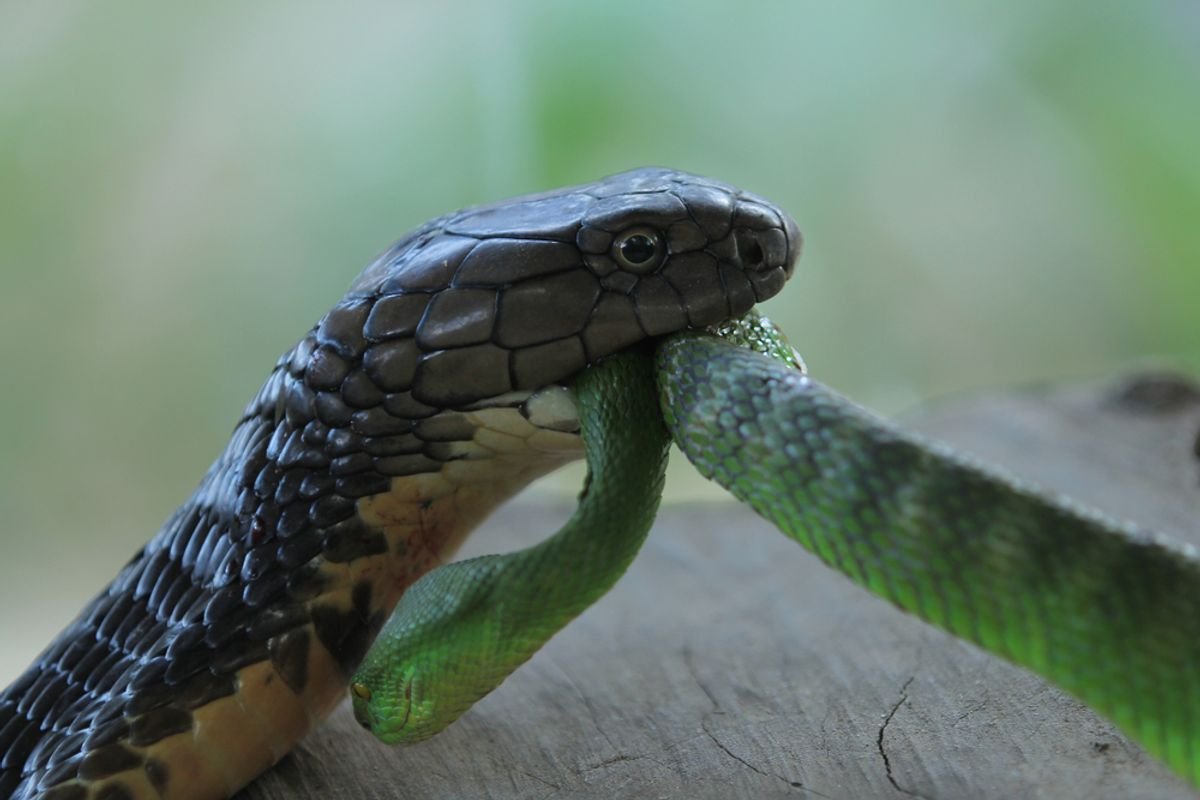
Cannibalism in Snakes Is Not Uncommon — but Could be a Behavior That’s Tied to Evolution

In November 2025, researchers at the Universidade Federal de São Carlos in Brazil published a study in Biological Reviews that reviewed more than 500 cases of snake species documented in the scientific literature as having eaten conspecifics, or snakes of the same species. In total, the scientists recorded at least 207 species exhibiting cannibalism across 15 families, both in captivity and in the wild.
According to the study authors, cannibalism in snakes can be seen as a predatory event, even if consuming a conspecific may seem like a counterproductive behavior. Some researchers thought it was a stress-triggered behavior in captivity, but it’s been shown to occur in the wild.
Since then, the team wrote, a variety of hypotheses have been proposed to explain cannibal behavior, such as a method of preserving energy, controlling their brood size, and an adaptation when no other food is available. Cannibalistic behavior has been recorded in many animal groups, including fish, birds, mammals, and amphibians. But snakes may be among the most frequent animals to engage in cannibalism.
Read More: Partially Eaten Remains Reveal Cannibalism Is the Biggest Threat to Young Blue Crabs in Chesapeake Bay
Are Snakes Evolving to be Cannibals?
To reach their conclusions, the Brazilian team reviewed existing Portuguese and English scientific literature documenting recorded cannibalism in snake species, totaling 299 papers. A majority of these cases — 218 — were recorded in captivity, where confinement and movement restriction, as well as a lack of enrichment and proximity to other snakes, could play a major role.
Even so, the researchers concluded that their work is the most comprehensive review of cannibalism in snakes to date and found that this behavior is widely distributed in both taxonomic and geographical terms. The team noted that snake cannibalism has been recorded on all continents where snakes live.
But does that mean that snakes are evolving to be cannibals, or are they simply practicing cannibalistic behaviors? Kurt Schwenk, a herpetologist and evolutionary biologist who was not involved in the study, said that in many of these cases, and in particular those recorded in confinement, the cannibalism was merely a matter of circumstances.
“Cannibalism is just something that happens once in a while in snakes, primarily for reasons of chance and opportunity,” Schwekn told Discover. “In fact, calling it ‘cannibalism’ is misleading because it is not an evolved diet, strategy, or specialization of any sort.
In other words, some snakes occasionally eat a conspecific not because they seek them out as a preferred prey type, but because the conspecific fits the general parameters of what the predating snake species would have eaten otherwise. The opportunity to eat another snake is purely by chance.
When Snakes Exhibit Cannibalistic Behavior
Cannibalistic behavior is a relatively rare, albeit widespread, phenomenon in snakes that is most likely to occur in species that already have a propensity to eat other snakes, a concept known as ophiophagy. This is especially true of cobras. Cape cobras, a medium-sized snake found in South Africa, are known to eat other snake species, which can make up about a third of their diet. However, eating their conspecifics is even rarer, according to 2018 research from the Ecological Society of America.
“To them, it’s just another prey item,” Schwenk told Discover.
Cannibalistic behavior is most likely to occur in snake species with a generalist diet.
“They’ll eat pretty much anything they can fit into their mouths — they’re not picky. As in the more specialized, ophiophagous species, they simply don’t avoid eating conspecifics. It is simply not relevant,” Schwenk said.
Another way of framing the study results, Schwenk said, is that there is little evidence that snakes do not exhibit any avoidance of cannibalism.
“In other words, any animal that falls within the broad category of prey species consumed by a snake is fair game, conspecific or not. Relationship is not part of what they consider when assessing a potential prey item as appropriate or not,” he said. “Cannibalism is only beneficial to snakes in that eating the occasional conspecific provides a meal, like any other. There is no evidence that it serves any other function or is any kind of evolved, adaptive strategy.”
Read More: Why Cannibalism Is A Common Behavior For Some Animals
Article Sources
Our writers at Discovermagazine.com use peer-reviewed studies and high-quality sources for our articles, and our editors review for scientific accuracy and editorial standards. Review the sources used below for this article: