
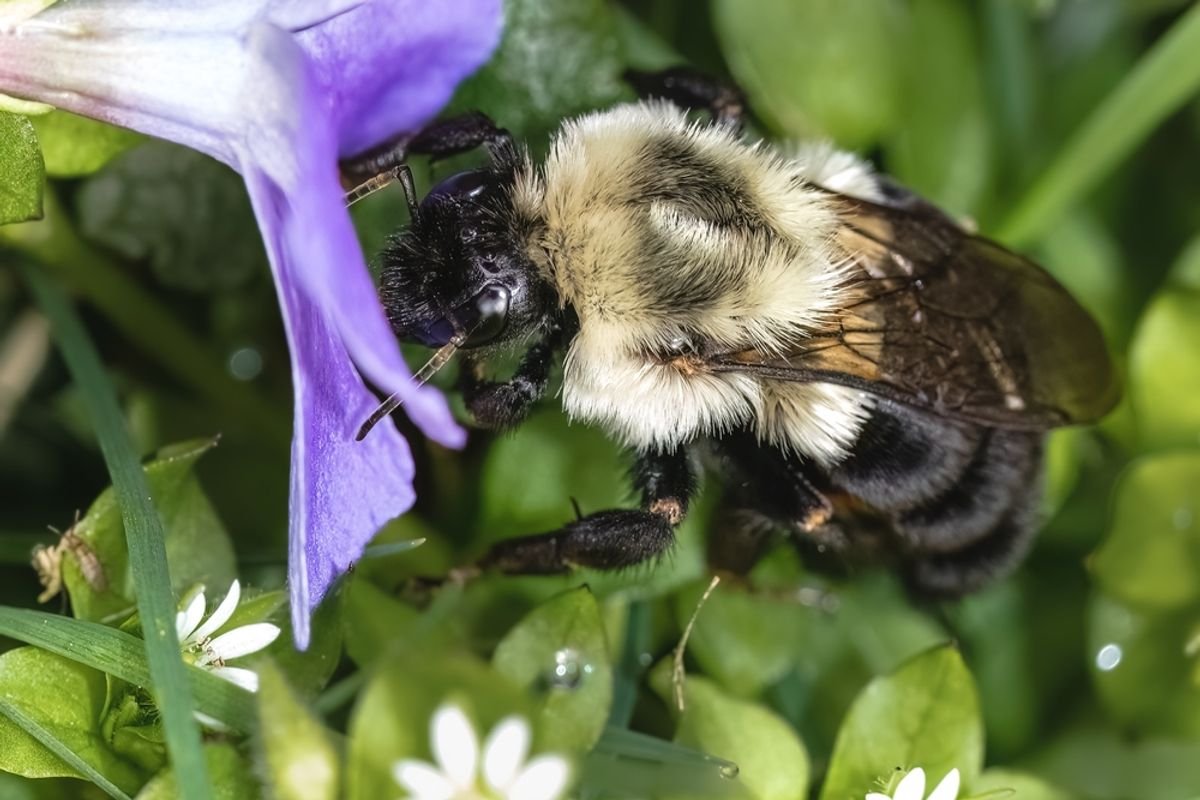
Bumblebee Queens Can Survive and Breathe Underwater For Over a Week By Cutting Energy Demands

Holding your breath underwater for a minute or two may seem impressive, but that doesn’t come close to bumblebee queens’ ability to survive underwater for a whole week. This extraordinary feat happens with the help of diapause, a state of dormancy that allows bees to get through the winter safe and sound.
A new study published in the Proceedings of the Royal Society B: Biological Sciences has found out what makes bumblebee queens capable of surviving for so long while submerged in water. This survival superpower hinges on their drastically reduced metabolism during diapause, along with continued gas exchange underwater. And after escaping their watery prison, the bee queens have no problem getting back on their feet.
Read More: Bumblebees and Ants Battle in Violent Nectar Wars, Leading to Death and Food Shortage
The Survival Skills of Bumble Bee Queens
Like many other animals, bee queens need to take action to endure the cold temperatures and food scarcity that winter brings. To survive these conditions, they bury themselves underground and remain in the soil until spring arrives. During this waiting period, bees enter diapause, lowering their metabolic activity to halt growth and development.
Diapause lets bees conserve energy so that they can emerge healthy come spring, but sometimes, the underground spots they occupy are vulnerable to flooding as snow melts and rainfall becomes more frequent.
Flooding doesn’t always spell doom for the queens, though; that’s because when they’re submerged underwater, they can continue exchanging gases at a low metabolic rate.
“The first key is metabolic depression,” said study author Charles-Antoine Darveau, a professor of comparative physiology at the University of Ottawa, in a statement. “Their metabolism is already extremely low during diapause. That low energy demand makes survival possible.”
Keeping Energy Costs Low
To get a closer look at the mechanisms that allow bumblebee queens to stay alive underwater for such a long time, researchers recreated winter conditions in a lab to induce diapause in bees they had collected.
After the bees entered diapause, the researchers placed them inside small containers filled with water, where they remained for eight days. During this time, the researchers monitored the bees’ metabolic rate and physiological changes.
They found that the submerged bees were producing carbon dioxide at considerably lower rates than non-submerged bees, suggesting reduced metabolism.
Dissolved oxygen in the water decreased, indicating that the bees were extracting oxygen from it. Although the researchers are not yet sure how this is possible, they think it may be enabled through a physical gill, which involves a layer of trapped air that’s created around the bodies of bees and other insects when they are submerged in water.
It’s likely that a physical gill allows bees to continue exchanging gas and breathe underwater. For the bees in the study, though, oxygen consumption rates also declined, indicating they required less oxygen due to reduced energy costs.
Bees Bouncing Back
Another aspect that researchers noticed was the accumulation of lactate — a byproduct of metabolism that increases when oxygen levels are low — in the submerged bees’ bodies; this signaled that the bees were also producing energy without oxygen at some point.
“They’re not relying on just one strategy,” Darveau said. “They combine underwater gas exchange with anaerobic metabolism. That flexibility is what allows them to survive these extreme conditions.”
After eight days of being submerged, the bees were taken out of the water-filled containers. During their recovery, they experienced a spike in metabolic rate, since they needed to clear the built-up lactate. After a few days, though, their metabolism and CO2 release levels returned to normal.
The researchers emphasize that although bumblebee queens can remain submerged for over a week, climate change could soon affect their chances of survival.
“This study shows how resilient these pollinators are,” Darveau said. “Understanding these mechanisms helps us predict how bumble bee populations might cope with increasingly frequent spring floods.”
Read More: Bumble Bees Like To Play Just For Fun
Article Sources
Our writers at Discovermagazine.com use peer-reviewed studies and high-quality sources for our articles, and our editors review for scientific accuracy and editorial standards. Review the sources used below for this article: