
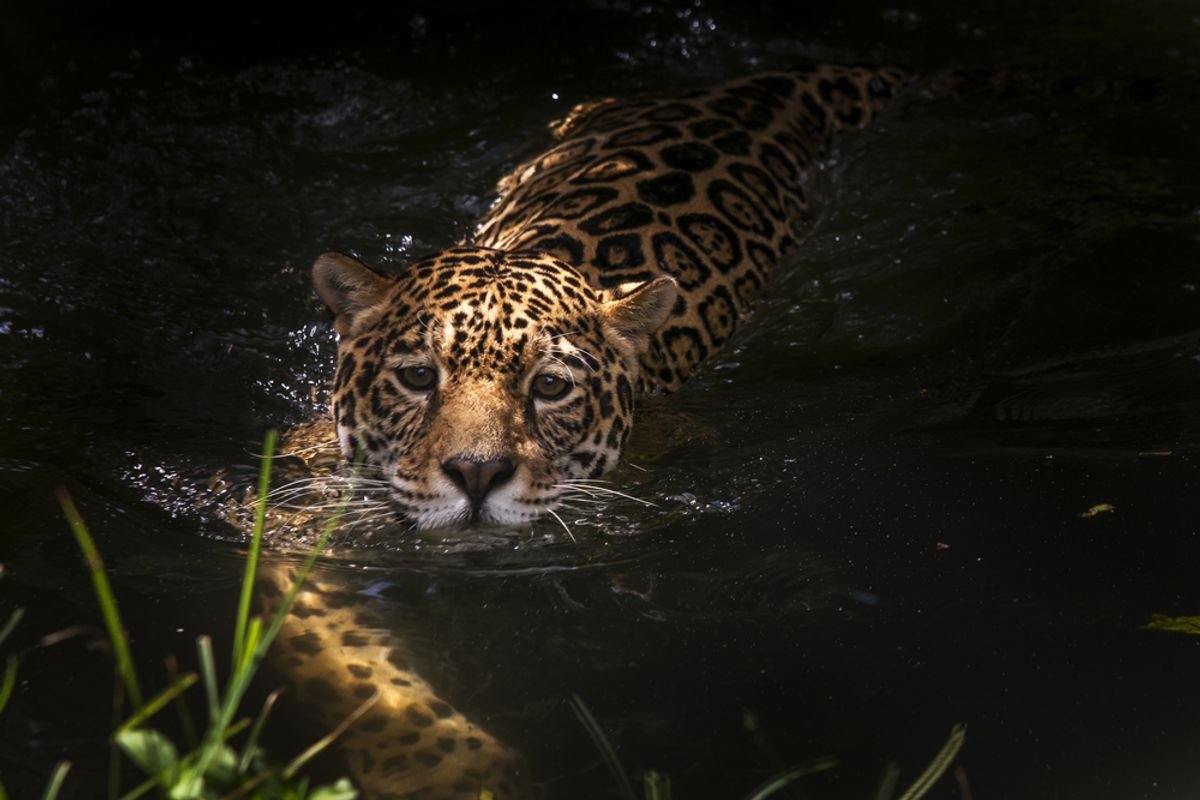
Brazilian Jaguar Sets a New Mile-Long Swimming Record With Big Implications For the Species’ Future
Normally, cats and water are two things that don’t really get along. But a jaguar in Brazil has demonstrated some impressive swimming skills and now holds a world record.
The jaguar’s swim, which equals almost a mile in length, is the longest ever documented and beats the previous record-holder by over six times. A new study, published in bioRxiv, discusses the significance of the swim, not just for feline athleticism but for the ways in which it can help conservation projects aimed at protecting these apex predators.
“Our documentation, of a 1.27 km (.78 miles) swim by a jaguar across the Serra de Mesa Reservoir, challenges the prevailing assumption that large water bodies function as absolute barriers to carnivore movement,” said the authors of the study. “This record — nearly six times longer than any previously reported jaguar swim — reveals a far greater capacity for aquatic dispersal than previously recognized.”
Read More: These Animals Have A Killer Bite Force
Documenting a New Jaguar Swim Record

Study area and camera-trap locations around Serra da Mesa Reservoir. Camera trap locations: 1 – first jaguar record; 2 – second record; 3 and 4 no records.
(Image credit: Silveira, L., et al, bioRxiv (2025); CC BY 4.0)
This record-breaking swim was captured in the reservoir of the Serra de Mesa Hydroelectric Dam in Brazil. The reservoir is situated between the mainland and a forested island that was created after the development of the dam.
To monitor the behavior of jaguars in the area, researchers set up four camera-trap stations across both the mainland and the island. These stations include an infrared camera that continuously records footage, which is reviewed every 30 to 40 days.
Over the course of the four-year project, a particular male jaguar was seen both on the mainland and then on the island — a location only accessible by making the swim across the flooded reservoir. This footage became the first visually confirmed long-distance swim across a human-made lake by a jaguar.
Why the Record-Breaking Swim Is Significant
A jaguar being able to swim is nothing new, as they often prefer forested habitats near bodies of water. However, documenting a jaguar swimming such a long distance across an artificial body of water is significant for the species.
“Given the scarcity of documented long-distance swims by large terrestrial carnivores, this event provides a rare quantitative measure of jaguar aquatic dispersal capacity within a human-modified landscape,” said the authors in their paper.
Hydropower development has become a major threat to jaguars. Overall, jaguars in the Americas have lost 50 percent of their original habitat due to many human-induced changes that have resulted in population decline and even extinction in some areas.
Luckily, jaguars are also known to have high levels of ecological plasticity, meaning that they are able to adapt well to changes in their environment. With this newly documented swim, researchers have confirmed that the ability to swim long distances is one of the behaviors jaguars can engage in if necessary.
How Swimming Relates to Jaguar Conservation
Understanding the conditions that enable jaguars to swim long distances between habitats is crucial for future jaguar conservation. Through this study, the team concluded that large, human-made bodies of water aren’t necessarily a barrier to jaguar survival. Instead, artificial lakes with warm water, low currents, and the presence of stepping-stone islands could aid in jaguar dispersal.
This rare documented case of long-distance jaguar swimming could help shape the future of the species by helping to inform infrastructure planning and promote conservation efforts and actions tailored to the jaguars’ newly-discovered skill.
Read More: Why Do Cats Bring Rodents Home as Gifts? Most Likely for a Snack Later
Article Sources
Our writers at Discovermagazine.com use peer-reviewed studies and high-quality sources for our articles, and our editors review for scientific accuracy and editorial standards. Review the sources used below for this article: