
Brain-Eating Amoeba Cases Are Growing in Swimming Holes — Here’s What to Look Out For

In recent months, Kerala, India, has been hit hard by Naegleria fowleri, better known as the brain-eating amoeba, where a reported 70 people have been diagnosed with the condition and 19 have died. In the U.S., there have been 31 cases of the infection since 2018, and in all but three cases, the individual died.
The deadly amoeba infects people who swim in contaminated freshwater lakes where the water goes up their nose, making its way to the brain and spreading. Rare but often deadly, the amoeba is a single-celled organism that feeds off bacteria and lives in lakes, ponds, under-chlorinated swimming pools, and splash pads.
Where Are Brain-Eating Amoeba Found?
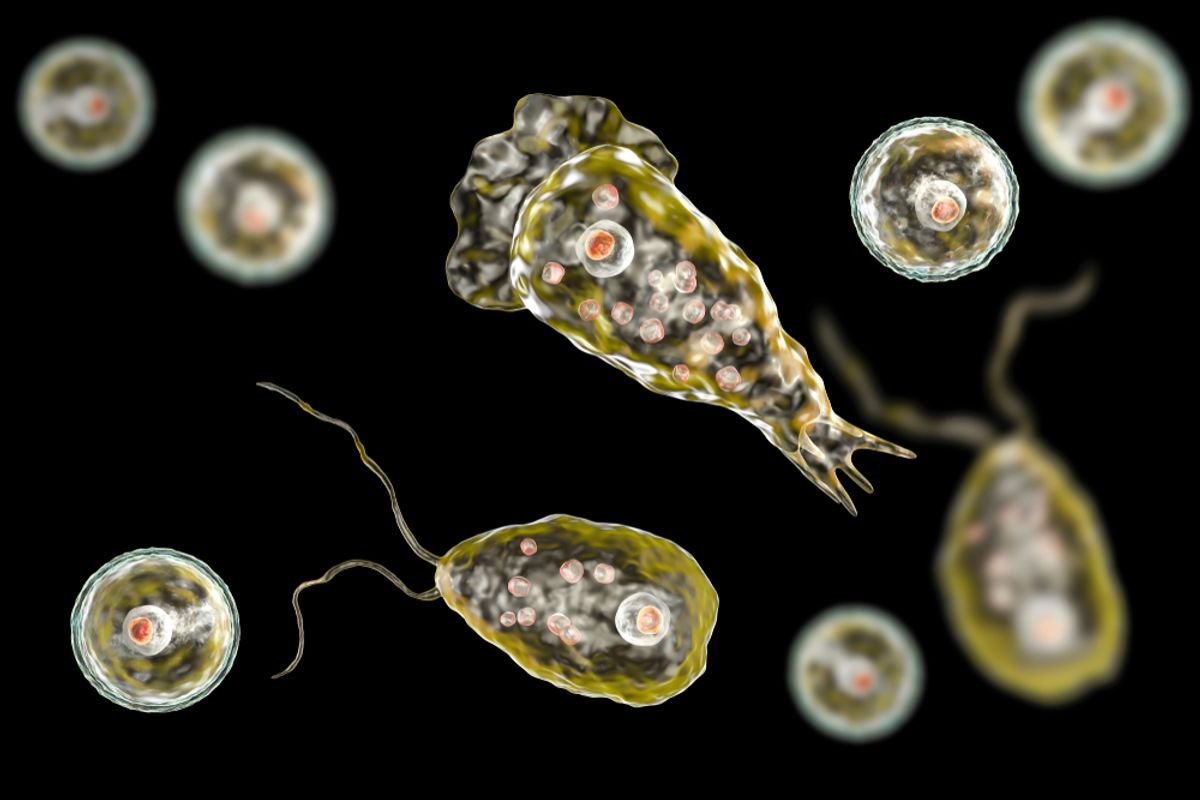
In freshwater lakes and ponds during the summer months, the amoeba can be found floating in the warm water. In the trophozoite stage of the life cycle, the amoeba actively feeds and reproduces. When you jump in the water, microscopic amoebae go up your nose and attach to the olfactory tissue, where they replicate using binary fission. As the cells grow and split into daughter cells.
The elder amoebas, those in the cyst stage, live at the bottom of the lake. At this point, they’ve hardened to endure the harsh environment at the bottom of the lake, says David P. Siderovski, Ph.D., a professor of pharmacology and neuroscience at the University of North Texas Health Science Center at Fort Worth, Texas.
If you dive to the bottom and kick up silt, they can be released. They’re deadly when ingested because the trophozoites are housed inside of them. “Wear a nose clip if you jump in and don’t dig up dirt at the bottom of the lake,” says Siderovski.
Read More: It Is Possible to Get a Tapeworm in Your Brain — Here’s What Can Happen
Why Are Brain-Eating Amoebae So Deadly?
While the brain-eating amoeba is extremely deadly, a few people in the U.S. and a number of people in India have survived the infection. Siderovski says that it’s nearly always fatal because we don’t catch it fast enough and because our treatments for the condition aren’t great. However, it is possible to quickly diagnose the infection by extracting spinal fluid and examining it under the microscope to identify the amoeba. But this is only possible if you live near a laboratory that can test for it.
In this case, it’s possible to dose a patient with enough medications to stop the amoeba before it takes over. One case study shows a 12-year-old in the U.S. who was rapidly diagnosed and given the recommended medications of amphotericin, rifampin, azithromycin, fluconazole, aggressive, and dexamethasone, and the child survived.
In India, patients are better equipped to survive the infection, likely because they have the necessary laboratories to rapidly test for the amoeba in Kerala and because they have the antimicrobials on hand to treat the condition.
Additionally, as a result of public health messaging, individuals are quick to get tested when they have a headache, fever, nausea, or vomiting, and they might have been exposed to the amoeba.
How to Avoid the Brain-Eating Amoeba
If you venture into the warm, fresh water during the hottest months of the summer, as mentioned above, wear a nose clip. Avoid swimming in pools that aren’t properly chlorinated. Don’t put your head under in hot springs. Don’t dig in the bottom of lakes, especially when it’s shallow. If you rinse your nasal passages with a neti pot, make sure the water is distilled or boiled.
“Part of the reason that we don’t have more effective treatments is because it’s so rare,” says Siderovski.
But its rarity doesn’t change the impact that it has on those who lose their loved ones to the infection.
This article is not offering medical advice and should be used for informational purposes only.
Read More: Naegleria fowleri: The Brain-Eating Amoeba
Article Sources
Our writers at Discovermagazine.com use peer-reviewed studies and high-quality sources for our articles, and our editors review for scientific accuracy and editorial standards. Review the sources used below for this article: