
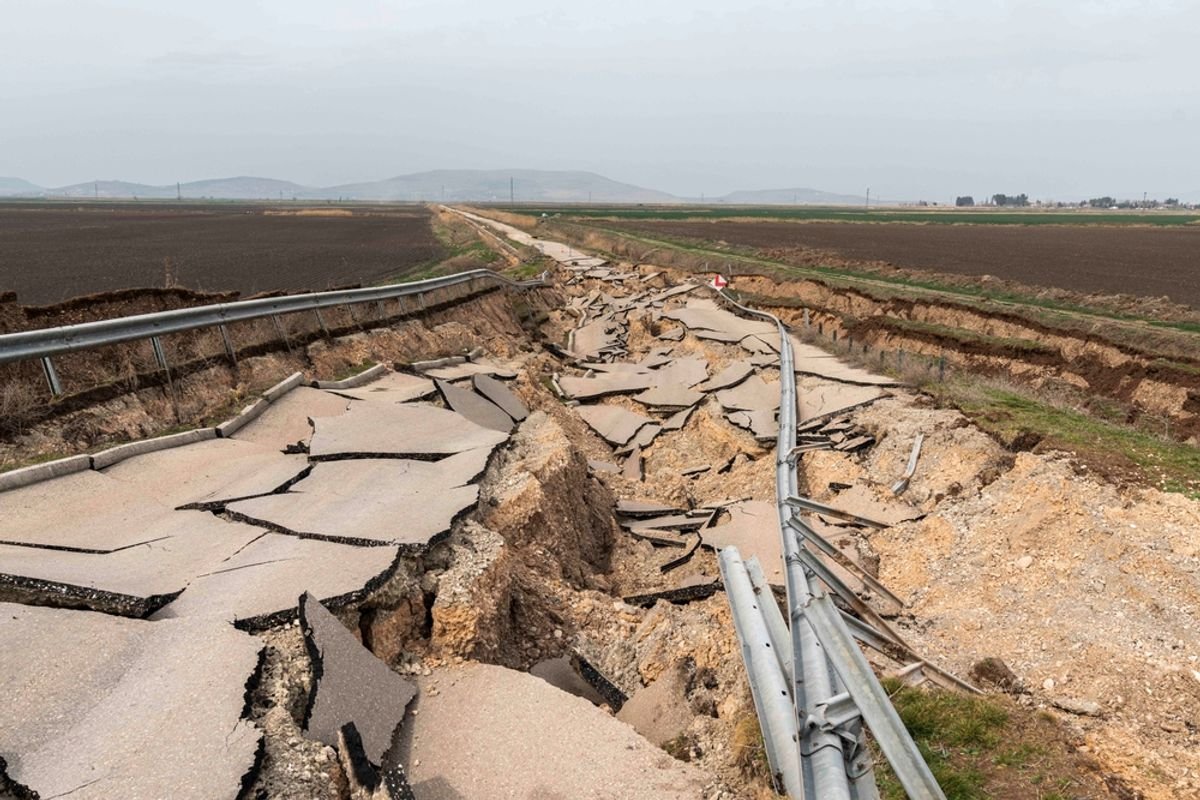
Boomerang Earthquakes Don’t Just Move Forward — They Bounce Back

Earthquakes are usually thought of as one-way events. Stress builds up deep underground, a fault snaps, and seismic ruptures race outward from their point of origin, shaking the ground as they go. But in certain cases, researchers have observed something stranger: earthquakes that appear to reverse direction, rattling regions they already passed through moments earlier.
These unusual events, known as “boomerang” earthquakes, have typically been associated with complex fault systems — places where multiple fractures intersect and interact in unpredictable ways. Now, a new study published in AGU Advances suggests that these seismic reversals may not be so rare after all.
According to the researchers, even simple, straight faults — like segments of the San Andreas fault in California — may be capable of producing quakes that double back on themselves under the right conditions.
Read More: Earthquake Faults Can Heal Themselves In Mere Hours, Adding Power to Disastrous Quakes
What Is a Boomerang Earthquake?
A boomerang earthquake is exactly what it sounds like: a seismic rupture that travels along a fault, then partially reverses course. Scientists refer to these as “back-propagating fronts,” meaning the rupture doesn’t just keep moving forward but splits, with part continuing ahead while another races back toward where it started.
A handful of real-world earthquakes have exhibited this behavior in recent years. In 2016, a quake in the middle of the Atlantic Ocean appeared to move eastward before ricocheting back west. Similar seismic signatures may have occurred during the massive 2011 earthquake off Japan and the devastating 2023 magnitude 7.8 quake in Turkey and Syria. These events occurred in both complex fault zones and regions dominated by single, straight faults — an observation that raised new questions for seismologists.
“Our work suggests that these boomerang quakes may have been undetected in a number of cases,” said study author Yudong Sun in a press release. “We do think this behavior may be more common than we have seen so far in the seismic data.”
How Researchers Recreated Boomerang Earthquakes
To explore how a boomerang quake might form, the research team turned to computer simulations. Using a physics-based model of a simple fault, they recreated earthquakes under a wide range of conditions, tweaking how ruptures moved and how friction behaved along the fault surface.
In these simulations, friction along the fault played a crucial role. When friction rapidly dropped, increased, and dropped again, sections of the fault that had already slipped could lock up and then rupture a second time. Unilateral quakes, which rupture in a single direction rather than spreading outward both ways, were the only type of earthquake to consistently produce boomerang behavior.
“When the quake propagates in one direction, it produces a ‘breaking’ effect that reduces the sliding velocity, increases friction, and allows only a narrow section of the fault to slide at a time. The region behind the quake, which stops sliding, can then rupture again, because it has accumulated more stress to slide again,” explained co-author Camilla Cattania.
What Can We Learn From Boomerang Quakes?
Understanding boomerang earthquakes isn’t just a curiosity exercise for scientists, but could also help them better predict and prevent earthquakes and their devastating damage in the future.
“We know that shaking is amplified in the direction of rupture, and buildings would shake more in response. So there is a real effect in terms of the damage that results. That’s why understanding where these boomerang events could occur matters,” concluded Cattania in the press release.
Overall, the new study suggests that older, simpler faults — long thought to be more predictable — may still harbor hidden seismic surprises.
Read More: Mini Earthquakes Expose Hidden Tectonic Features Buried Beneath Earth’s Surface
Article Sources
Our writers at Discovermagazine.com use peer-reviewed studies and high-quality sources for our articles, and our editors review for scientific accuracy and editorial standards. Review the sources used below for this article: