
Bonobo Kanzi Plays Pretend Like a Child, Showing Ape’s Capacity to Imagine
Imagination develops in early childhood through creative play and later becomes a foundational force in shaping the modern societies we know today. Often considered exclusive to humans, engaging with ideas only present in one’s mind might not be as unique to us as we think.
By playing tea-party-like games with Kanzi, a bonobo in the Ape Initiative research center in Iowa, researchers from Johns Hopkins University demonstrated that apes may have the capacity for imagination. When asked where the imaginary juice or grape went after pretending to pour or place it somewhere, he pointed to the right cup or jar.
These experiments, published in Science, not only give us a glimpse of the real mental abilities of our closest cousins but also suggest this skill was likely rooted about 6 million years to 9 million years ago.
“This work tells us that humans are not the only animals that have complex mental lives, and it reminds us how much we have to learn from apes — about them and about ourselves,” study co-author Christopher Krupenye, assistant professor at Johns Hopkins’ Department of Psychological and Brain Sciences, told Discover.
Imagination Is Not Uniquely Human
The first sparks of human imagination start early. Children as young as 2 years old take part in imaginary play, such as tea parties — a perfect outward expression of the cognitive ability to engage with something that only exists in our minds. Imagination has therefore played a fundamental role in building today’s complex human world, but it might not be limited to us.

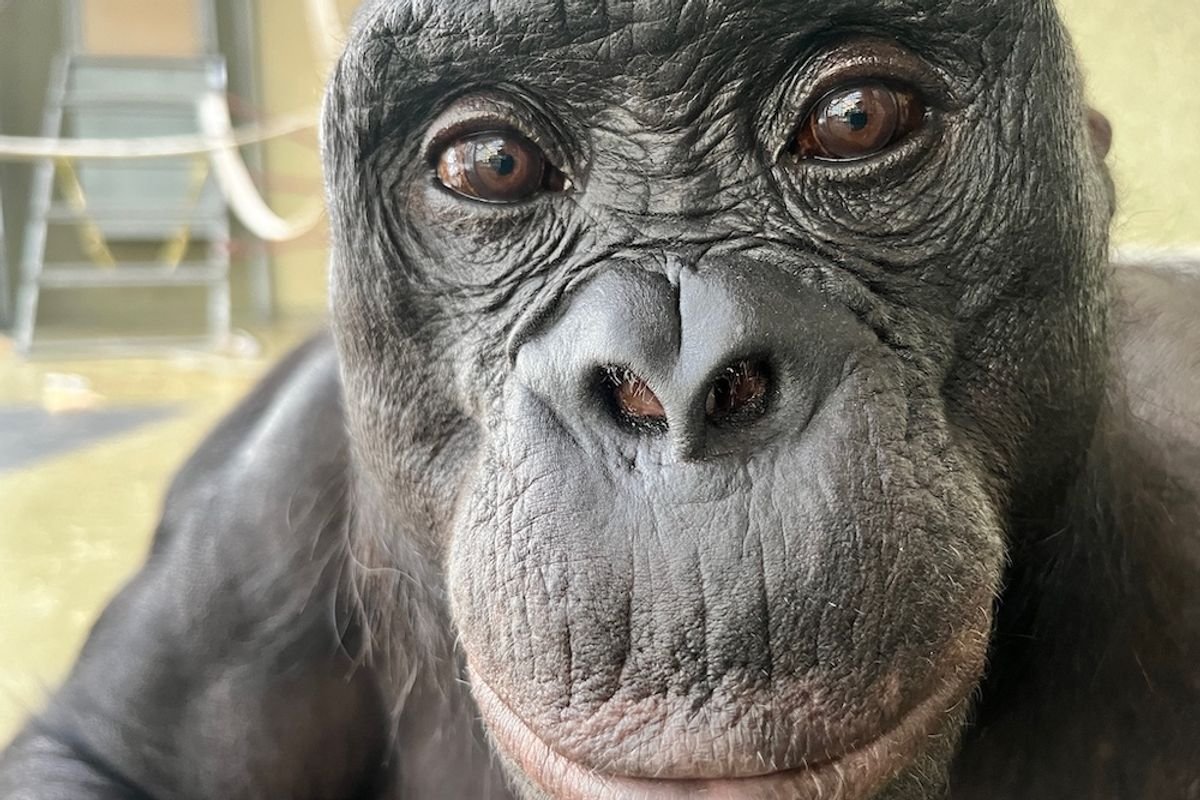
Kanzi, the bonobo.
(Image Credit: Ape Initiative)
After Jane Goodall described the tool-making and use of chimpanzees, researchers started to look for complex cognitive abilities beyond Homo sapiens. Both in the wild and in captivity, chimpanzees have been observed to engage in imaginary play, holding sticks caringly like infants or dragging imaginary blocks across the floor. Despite the anecdotal evidence of different wild and captive animals displaying pretend behavior, controlled studies that support the observations are lacking.
“Bonobos and chimpanzees are our very closest relatives,” Krupenye said to Discover. “Therefore, they have a unique role to play in clarifying what makes the human mind unique and, conversely, which foundations of our psychology are shared and likely evolved millions of years ago in our common evolutionary ancestor.”
Read More: Long Thumbs and Large Brains Co-Evolved in Primates, Giving Humans Our Most Unique Traits
A Bonobo Playing Pretend
The researchers tested Kanzi, a 43-year-old captive bonobo previously seen to engage in pretend play and trained in responding to verbal prompts, in a tea-party-like experiment to finally record any display of imagination in a controlled environment. The bonobo and experimenter sat around a table dressed with empty pitchers and cups or bowls and jars.
As described in a press release, the experiments went as follows: After pretending to pour juice with the pitcher in one of the cups and the experimenter asking Kanzi where the juice was, he generally pointed to the correct cup, even after multiple repetitions and changing the location of the cup. Another experiment involved placing imaginary grapes in one of two jars, and again, after asking Kanzi where the grape was, he pointed at the right location.
“We didn’t take it for granted that he would necessarily succeed,” Krupenye told Discover. “I was amazed and thrilled to see him perform so well across all of the experiments!”
Showing Imagination in Apes for the First Time
Although Kanzi wasn’t always right, most of his responses were correct, making it unlikely that his reactions happened only by chance. The research shows that bonobos may have the cognitive capacity to generate an idea in their minds despite knowing it’s not real, said study co-author Amalia Bastos, lecturer at Scotland’s University of St. Andrews, in the statement.
Based on those findings, more research will likely follow, probably including other apes and animals in similar experiments. Besides imagination, the team hopes to explore other parts of imagination, like thinking about the future and the anticipation of others’ thoughts.
“I hope this discovery will get people excited to learn more about these remarkable creatures, and to become invested in saving them,” said Krupenye to Discover. “It will take a big effort, donations to conservation organizations, and government intervention but if we work together, we can ensure that these inquisitive and wonderous animals get to share the future with us.”
Read More: Chimps, Like Humans, Break Down Complex Tasks into Smaller Pieces
Article Sources
Our writers at Discovermagazine.com use peer-reviewed studies and high-quality sources for our articles, and our editors review for scientific accuracy and editorial standards. Review the sources used below for this article: