
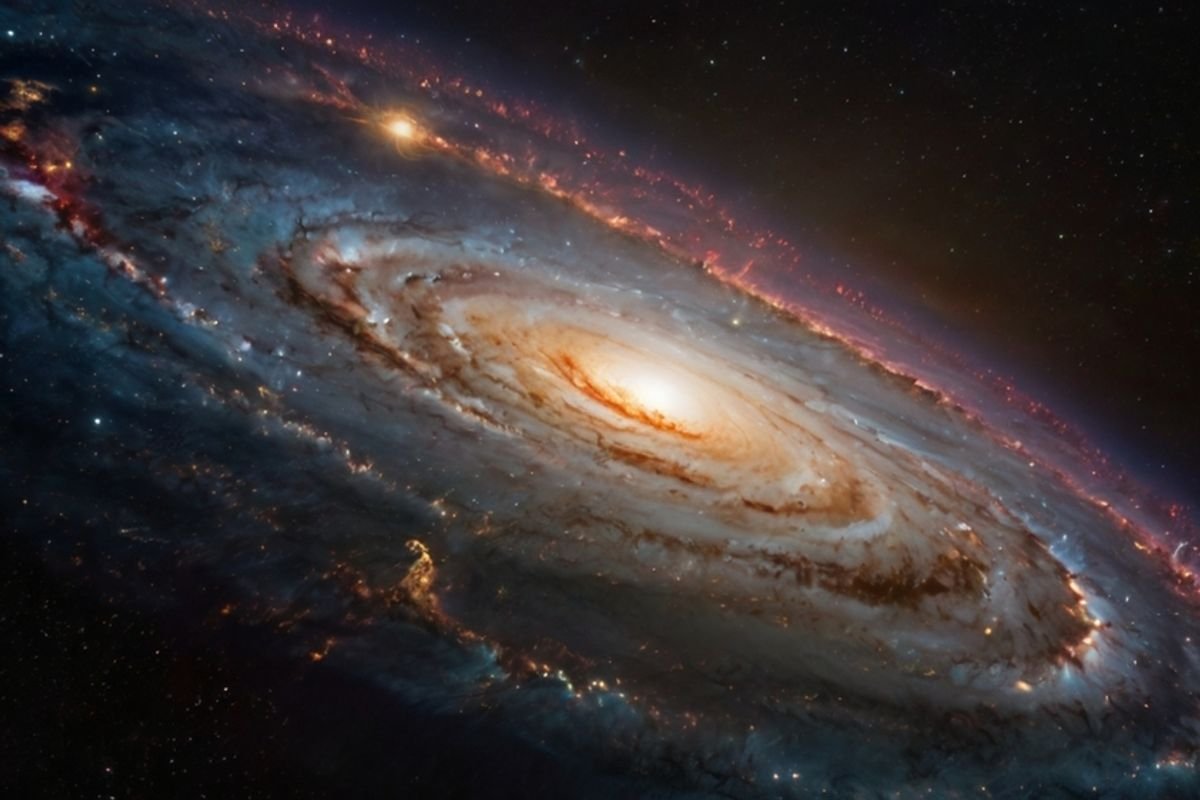
Black Holes Can Die, But the Process – Hawking Radiation – Is Incredibly Slow

Key Takeaways on if Black Holes Can Die
- Yes, black holes can die, and the process is called Hawking radiation.
- The faintness of Hawking radiation makes it virtually impossible to observe in the black holes we can see today.
- A black hole with roughly the same mass as our Sun would take about 10^67 years to vanish. However, the more massive the black hole, the slower the process. Supermassive black holes that reside at the centers of galaxies would take closer to 10^100 (or a googol) years to disappear.
At first glance, black holes seem eternal. They’re the cosmic behemoths where gravity is so strong that not even light can escape. But if our current understanding of physics holds, even these giants don’t last forever. Given enough time, every black hole in the universe should eventually fade away.
That somewhat sad fate is the result of one of the most fascinating ideas in modern astrophysics: Hawking radiation, the incredibly slow process that causes black holes to evaporate and changes the way we think about the fate of the universe.
How a Black Hole Dies
In the mid-1970s, Stephen Hawking showed that when you combine the rules of quantum mechanics with Einstein’s general relativity, black holes don’t actually stay perfectly black. They give off a faint glow of radiation.
Physicists explain this using “virtual particles,” which constantly pop in and out of existence in empty space. Usually, they appear in pairs that annihilate each other almost instantly, leaving no trace behind. But as Yvette Cendes, assistant professor of physics and astronomy at the University of Oregon, says, the event horizon of a black hole makes things interesting.
“If this particle/anti-particle is created exactly on the event horizon — the point of no return for a black hole — you can get one particle falling into the black hole, and one going out into the universe. This means the energy for creating the new particle has to come from somewhere, and that source is the black hole,” says Cendes.
Over incredibly long timescales, this tiny but persistent energy drain causes the black hole to lose mass and slowly shrink. And the smaller the black hole, the more noticeable the effect. But for most black holes we know about, it’s still astonishingly subtle.
Read More: The Oldest Black Hole Could Wreak Havoc on a Faraway Galaxy
How Long Does It Take for a Black Hole to Die?
So just how long would it take for a black hole to evaporate completely? That depends on its size. A black hole with roughly the same mass as our Sun would take about 10^67 years to vanish. However, the more massive the black hole, the slower the process. Supermassive black holes that reside at the centers of galaxies would take closer to 10^100 (or a googol) years to disappear.
“We don’t actually know the precise answer,” Cendes says, “because we cannot detect Hawking radiation, and it is so faint that it’s likely we will not be able to within our lifetimes.”
But she notes the time it will take a black hole to die is “well in excess of the age of the universe many times over.”
The faintness of Hawking radiation makes it virtually impossible to observe in the black holes we can see today.
“Hawking radiation as proposed is supposed to be so faint,” Cendes says, “that it would be dominated by any radiation from material falling onto a black hole.”
Detecting Evaporation in Black Holes
If we want to catch a black hole evaporating, our best bet might be to look for much smaller ones. Physicists have proposed that primordial black holes — tiny objects formed in the early universe — could still be out there. And because they’d be so small, they’d also be much hotter and could evaporate on timescales shorter than the current age of the universe.
In theory, the final stages of these black holes would produce an intense flash of gamma rays. However, NASA’s Fermi Gamma-ray Space Telescope has spent years scanning the sky for such bursts and hasn’t found any so far.
The End of Black Holes and the Universe
Hawking radiation offers a glimpse into the deep future of the cosmos itself. For now, black holes can be thought of as basically eternal. But endless eons from now, after stars burn out, galaxies drift apart, and the last lingering embers of cosmic light fade, black holes will slowly evaporate too.
As Cendes puts it, “The universe is going to be a very cold, dark, empty space in a couple trillion years. Enjoy the light and stars while you can!”
Read More: Here’s What Would Happen If You Walked Through a Black Hole
Article Sources
Our writers at Discovermagazine.com use peer-reviewed studies and high-quality sources for our articles, and our editors review for scientific accuracy and editorial standards. Review the sources used below for this article: