
Black Hole Reawakens Like a Cosmic Volcano After 100 Million Years of Sleep

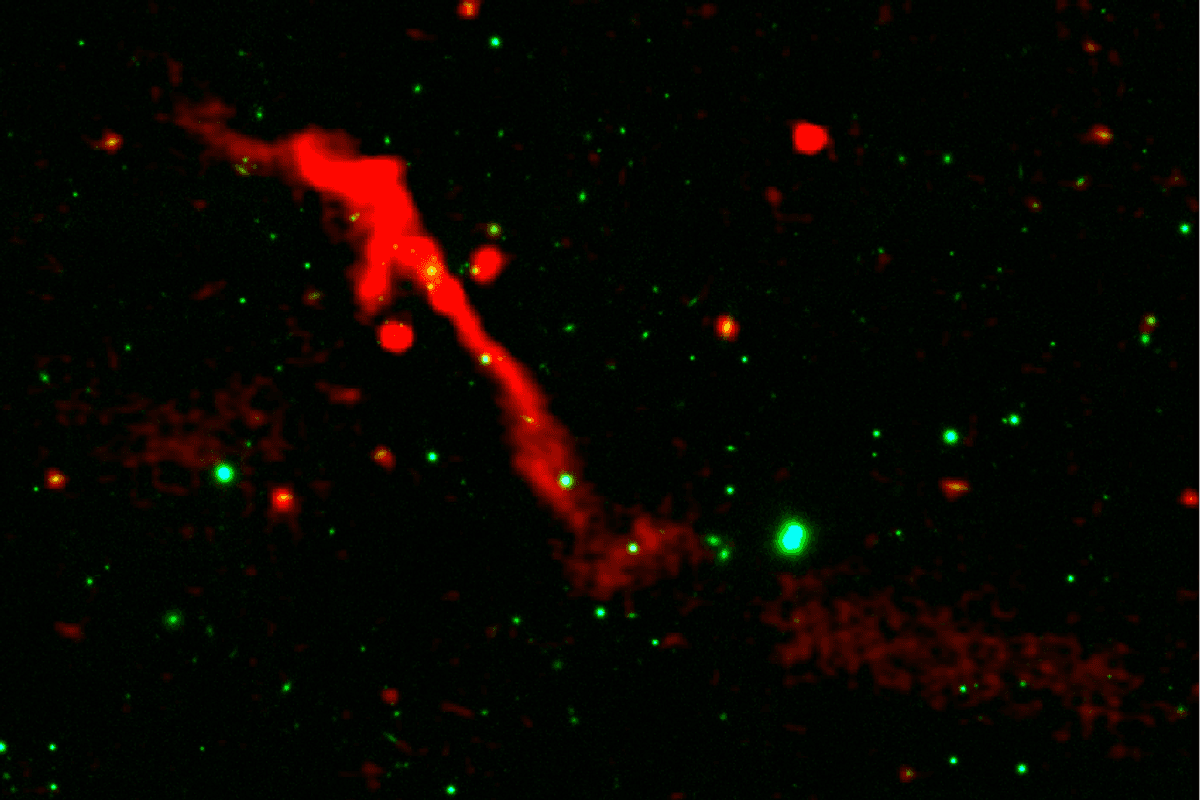
After lying dormant for nearly 100 million years, a supermassive black hole has roared back to life — and astronomers have caught it in the act. New radio images, published in Monthly Notices of the Royal Astronomical Society, reveal the black hole at the heart of galaxy J1007+3540 restarting its jets, producing one of the clearest examples yet of a so-called “reborn” black hole.
The scene, likened by researchers to a volcanic eruption on an almost unimaginable scale, stretches across nearly one million light-years. Captured using two of the world’s most sensitive radio observatories, the images offers a glimpse of how black holes can shut down, reignite, and reshape entire galaxies.
“It’s like watching a cosmic volcano erupt again after ages of calm — except this one is big enough to carve out structures stretching nearly a million light-years across space,” said lead researcher Shobha Kumari in a press release.
How Do Black Holes Turn On and Off Again?
Most large galaxies host supermassive black holes at their centers, but only a small fraction actively launch enormous jets of magnetized plasma that glow at radio wavelengths. J1007+3540 stands out because it shows evidence of multiple jet outbursts, revealing that its central black hole has cycled between active and quiet phases.
The galaxy’s black hole recently restarted its jet emission after a long period of silence, creating a compact, bright inner jet – a telltale sign of a newly awakened engine. Older, faded plasma surrounds the black hole, which is likely debris left behind from previous eruptions that occurred millions of years earlier.
“This dramatic layering of young jets inside older, exhausted lobes is a signature of an episodic AGN — a galaxy whose central engine keeps turning on and off over cosmic timescales,” explained Kumari.
Read More: Supermassive Black Hole Flare Launched Wind and Debris Into Space at 37,000 Miles Per Second
What Did The Radio Images Reveal About J1007+3540
The images were obtained using the Low Frequency Array (LOFAR) in the Netherlands and India’s upgraded Giant Metrewave Radio Telescope (uGMRT). Together, they revealed different aspects of this exciting cosmic event.
J1007+3540 resides inside a massive galaxy cluster filled with extremely hot gas, creating intense external pressure. As the awakened jets push outward, they become distorted. This distortion was captured in the LOFAR images, which showed the curved and twisted shape of J1007+3540’s northern lobe.
The uGMRT data showed the northern lobe includes particles that are extremely old and have lost much of their energy. Additionally, the images showed that magnetized plasma is being dragged through the cluster to the southwest, leaving a long tail that is likely millions of years old.
What Have Astronomers Learned From These Images?
Systems like J1007+3540 are especially valuable because they capture galaxy evolution in action. They reveal how black holes cycle through active phases, how jets age and fade, and how dense cluster environments can sculpt a galaxy’s entire structure. Rather than growing smoothly, the research suggests galaxies evolve through violent confrontations.
The team now plans to conduct even more sensitive, high-resolution observations to look deeper into the galaxy’s core and track how the restarted jets continue to spread through their environment.
Read More: The Closest Black Hole to Earth Is Gaia BH1 at Only 1,600 Light-Years Away
Article Sources
Our writers at Discovermagazine.com use peer-reviewed studies and high-quality sources for our articles, and our editors review for scientific accuracy and editorial standards. Review the sources used below for this article: