
Betelgeuse’s Brightness Wavers Due to a Companion Star and Its Swirling Trail of Gas

There are times when the red supergiant star Betelgeuse looks slightly amiss, becoming dimmer than usual. Emerging data from NASA’s Hubble Space Telescope is now suggesting that this mysterious change could be the doing of a much tinier companion star to Betelgeuse, named Siwarha.
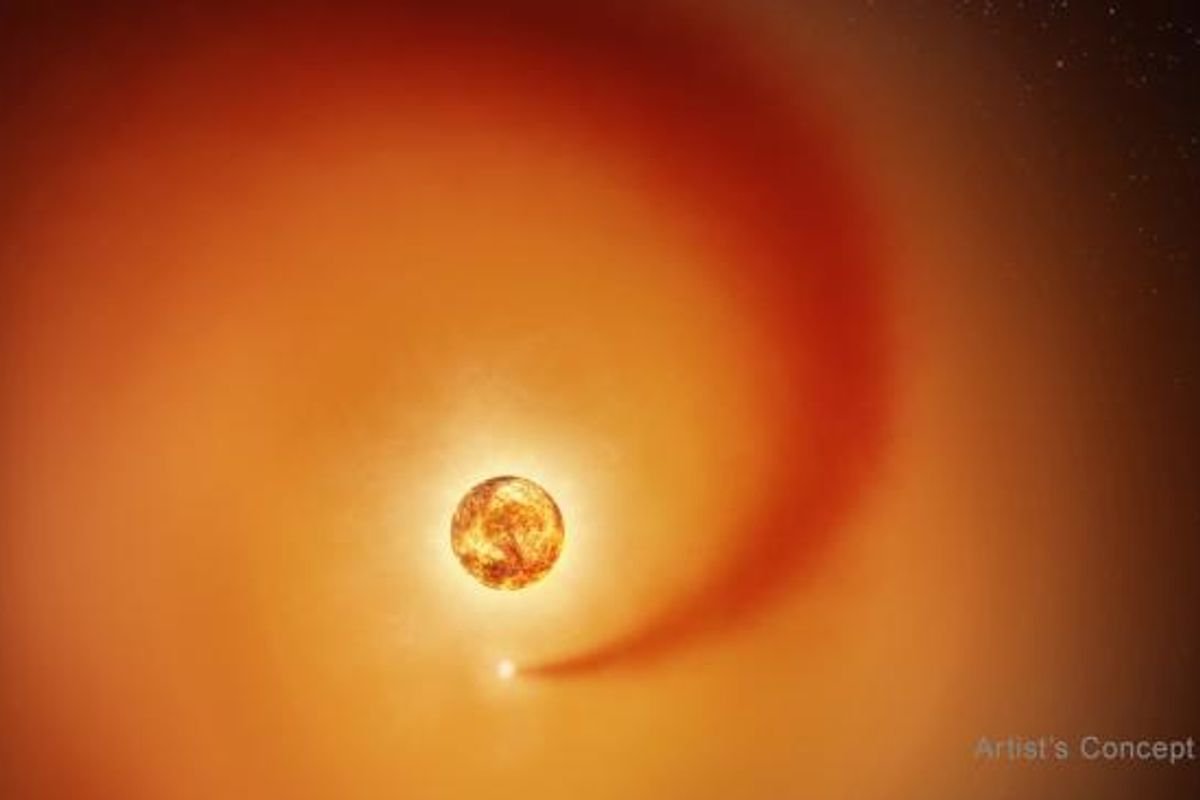
New observations featured in an arXiv preprint paper have revealed a stunning aftereffect of Siwarha’s brush with Betelgeuse, leaving the red supergiant with an altered appearance. With a keen eye on the two stars, researchers noticed that Siwarha has been leaving a wake of dense gas as it passes through Betelgeuse’s outer atmosphere. This revelation could be a pivotal turning point in understanding why Betelgeuse’s brightness has fluctuated in the past.
Read More: The Red Supergiant’s Companion Is Discovered, Solving Centuries-Old Mystery
Brightness Changes in Betelgeuse
Betelgeuse, located nearly 650 light-years from Earth in the shoulder of the constellation Orion, has been studied by astronomers for centuries. It is well known as one of the brightest stars in the night sky, shining 7,500 to 14,000 times brighter than the sun. At around 10 million years old, Betelgeuse is nearing the end of its life after having evolved rapidly due to its immense mass; sometime within the next 100,000 years, the aging star will go out with a tremendous supernova explosion.
Astronomers have determined that Betelgeuse goes through two significant periods of variation in brightness: a 400-day cycle caused by the star’s own pulsations, and a longer 2,100-day (nearly six-year) period.
In 2019 and 2020, the star experienced an unusually steep decrease in brightness that became known as the “Great Dimming.” Astronomers found this to be the result of a large dust cloud ejected from Betelgeuse, but as interest in the star reached new heights, curiosity about its six-year variability period began to grow.
Betelgeuse’s Companion Star
Astronomers had long suspected that Betelgeuse’s six-year variability period may be influenced by a companion star. It wasn’t until July 2025 that researchers announced that they had finally caught a glimpse of this companion star with the Gemini North telescope in Hawai’i. It was named “Siwarha,” an Arabic term meaning “her bracelet,” according to NASA.
Researchers are still in the midst of studying Siwarha, but recent Hubble data have now shed more light on the star, which is hundreds of times smaller than Betelgeuse.
Using Hubble and ground-based telescopes at the Fred Lawrence Whipple Observatory in Arizona and Roque de Los Muchachos Observatory in Spain, researchers carefully tracked changes in Betelgeuse’s outer atmosphere. They saw changes in the star’s spectrum — the colors of light given off by different elements — and the speed and direction of gases shaped by a wake of denser material.
This wake, the researchers say, is clear evidence of Siwarha crossing in front of Betelgeuse, which happens every six years in accordance with the variability period.
“It’s a bit like a boat moving through water. The companion star creates a ripple effect in Betelgeuse’s atmosphere that we can actually see in the data,” said the preprint’s lead author, Andrea Dupree, an astronomer at the Harvard-Smithsonian Center for Astrophysics, in a statement. “For the first time, we’re seeing direct signs of this wake, or trail of gas, confirming that Betelgeuse really does have a hidden companion shaping its appearance and behavior.”
Waiting for Siwarha to Reappear
With this latest observation of Siwarha’s wake, researchers are now more confident about their knowledge of Betelgeuse’s varying brightness. As for the future of Siwarha, the small companion star will likely have a shortened lifespan; it’s believed that strong tidal forces will cause the star to spiral into Betelgeuse, which may happen within the next 10,000 years.
Moving forward, the researchers hope to study Siwarha’s wake to gain a better understanding of how supergiant stars evolve over time. Although Siwarha is now blocked from view by Betelgeuse, it will reemerge in 2027 to usher in a new wave of research on the companion star.
Read More: Two Nova Explosions Reveal Never-Before-Seen Structures in Stellar Blasts
Article Sources
Our writers at Discovermagazine.com use peer-reviewed studies and high-quality sources for our articles, and our editors review for scientific accuracy and editorial standards. Review the sources used below for this article: