
Astronomers Looked Back 12 Billion Years, and Found a Galaxy Cluster That Defies Theory

Astronomers studying the early universe have identified a galaxy cluster that appears far hotter — and far more energetic — than current theories say it should be. To spot it, researchers had to peer back roughly 12 billion years, observing the cluster as it existed just 1.4 billion years after the Big Bang.
The finding, reported in Nature, pushes back the timeline for when galaxy clusters develop their characteristic hot atmospheres. Standard models suggest this extreme heating takes place only after clusters slowly mature and collapse over billions of years. Instead, the new observation suggests that some clusters may form far faster than expected.
“We didn’t expect to see such a hot cluster atmosphere so early in cosmic history,” said lead author Dazhi Zhou, in a press release. “In fact, at first I was skeptical about the signal as it was too strong to be real. But after months of verification, we’ve confirmed this gas is at least five times hotter than predicted, and even hotter and more energetic than what we find in many present-day clusters.”
A Young Galaxy Cluster With Outsized Energy
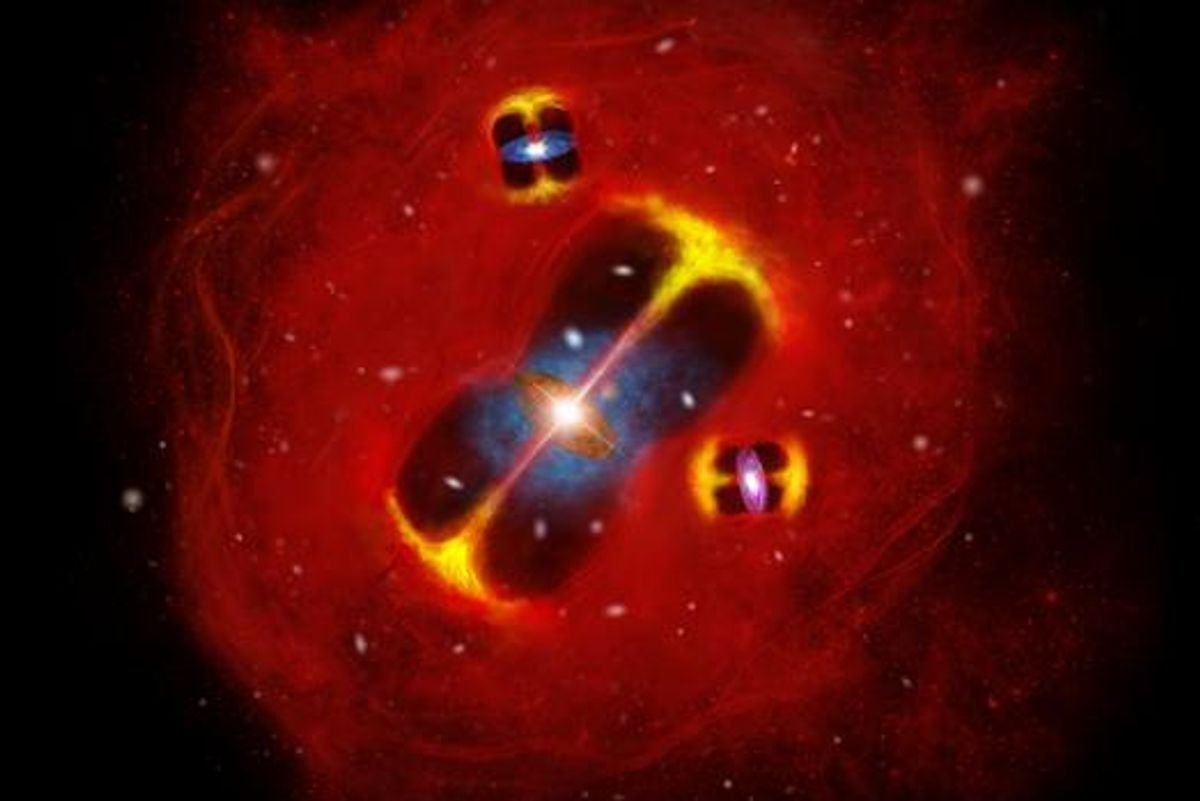
The object at the center of the study is a distant cluster known as SPT2349-56. Because it formed so early in cosmic history, astronomers consider it a “baby” galaxy cluster — though its properties are anything but small.
Its dense core spans roughly 500,000 light-years, similar in size to the halo surrounding the Milky Way. Within that compact region sit more than 30 galaxies forming stars at a combined rate over 5,000 times faster than our galaxy does today. All of this activity is packed into a space that, by cosmic standards, is remarkably small.
What stood out most, however, was not the galaxies themselves but the gas filling the space between them. Known as the intracluster medium, this gas is usually heated gradually as gravity pulls matter inward. In SPT2349-56, that heating appears to have happened much earlier — and much more intensely.
“This tells us that something in the early universe, likely three recently discovered supermassive black holes in the cluster, were already pumping huge amounts of energy into the surroundings and shaping the young cluster, much earlier and more strongly than we thought,” said co-author Dr. Scott Chapman in the press release.
Read More: Brightest Radio Burst on Record Originated in Galaxy 130 Million Light Years Away
How ALMA Measured the Cluster’s Heat
To probe conditions inside the cluster, the team used the Atacama Large Millimeter/submillimeter Array (ALMA) — a network of radio telescopes.
Rather than directly measuring the gas, the researchers relied on a subtle signal known as the Sunyaev–Zeldovich effect. When hot gas inside a galaxy cluster interacts with the faint afterglow of the Big Bang, it slightly distorts that background light. By measuring the distortion, astronomers can estimate how much thermal energy the gas contains.
“Understanding galaxy clusters is the key to understanding the biggest galaxies in the universe,” said Chapman. “These massive galaxies mostly reside in clusters, and their evolution is heavily shaped by the very strong environment of the clusters as they form, including the intracluster medium.”
Early Black Holes and Rapid Cosmic Heating
In current models, the intracluster medium heats up mainly through gravity as clusters slowly assemble and stabilize. The new results suggest a more chaotic origin, one in which intense star formation and active supermassive black holes rapidly inject energy into a cluster’s core.
That raises new questions about how quickly galaxy clusters can form — and how early black holes begin influencing their surroundings. The team now wants to understand how these processes work together in such a young system.
“We want to figure out how the intense star formation, the active black holes and this overheated atmosphere interact, and what it tells us about how present galaxy clusters were built,” said Zhou. “How can all of this be happening at once in such a young, compact system?”
Read More: Future Black Hole Images Could Put Einstein’s Theory to the Ultimate Test
Article Sources
Our writers at Discovermagazine.com use peer-reviewed studies and high-quality sources for our articles, and our editors review for scientific accuracy and editorial standards. Review the sources used below for this article: