
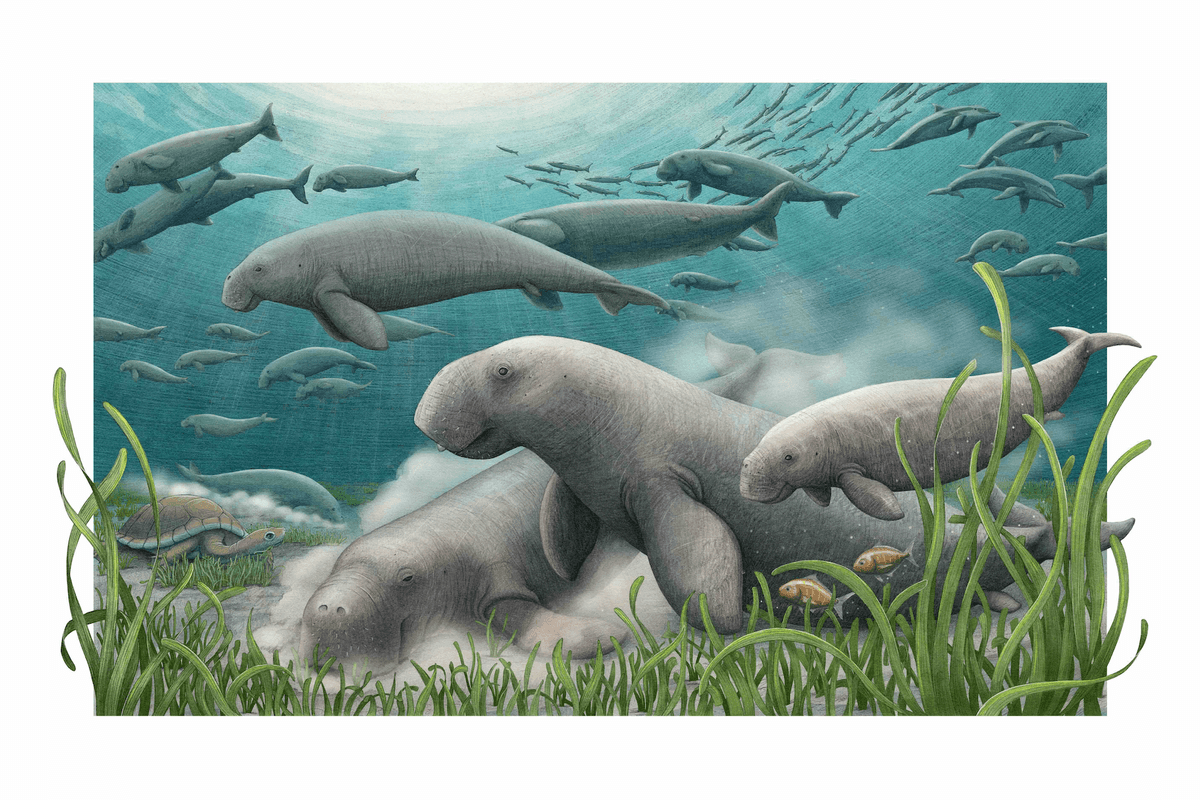
As an Ancient Cow Species Foraged For Seagrass, it Shaped Its Surroundings Around 21 Million Years Ago
Thousands of dugongs swim through the Arabian Gulf today, transforming the seafloor as they search for seagrass, their favorite food. Pulling this foliage from its place in the sand, these creatures create feeding trails as they forage, shaping their environment and freeing nutrients for their entire ecosystem.
Digging deeper into the evolution of these dugong “engineers,” a new study in PeerJ has shown that sea cows, or sirenians, are not a new addition to the seascape, as they have trimmed the Arabian Gulf’s marine meadows for millions of years.
Describing fossils from a massive deposit of marine mammals in Qatar and identifying a new sea cow species among them, the study suggests that a distant dugong relative, Salwasiren qatarensis — a miniature modern dugong — served a similar purpose in the Arabian Gulf around 21 million years ago.
“We discovered a distant relative of dugongs in rocks less than 10 miles away from a bay with seagrass meadows that make up their prime habitat today,” said Nicholas Pyenson, a study author and a paleontologist at the Smithsonian National Museum of Natural History, according to a press release. “This part of the world has been prime sea cow habitat for the past 21 million years — it’s just that the sea cow role has been occupied by different species over time.”
Read More: How An Ancient Fossil Found in Egypt May Explain Whale Evolution
Searching for Ancient Sea Cows
Modern dugongs swim through the warm, shallow waters from the shores of Africa to Australia today, though their ancient relatives were much more widespread, appearing in fossil sites around the world. Still, one of the best places by far for finding these fossils is Al Maszhabiya, a site along the coast of the Arabian Gulf in Qatar, which was identified as a sirenian bonebed in the 2000s.
“The area was called ‘dugong cemetery’ among the members of our authority,” said Ferhan Sakal, another study author and an archaeologist at Qatar Museums, according to the press release. “But at the time, we had no idea just how rich and vast the bonebed actually was.”
Returning to the site for a survey in 2023, Pyenson, Sakal, and their team found fossils of ancient dolphins, sharks, sea turtles, and fish from the Early Miocene (around 21 million years ago). More importantly, they also found an assortment of sea cow fossils, which were spread throughout the area in around 170 locations. This abundance, the team says, makes the site one of the largest marine mammal locales on record and an ideal place for studying sirenian evolution.
Read More: These Ancient Whales Lived Like Modern Manatees 40 Million Years Ago
A Small Sirenian
Analyzing the fossils of the ancient sea cows, the team spotted a strong resemblance to the bones of modern dugongs. But they also saw some substantial differences, including the presence of limb bones that are long lost in today’s sirenians, allowing the fossils to be named as a new species, Salwasiren qatarensis. Weighing approximately 250 pounds, Salwasiren was also surprisingly small, the team says, weighing around eight times less than some modern dugongs, with a straight snout and two tiny tusks.

The fossils of Salwasiren qatarensis suggest that the species was small, with a distinctive snout and set of tusks.
(Image Credit: ARC.2023.23.008, Qatar Museums, Doha, State of Qatar. Photo by James Di Loreto, Smithsonian.)
Taken together, the fossils and their abundance suggest that seagrasses have flourished in the Arabian Gulf for a long, long time, with sea cows managing the meadows around 21 million years ago.
“The density of the Al Maszhabiya bonebed gives us a big clue that Salwasiren played the role of a seagrass ecosystem engineer in the Early Miocene, the way that dugongs do today,” Pyenson said in the release. “There’s been a full replacement of the evolutionary actors but not their ecological roles.”
According to the team, more fossil finds may follow at the site, assuming that it is protected and preserved for future study. In fact, it is possible that Salwasiren was only one of several sea cows in the area at the time, as some species are famous for sharing their environments with other seagrass-managing sirenians.
“The most important part of our collaboration is ensuring that we provide the best possible protection and management for these sites,” Sakal said in the release, “so we can preserve them for future generations.”
Read More: Ancient Shark-Like Whale Roamed Australia’s Surf Coast 26 Million Years Ago
Article Sources
Our writers at Discovermagazine.com use peer-reviewed studies and high-quality sources for our articles, and our editors review for scientific accuracy and editorial standards. Review the sources used below for this article: