
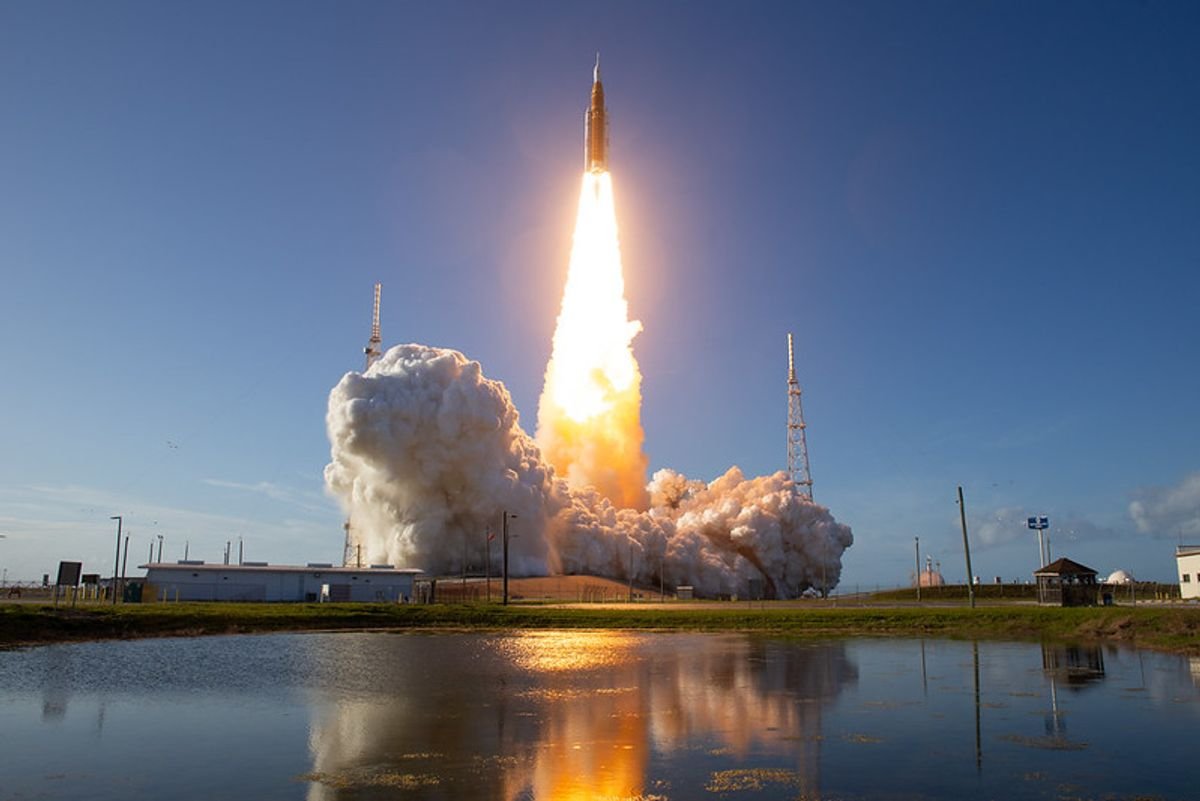
Artemis II Has Successfully Launched and Is Heading for the Moon — What Comes Next for the Mission?

As the Artemis II Space Launch System (SLS) rocket prepared for launch, some of the Artemis crew gave parting words of wisdom via the NASA livestream:
“This is Victor,” said Victor Glover, the mission’s pilot. “We are going for our families.”
“This is Christina,” said Christina Koch, a mission specialist. “We are going for our teammates.”
“This is Jeremy,” said Jeremy Hansen, a mission specialist from Canada. “We are going for all humanity.”
After a few delays, Artemis II successfully launched on April 1, 2026, and humanity heads back to the moon for the first time in over 50 years. Thousands of viewers watched from the ground, while millions watched this historic takeoff from a NASA livestream on YouTube.
After the success of Artemis I, an uncrewed moon mission, Artemis II will fly by the moon, collect data, and return to Earth. The resources gained from this mission will help guide Artemis III, where humans will set foot on the moon again.
What Will Artemis II Do?
Artemis II will carry four crew members: Commander Reid Wiseman, Victor Glover, and Christina Koch from the U.S., and Jeremy Hansen from the Canadian Space Agency (CSA). During the approximately 10-day mission, the crew will conduct the first human lunar flyby in over 50 years, testing the Space Launch System and various components of the Orion spacecraft, including its maneuvering capabilities, according to NASA.
Other tests include how the life support systems will operate, how the crew will interact in deep space, and how communications and navigation will function far from Earth.
Read More: NASA Unveils Roadmap for Permanent Moon Base and Increased Missions to the Moon
What Path Will Artemis II Take?
At takeoff, the mission left Launch Pad 39B at the Kennedy Space Center in Florida, with 8.8 million pounds of thrust, according to NASA. But it didn’t head straight for the moon. Instead, the craft will circle Earth twice before shooting off to fly around the moon.
The trajectory looks like a complicated figure 8, but it is necessary to ensure that all support systems are active, and for the crew to test procedures and living conditions in deep space.
Once Orion separates from the Interim Cryogenic Propulsion Stage (ICPS), the craft will begin high Earth orbit and its second lap around the planet before beginning outbound transit to the moon. From there, it will perform the lunar flyby and make its way back home, where it will perform a splashdown in the Pacific Ocean, off the coast of San Diego, California, according to NASA.
Artemis II Is a Mission of Firsts
Besides being the first crewed mission to return to the moon in over 50 years, Artemis II is a mission of many firsts. This is the first crewed mission of the Orion spacecraft, the first time a woman, a person of color, and a non-U.S. citizen have traveled beyond low Earth orbit, and to the vicinity of the moon.
What we learn from this mission, and the Artemis missions beyond, could help put the first-ever person on Mars.
There’s still more to come from this incredible return to the moon.
Read More: How Artificial Moon Dust Helps Us to Build the First Long-Term Lunar Bases
Article Sources
Our writers at Discovermagazine.com use peer-reviewed studies and high-quality sources for our articles, and our editors review for scientific accuracy and editorial standards. Review the sources used below for this article: