
Artemis II Crew Gears Up for Return to Earth — Why Is Re-entry into Earth’s Atmosphere so Risky?
After spending 10 days in space, the Artemis II mission is primed to return to Earth. The Artemis crew will splash down off the coast of San Diego at approximately 8:07 p.m. ET on Friday, April 10, 2026, marking a triumphant end to an undertaking that has already set a strong foundation for future missions to the Moon.
In the days leading up to the imminent splashdown, the four astronauts on this mission have been laser-focused on preparing to re-enter Earth’s atmosphere as everyone back home awaits their arrival with bated breath.
A Risky Re-entry for Artemis II
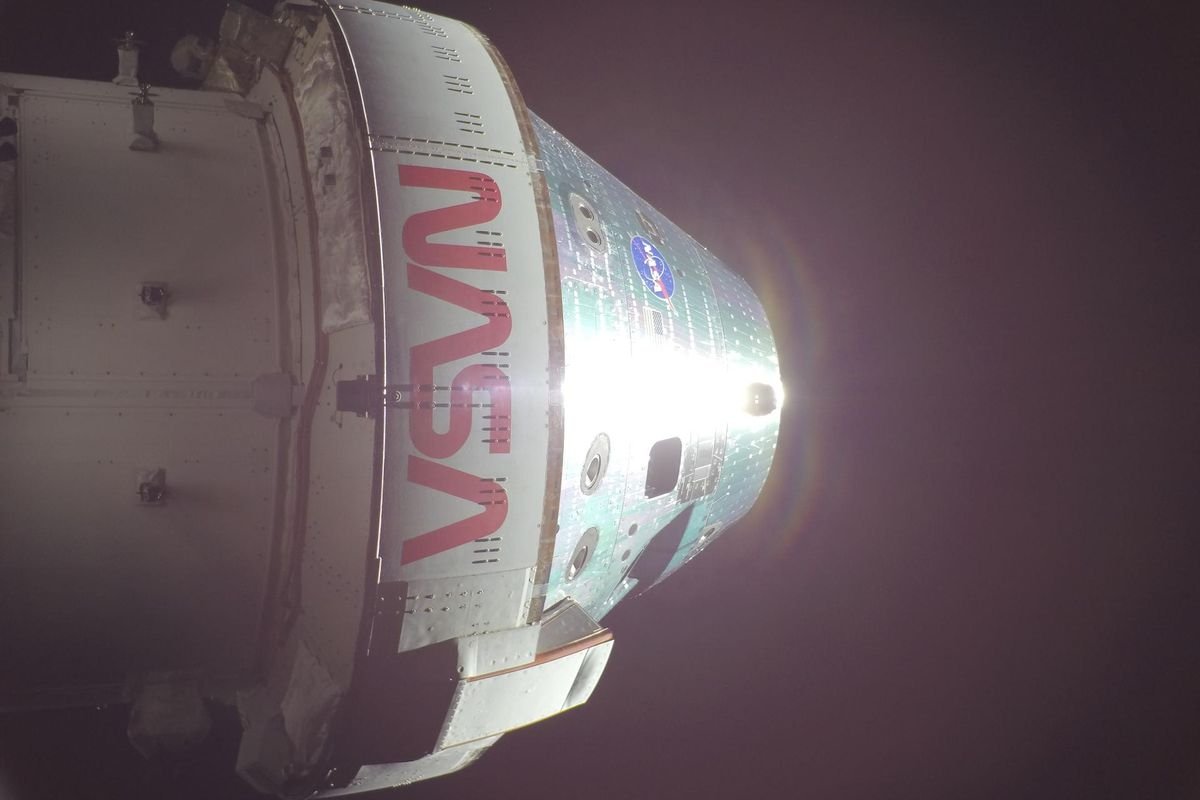
The re-entry of Artemis II is a pivotal moment that is technically the most risky part of the entire mission. That’s because of two reasons, according to Chris James, a researcher at the University of Queensland: One is that the Orion spacecraft that the Artemis crew is on will be subjected to intense heat and forces as it slows down and sheds enormous amounts of kinetic energy from hypersonic speeds of around 24,606 mph.
The other reason is that the gas surrounding Orion will turn into electrically conductive plasma that will induce a “communication blackout,” a short period during which the crew cannot communicate with those back on Earth.
Orion will re-enter the atmosphere moving at more than 30 times the speed of sound, and will be hit with a shockwave that heats surrounding air temperatures of more than 18,000 degrees Fahrenheit, according to James. Heat shields on the spacecraft, however, will help counter the extreme temperatures.
Read More: How Artificial Moon Dust Helps Us to Build the First Long-Term Lunar Bases
Lifting Up to Slow Down
To make re-entry manageable for the Artemis crew, Orion will rely on a tactic called aerodynamic lift, in which the spacecraft will shift its angle to lower g-forces.
The previous, unmanned Artemis I mission in 2022 used a more intensive version of aerodynamic lift, generating enough lift to fully pull itself out of the atmosphere before performing a second entry at a lower speed. However, scientists noticed that heat shields on Artemis I experienced more wear than expected; this was likely a result of pressure that had built up in the shields’ material when they cooled upon leaving the atmosphere.
To prevent this damage to the heat shields, Artemis II re-entry won’t happen the exact same way. While it will likely still experience aerodynamic lift, it won’t be enough to make the spacecraft fully leave the atmosphere.
Once the spacecraft splashes down in the Pacific Ocean, the crew will be recovered by the USS John P. Murtha, a transport dock ship of the U.S. Navy. According to NASA, the Artemis II crew has rigorously trained for the splashdown at the agency’s Neutral Buoyancy Laboratory, rehearsing how to stabilize the spacecraft, exit it, and board a raft.
Preparing for Future Moon Landings
In the final days of the Artemis II mission, the crew has been conducting various tests while preparing for re-entry.

Artemis II crew: (from left) Mission Specialist Christina Koch, Mission Specialist Jeremy Hansen, Pilot Victor Glover, and Commander Reid Wiseman.
(Image Credit: NASA)
On Flight Day 8 (April 8, 2026), the astronauts took turns testing out the orthostatic intolerance garment, a three-piece compression garment worn on the torso and both legs, according to NASA TechPort.
The custom-built garment applies lower-body compression to help astronauts maintain blood pressure and circulation as they transition from microgravity (the environment that makes them “weightless”) to Earth’s gravity, which often causes them to experience lightheadedness when attempting to stand upright.
Later in the day, the crew took manual control of Orion to guide the spacecraft to a tail-to-Sun attitude, where the tail points toward the Sun to generate more power.
These types of tests will allow NASA to plan accordingly for the Artemis IV mission, scheduled to launch in early 2028 with the goal of bringing humans to the Moon for the first time since 1972.
Read More: NASA Unveils Roadmap for Permanent Moon Base and Increased Missions to the Moon
Article Sources
Our writers at Discovermagazine.com use peer-reviewed studies and high-quality sources for our articles, and our editors review for scientific accuracy and editorial standards. Review the sources used below for this article: