
Antarctica’s Mysterious Radio Pulses Remain Unexplained — but Better Particle Experiments Could Change That
The brittle crunch of snow underfoot in Antarctica is a stark contrast to the sandy beaches of Hawaii, where Peter Gorham works on much of his research.
But Antarctica has something that Hawaii does not: Ice.
“There’s something that is a super important characteristic of ice that many people […] aren’t perhaps aware of,” Gorham, a professor at the University of Hawaii, told Discover. “And that is that it is in the radio-wave regime; it is the clearest material that we know of. […] There is nothing more transparent to radio waves as a solid material than cold ice in Antarctica.”
Gorham and his research team were initially hunting for neutrinos — nearly massless and invisible particles that stream through the cosmos, and even our bodies undetected — as part of the Antarctic Impulsive Transient Antenna (ANITA) project. This meant that analyzing radio waves was essential. And therefore, so was the frigid South Pole, and the Antarctic ice.
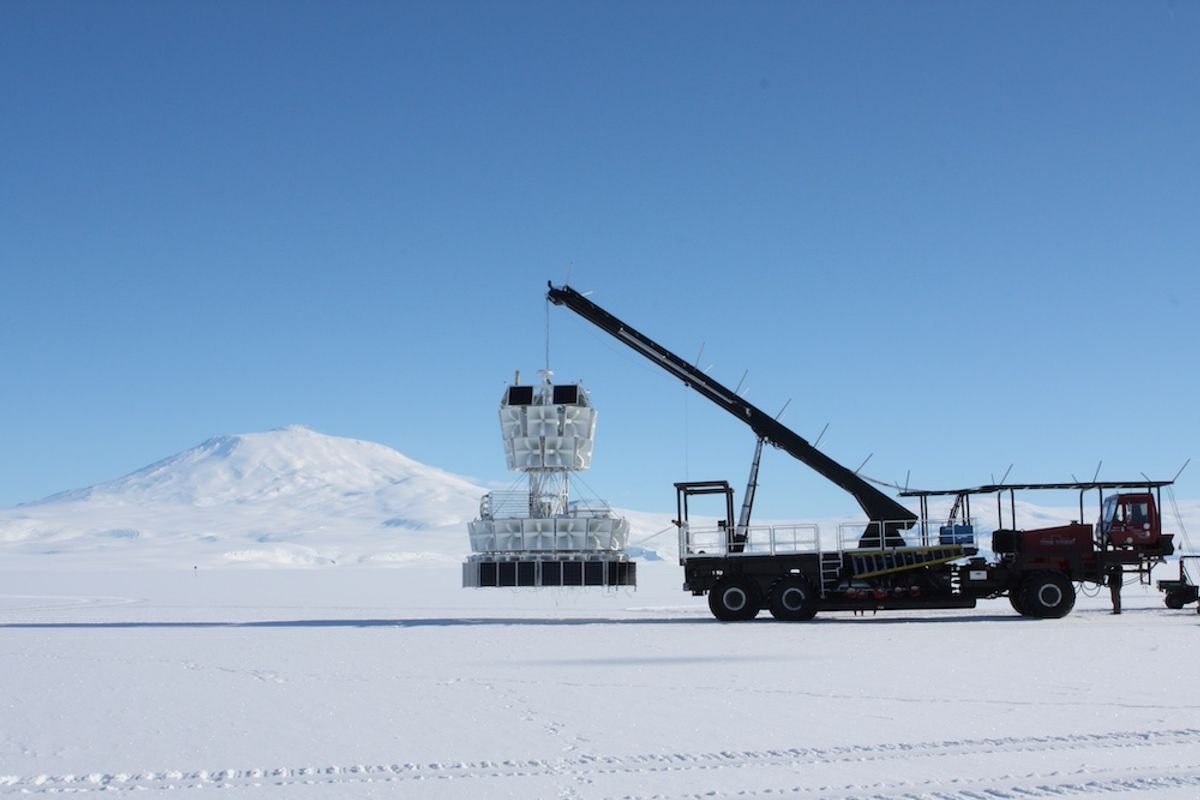
ANITA is a device meant to detect radio waves from neutrinos that interact with Antarctic ice, and radio signals from Earth’s atmosphere, according to the Kavli Institute for Cosmological Physics at the University of Chicago. A device that can help further our understanding of this particle and perhaps the evolution of the universe.

ANITA in Antarctica.
(Image Courtesy of Brian Hill)
In this quest for neutrinos, however, during the ANITA I flight in 2006 and the ANITA III flight in 2014, the team detected something else — mysterious pulses coming from beneath the Antarctic ice. This finding sparked viral theories, with some claiming that these pulses were evidence of extraterrestrial life or that they came from a parallel universe. While Gorham and other researchers doubt these ideas, the findings do remain a mystery.
“And I think to me, […] it’s fun to think about what they could be,” Abigail Vieregg, professor and director of the Kavli Institute for Cosmological Physics at the University of Chicago, who was working on her Ph.D. thesis during the ANITA II flight, told Discover.
Though these mysterious pulses may have inspired some out-of-this-world conspiracy theories, the ANITA project has inspired the next generation of neutrino physicists to carry on this research.
According to Gorham, as ANITA I lifted off in 2006, it was both exhilarating and sobering. He knew the real work was about to begin. After ANITA’s first successful flight, it would launch three more times over a decade and inspire other neutrino researchers, like Vieregg.
“You’re flying the most sensitive radio experiment anyone has ever built over Antarctica, and you’re looking down for these tiny sparks of radio waves from the ice,” Vieregg said.
While the ANITA missions have wrapped up, they’ve inspired the next mission, the Payload for Ultrahigh Energy Observations (PUEO), a device that’s much more sensitive at detecting radio signals in the Antarctic ice.
Read More: Antarctica Has a Massive Gravity Hole — and It Dates Back 70 Million Years
The Hunt for Neutrinos
The hunt for neutrinos is not a new venture. While researchers were initially studying radioactive atoms, they noted that energy that should have been conserved in their experiments was instead vanishing, according to the Fermi National Accelerator Laboratory (Fermilab). In 1930, physicist Wolfgang Pauli proposed the idea that an invisible particle was carrying the energy away. Eventually, this mysterious particle would be called the neutrino.
This led to further research, theories, and experiments that detected neutrinos from the sun, the role they played in supernovae, and how they traveled throughout the universe. Understanding these particles is one of the keys to understanding life in the universe.
“We owe our existence to supernovae, which create the elements essential to our biology, and neutrinos were crucial to that process,” Gorham told Discover.
From that neutrino research came a physics process, called the Askaryan effect, that, until ANITA, had not been experimented on a large scale in nature.
The Askaryan effect occurs when a high-energy particle interacts with a solid medium, such as ice or salt, and produces a shower of secondary particles. This effect generates a rapid energy current and produces something like a mini lightning bolt.
Initially, according to Gorham, no one took the Askaryan effect seriously until the 1990s, when researchers thought it could help detect neutrinos on the moon.
It was also around then that missions such as the Antarctic Muon And Neutrino Detector Array (AMANDA) and its successor, IceCube, began looking for neutrinos while embedded in the Antarctic ice.

ANITA in Antarctica.
(Image Courtesy of Brian Hill)
But ANITA would be different.
Instead of missions embedded in the ice, ANITA took to the skies to detect Askarayn radio pulses and look for these tiny “lightning bolts.”
How ANITA Works
In 2006, when ANITA first launched, it was the most advanced technology of its kind, and though NASA primarily funds it, it was Gorham’s idea.
“Let me try to be humble about it,” Gorham laughed.
Gorham originally pursued an English degree, but later in his studies, he took an astronomy class that inspired him to study physics, and ultimately led him into laboratory work. There, he discovered a love for experimental science and met influential physicists like Herb Chen, Fred Reines, and John Learned, who guided him toward neutrino research and eventually to postgraduate work in Hawaii.
For the ANITA project, Gorham teamed up with researchers from several institutions, including NASA and UCLA.
“I was the instigator of the thing, but by no means the one who made it made it really work,” Gorham told Discover. “It was an amazing team effort, and lots of incredible students who came up through the program.”
ANITA is about 26 feet tall, with horn antennas that look like white, boxy megaphones arranged 360 degrees around the payload. It is fine-tuned to pick up as many signals as possible by looking at as much ice as possible.
“So, knowing what we know about ice, and knowing that we want to look for neutrinos, and knowing that they make lightning bolts when they interact with the ice. Our job, then, is to stare at as much ice as we can possibly see without being too far away that the radio bursts are still detectable by us,” Gorham said.
The perfect distance seems to be about 120,000 feet above Antarctica, where ANITA flies as its antennas detect radio pulses. During its 20- to 30-day flight, ANITA records millions of radio pulses. The antennas are so accurate that they can even localize a radio event to within a fraction of a degree, according to Gorham.
Though ANITA picks up millions of signals, about 99.9999 percent come from human-made sources, including signals from research vehicles, snowmobiles, aircraft, and other items around basecamp.
“You can imagine other things also make tiny sparks of radio waves, right? Like you drive a snowmobile around and it makes sparks of radio waves,” Vieregg told Discover.

ANITA in Antarctica.
(Image Courtesy of Christian Miki)
Once the flight concludes and the data is ready to sift through, the research team first reviews signals it already knows and discards them. Sometimes, out of millions of recordings, there may only be about 30 to 50 events left to analyze that may be neutrinos.
According to Gorham, those last few are what the team will focus on.
Read More: The Ozone Layer Is On Track for a Full Recovery, Thanks to Global Collaboration Since 1987
Picking Up an Anomalous Signal
For the most part, the results from the ANITA I and ANITA III missions indicated that the detected signals were cosmic rays — charged particles like protons — rather than neutrinos.
A March 2025 study in Physical Review Letters, which neither Gorham nor Vieregg was an author on, discussed anomalous events ANITA had detected coming from under Antarctica’s ice. The radio pulses are typically recorded after they have bounced off the ice; however, these events seemed to originate from Earth.
Cosmic rays produce a characteristic radio polarity. The rays reflect off the ice, and their polarities invert. The anomalous events, on the other hand, appeared exactly like cosmic rays except for the polarity. This may not seem like much, but according to Gorham, the team simply could not ignore this distinction.
A cosmic ray cannot originate from the ice, though a neutrino could, if it didn’t have to pass through a large portion of Earth first. There are tau neutrinos, which have different partition behaviors compared to other neutrinos. But, according to Gorham, the angles that these anomalous events were coming from did not line up with the angle of tau neutrinos.
The data was even sent to the Pierre Auger Observatory, but the results remained inconclusive.
Sparked Conspiracy Theories
One theory that circulated widely online claimed that these mysterious events were caused by particles traveling backward in time from another universe, a twin universe where everything moves in reverse.
Another theory suggests the particles came from a parallel universe. The theory quickly went viral on social media and even resurfaces every so often, with a slew of new sources, including Newsweek and Forbes.
“There’s been a lot of creative explanations out there. But I’m not very convinced,” Gorham told Discover.
According to Vieregg, some believed that the anomalous event detected by ANITA was proof of dark matter or a different dimension.
“It’s […] probably not the discovery of dark matter. It’s not, you know, extra dimensions or whatever, but it is weird. We don’t quite know what it is,” Vieregg told Discover.
Even if the signals aren’t something outlandish, the findings have still brought attention to neutrino research.
What’s Next for Ice and Neutrino Research?
The ANITA flights did not capture any confirmed neutrinos, but the anomalous events it did detect have Gorham and Vieregg feeling excited about the future.
“Physics, when you measure something that you didn’t expect or that, you know, trashes your previous worldview, that’s never disappointing, that’s always exciting,” Gorham told Discover.
Upon completing her Ph.D., Vieregg now serves as the principal investigator (PI) for the follow-up project known as PUEO. Though the University of Chicago leads this mission rather than the University of Hawaii, the name honors the pueo owl, which is native to Hawaii. This small shout-out helps emphasize and honor how far this neutrino research has come since 2006.
The hope with PUEO is to detect neutrinos and to better understand what these anomalous events may have been. PUEO is now more advanced than ANITA and could hopefully produce more in-depth or higher-quality data to determine whether these anomalous events are real or could be human-caused errors.

PUEO research team.
(Image Courtesy of Cosmin Deaconu)
“How do I find out if they’re real or not? One way to do that is to build a better experiment, right?” Vieregg told Discover. “And so, then you go and build a better experiment and see what you see. And that’s one of the reasons we built PUEO.”
While PUEO may look similar to ANITA — it still launches via balloon and collects data in the stratosphere — it is made with more advanced electronics. It can add up signals from the antennas in real time and function as a radio telescope. PUEO is capable of beam forming, where it coherently sums all the signals for the antennas at once.
According to Vieregg, it’s really the oldest trick in the radio astronomy textbook applied to particle physics, and it creates a much more sensitive instrument.
PUEO Taking Flight
PUEO has just returned from its inaugural flight in 2026, and according to Vieregg, it will take about 1 to 2 years to sift through the data it recorded. This may seem like a long time, but with ANITA’s four flights, which spanned 2006 to 2017, Gorham was a co-author on several ANITA collaboration papers, including three in Physical Review Letters over the past decade.
Understanding what the antennas picked up takes time.
“Maybe we’ll know more in a year or two about these mystery events,” Vieregg said.
While the hunt for neutrinos continues with the PUEO missions, both Gorham and Vieregg emphasize how exciting these findings are and how fascinating Antarctica has been.
“Being in Antarctica is a place that you get off the plane the first time, and you’re like, this place is sort of surreal,” Vieregg told Discover. “Everything is big. Like, the mountains are big the plateau, the ice sheet is big. […] Everything just seems sort of on a different scale.”
With the mission’s first successful flight, we are closer to understanding what those mysterious pulses were today than we were yesterday, and perhaps PUEO will be the key to understanding what was coming from beneath the ice.
Read More: Record-Breaking Neutrino Detected in the Mediterranean in 2023 May Have Come From Blazars
Article Sources
Our writers at Discovermagazine.com use peer-reviewed studies and high-quality sources for our articles, and our editors review for scientific accuracy and editorial standards. Review the sources used below for this article: