
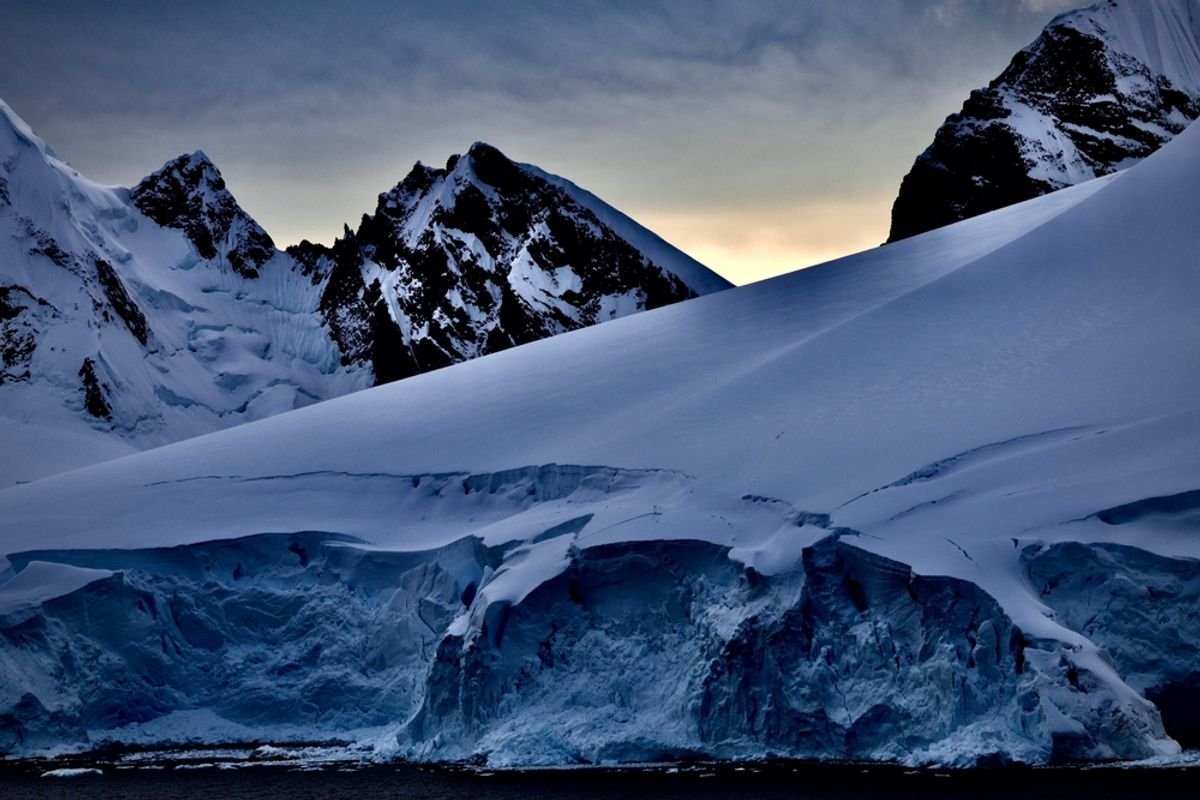
Antarctica’s Ice Sheet Shrouds a Vast Landscape of Alpine Valleys and Ice Rivers

There are areas on Earth that are less understood than the surfaces of some worlds in our Solar System. Antarctica’s landscape beneath its immense ice sheet is one of them. Hidden from view, this buried terrain still holds many secrets and revealing them could significantly improve our understanding of ice loss and sea-level rise in a warming climate.
Now, researchers from the University of Edinburgh and Dartmouth College have taken a major step toward uncovering that hidden world. By combining high-resolution satellite data with current knowledge of ice-flow physics, the team produced the most detailed map yet of Antarctica’s subglacial bedrock landscape. The new map reveals geological structures such as mountains, canyons, and deeply carved ice rivers concealed beneath nearly two miles of ice.
Read more: Observations of Antarctica’s Doomsday Glacier Reveal a Cracked Surface
Antarctica’s Secret Landscape Underneath a Frozen Sheet
Antarctica’s ice sheet is vast, covering more than 5.4 million square miles, making it the largest on Earth. Beneath this frozen blanket lies a surprisingly complex world of mountains, valleys, plains, basins, and even lakes — features that stand in stark contrast to the smooth, white surface above.
Surprisingly, the shape and texture of the land beneath the ice play a crucial role in how the ice sheet moves, melts, and ultimately contributes to future sea-level rise. Yet because Antarctica is so remote and difficult to access, much of this subglacial landscape has remained a mystery.
In a new study published in Science, researchers mapped the bedrock indirectly by analyzing the subtle imprints that mountains and valleys leave on the ice above them. By pairing high-resolution satellite observations with physical models of ice flow, they were able to reconstruct parts of the landscape buried beneath miles of ice.
Plenty of Detail by Only Looking at The Surface
The result is a continent-scale map showing Antarctica’s hidden topography in never-before-seen detail, resolving features of sizes between about 1.2 miles and 18.6 miles. According to the researchers, some of these structures may even date back to before the current ice sheet formed, around 14 million years ago.
The newly identified features include deep, narrow alpine valleys, scoured lowlands, and vast buried river channels.
“It is perhaps most surprising that ultimately so much detail of the bed topography — features such as glacial valleys, hills and canyons … — are captured at all in the shape of the ice surface so far above,” said study co-author Robert Bingham in a press release.
Bingham also noted that despite the presence of deep canyons beneath the ice, the surface expression is remarkably subtle, since the ice that passes over is almost 2 miles thick.
“…the ice surface elevation typically only falls a handful of meters, a change that is barely noticeable when travelling over the ice surface itself,” Bingham said, underscoring how impressive the detection really is.
Clearest Glimpse of a Hidden Landscape
Beyond producing a more accurate map, the newly resolved texture of Antarctica’s bedrock allows scientists to find patterns of glacial shaping across the continent. This gives valuable insight into the ice sheet formation, evolution, and how it continues to interact with the land below, informing predictions of future ice dynamics, according to the release.
Still, continuing research depends on even more defined technologies. In a related Science perspective article, Duncan Young from the University of Texas Institute for Geophysics pointed out that the methods used in the current study rely on assumptions about complex processes that can vary widely across the continent. In many regions, the boundary between ice and rock is blurry or constantly changing, making precise modeling difficult.
Emerging technologies like radar swath imaging, magnetotellurics, and seismic surveys could provide even richer data in the future, though they currently face logistical and spatial challenges. For now, the study offers the clearest glimpse yet of a landscape that has remained hidden for millions of years.
Read more: The Largest Mountain Range No One Has Seen Lives Under Antarctica’s Ice Sheets
Article Sources
Our writers at Discovermagazine.com use peer-reviewed studies and high-quality sources for our articles, and our editors review for scientific accuracy and editorial standards. Review the sources used below for this article: