
Ancient Wolf Stomach Reveals Remnants of 14,400-Year-Old Woolly Rhino Genome

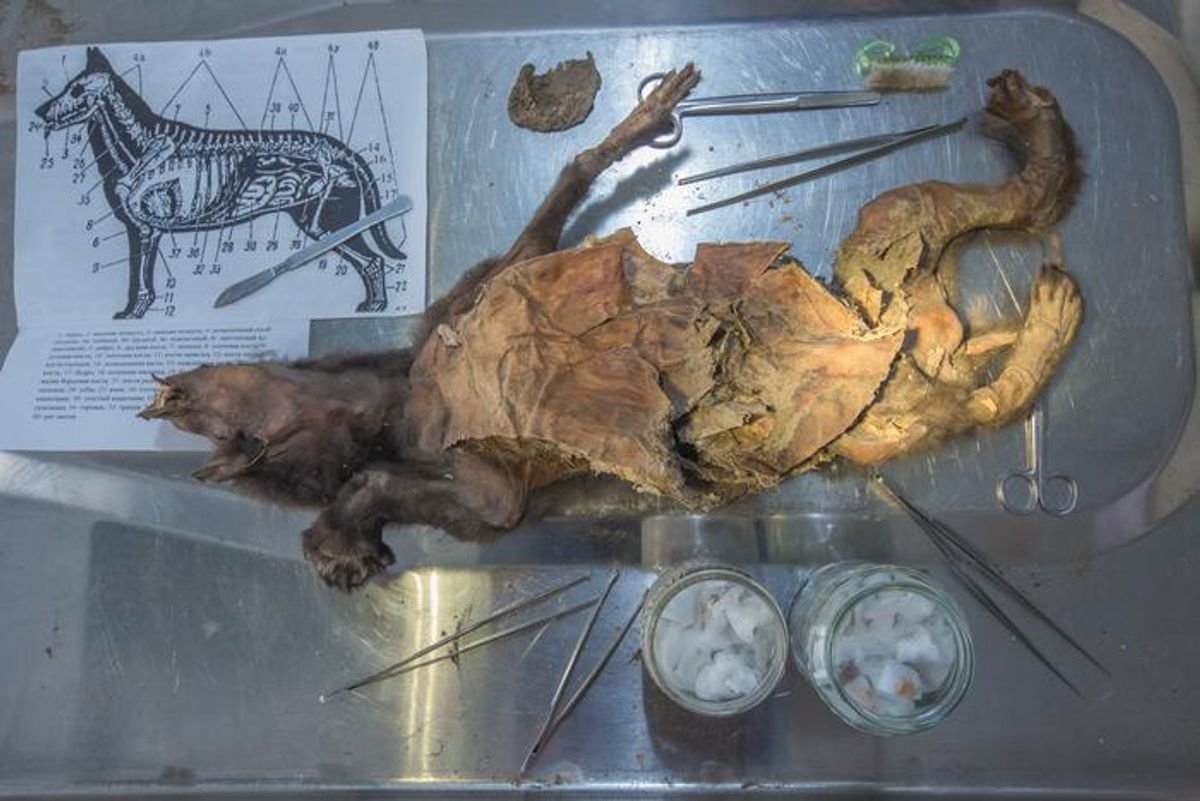
Although the woolly rhinoceros died out alongside other iconic Ice Age megafauna, a trace of this extinct species has survived for thousands of years inside an ancient wolf’s stomach. Inside the stomach, scientists spotted a piece of tissue that belonged to a woolly rhino that lived 14,400 years ago.
A new study published in Genome Biology and Evolution has determined from analysis of the woolly rhino tissue that the species’ numbers didn’t falter until shortly before its extinction. Upon sequencing the entire genome from this sample, the researchers found that the woolly rhino avoided inbreeding and, in doing so, maintained genetic diversity until its demise.
“Probably woolly rhinoceros and woolly mammoths are the only species for which we have high-quality genomes from samples that date very close to their final extinction. So far, both of them seem to have declined very shortly before their final extinction,” says the study’s last author, Camilo Chacón-Duque, a bioinformatician at Uppsala University.
Sequencing a Woolly Rhino Genome
The woolly rhino roamed northern Eurasia during the Pleistocene epoch, enduring the bitter cold of the steppes with its thick coat of hair, stocky body, and fat-filled back hump. It’s believed to have gone extinct around 14,000 years ago, as a result of the Bølling–Allerød Interstadial, an abrupt warming period that started around 14,700 years ago.
Few woolly rhino remains exist from shortly before their extinction. The tissue sample featured in the new study — radiocarbon dated to 14,400 years old — turned out to be one of the youngest woolly rhino specimens ever discovered; it was found when researchers were examining the stomach of an Ice Age wolf that had been preserved in permafrost near the village of Tumat in northeastern Siberia.
Read More: 75,000-Year-Old Treasure Trove of Ice Age Animal Remains Provides Snapshot of a Lost World
A Stable Life for Woolly Rhinos
The researchers compared two other genomes from older specimens, dated to around 18,000 and 49,000 years ago, to the 14,400-year-old woolly rhino’s genome.
Examining patterns on DNA and focusing on the distribution of genetic variation in the genomes, the team estimated how the species’ population changed over time; they ultimately found that the woolly rhino’s population size remained stable in the centuries leading up to extinction, before likely experiencing a sharp decline during the Bølling–Allerød warming.
“Something that is striking is that single high-quality genomes can be used to gain insight into their [woolly rhinos’] population histories, which is particularly useful in [paleogenomics], since most of the times we cannot find more than one or a few samples representing a given population in space and time,” says Chacón-Duque.
The Benefits of Avoiding Inbreeding
The stability of the woolly rhino population can be attributed in part to the lack of inbreeding, which the researchers confirmed by looking at the length and number of homozygous segments, which contain identical DNA inherited from both parents. The woolly rhino genomes exhibited no evidence of increased genetic load or genomic erosion shortly before extinction, meaning they didn’t contain harmful genetic variants that would have reduced their survivability.
“It seems like the woolly rhino was able to have a stable population for a long period of time, albeit low. This might have given them enough time (across many generations) to ‘naturally’ get rid of the most harmful mutations,” says Chacón-Duque.
By avoiding inbreeding, woolly rhinos could stay genetically healthy. Today, inbreeding can be a major problem for endangered animals, since it reduces genetic diversity and puts them at risk of population loss.
“For example, if suddenly the temperatures rise and a habitat starts changing very fast, cold-adapted species with less diversity have less chances to successfully adapt to those changes by accessing their hidden genetic ‘potential,'” says Chacón-Duque.
Questions surrounding the woolly rhino persist, particularly regarding its exact time of extinction; while the fossil record suggests they disappeared 14,000 years ago, there’s a chance some individuals lived on until the early Holocene, which started 11,700 years ago at the end of the last Ice Age.
Read More: Hippos Lived Alongside Mammoths 47,000 Years Ago During the Last Ice Age
Article Sources
Our writers at Discovermagazine.com use peer-reviewed studies and high-quality sources for our articles, and our editors review for scientific accuracy and editorial standards. Review the sources used below for this article: