
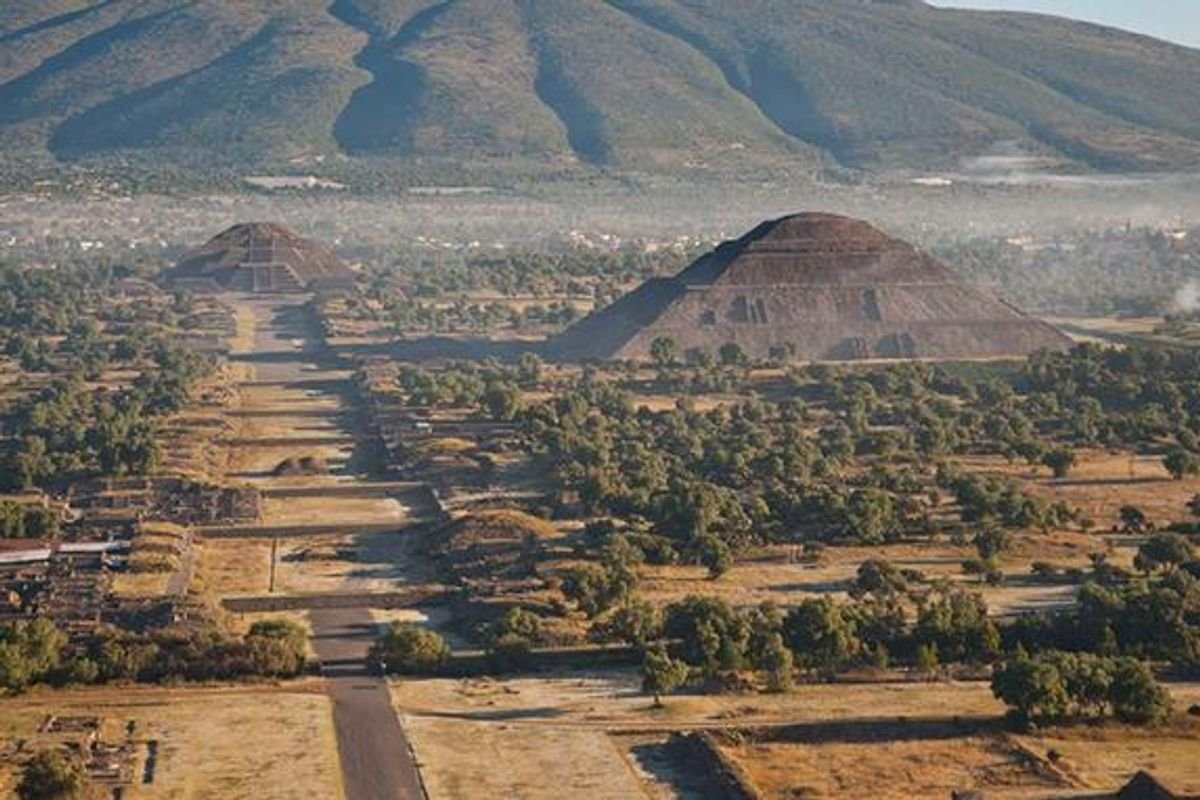
Ancient Teotihuacan Murals May Reveal a 2,000-Year-Old Written Language
The origins of Teotihuacan’s inhabitants remain one of archaeology’s enduring questions. The city dominated central Mexico for centuries, yet the language and identity of its people have long remained unknown. Now, researchers may have uncovered the answer, according to a new study in Current Anthropology.
The findings suggest a direct link between Teotihuacan and the Aztecs, long thought to have arrived centuries later. The city’s murals and symbols appear to form a writing system that records an early form of Uto-Aztecan, the language family that would later evolve into Nahuatl. The discovery could mean the Aztecs were descendants of Teotihuacan’s original inhabitants.
“No one before us has used a language that fits the time period to decipher this written language. Nor has anyone been able to prove that certain logograms had a phonetic value that could be used in contexts other than the logogram’s main meaning. In this way, we have created a method that can serve as a baseline for others to build on to expand their understanding of the texts,” said Magnus Pharao Hansen, co-author and associate professor at the University of Copenhagen, in a press release.
Teotihuacan: A Powerful Ancient City
Founded around 100 B.C.E., Teotihuacan became one of the largest and most influential cities in ancient Mesoamerica. At its height, it was home to more than 100,000 people and served as a major cultural and political hub until its decline around 600 A.D.
Often compared to Rome for its reach and influence, Teotihuacan shaped neighboring civilizations.
“There are many different cultures in Mexico. Some of them can be linked to specific archaeological cultures. But others are more uncertain. Teotihuacan is one of those places. We don’t know what language they spoke or what later cultures they were linked to,” said Hansen.
Even so, the city’s distinct art and architecture set it apart, from its temples to murals showing clear Maya influence.
Read More: The Fall of the Aztec Empire: What Really Happened in the Battle of Tenochtitlan?
Decoding Teotihuacan’s Writing System Using Ancient Nahuatl
Teotihuacan’s writing system is difficult to decode because its symbols can represent both pictures and sounds, making it hard to tell when an image should be read literally or phonetically. To solve this, researchers are reconstructing an earlier form of Nahuatl, part of the Uto-Aztecan language family they believe the script records.

Example of a linear text in Teotihuacan writing painted in three columns on the floor of the Plaza de los Glifos.
(Image Credit: Christophe Helmke, University of Copenhagen)
By rebuilding how those ancient words might have sounded, they can test whether the city’s signs follow real linguistic patterns. The work happens on several fronts — reviving a lost language while using it to interpret the few surviving texts found on murals and pottery.
“In Teotihuacan, you can still find pottery with text on it, and we know that more murals will turn up. It is clearly a limitation to our research that we do not have more texts. It would be great if we could find the same signs used in the same way in many more contexts. That would further support our hypothesis, but for now, we have to work with the texts we have,” said Hansen.
Read More: What Happened to the Aztec Empire? Lost Artifacts Help Rejuvenate Its Past
Rewriting the Story of Teotihuacan
The study has already drawn interest from international experts, who see potential for a deeper understanding of early writing in Mesoamerica. The researchers plan to host collaborative workshops to test and refine their methods with colleagues from around the world.
“If we are right, it is not only remarkable that we have deciphered a writing system. It could have implications for our entire understanding of Mesoamerican cultures and, of course, point to a solution to the mystery surrounding the inhabitants of Teotihuacan,” said Christopher Helmke, co-author of the study and fellow associate professor at the University of Copenhagen, in the press release.
Article Sources
Our writers at Discovermagazine.com use peer-reviewed studies and high-quality sources for our articles, and our editors review for scientific accuracy and editorial standards. Review the sources used below for this article: