
Ancient Shipwreck Cargo Sheds Light on Iron Age Trade And a Lost Mediterranean Seaport
Shipwrecks from ancient times have opened up a page of history that tells us how different cultures collaborated. A treasure trove of sunken cargo that was recently found in the Mediterranean, for instance, tells a multi-century story of maritime trade among civilizations.
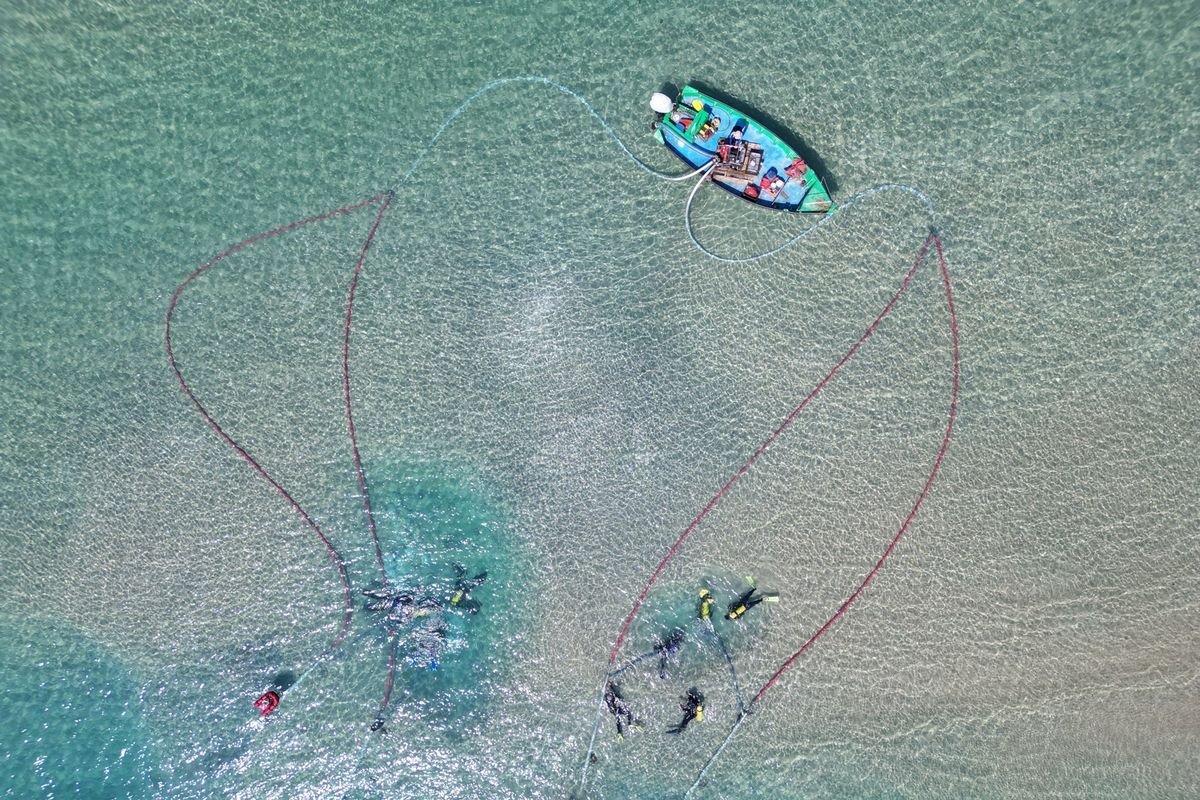
A study published earlier this year in Antiquity presented a trio of cargo clusters found in the Dor Lagoon on Israel’s Carmel Coast, signifying evidence of Iron Age commerce that was previously lost to time. The cargo — which contained items like storage jars and products of iron smelting — has shown researchers how trade had the power to link several ancient states.
Read More: Preserved Sunken Ship Found in Shipwreck Alley After 120 Years
Shipwrecks of the First Iron Age Cargoes

L2 material from Locus 23.006. a) Iron ingots [left scale 20 cm, right scale 10 cm]; b) base of basket handle amphora with resin [scale 10 cm]; c) handles of Basket handle amphorae [scale 10 cm]; d) Locus. 23.007 base of basket handle amphora with grape seeds [left scale 20 cm, top scale 5 cm]
(Image Courtesy Of Jonathan Gottlieb, Yoav Bornstein & Marko Runjajic)
The study describes the evidence as the first Iron Age ship cargoes to be found at Tel Dor, a coastal archaeological site in modern-day Israel that used to be a bustling port city. Dor got its start around 2000 B.C.E., during the Middle Bronze Age, and was eventually developed into a crucial seaport.
However, as civilizations were toppled by famines and invasions during the enigmatic Late Bronze Age collapse around 1200 B.C.E., trade reached a near-standstill.
But this wasn’t the end of Dor. Though the city faced destruction multiple times, it would later rebound in the Iron Age (1200 to 550 B.C.E.). As the years passed, Dor went through multiple phases marked by connections with multiple civilizations.
Each of the three ship cargoes excavated at Dor Lagoon, adjacent to the ancient port, carry key evidence on the stages of Dor’s history. Looking through them all, it becomes clear how the city evolved throughout the Iron Age.
Cargo on the Shipwreck
Chronologically, the first cargo in the set is Dor M, which dates to the 11th century B.C.E., according to a statement on the study. This collection was found to contain storage jars, along with an anchor inscribed with Cypro-Minoan writing; the Cypro-Minoan group of undeciphered scripts was used on the island of Cyprus and neighboring regions in the late Bronze Age and early Iron Age, possibly used for administrative, religious, and commercial purposes.
The researchers involved with the study also say that these items likely indicate Dor’s trading connections to Egypt and Cyprus. The findings in Dor M match with the Report of Wenamun, a literary work from around 1000 B.C.E. that describes maritime journeys to the Levant (including Dor).
The next cargo, Dor L1, contained Phoenician-style jars and thin-walled bowls that date from the late 9th to the early 8th century B.C.E. Unlike the older Dor M, this one didn’t have any items that would indicate trade with Egypt or Cyprus.
During this stage of the Iron Age, trade networks expanded across the Mediterranean and Phoenician cultural influence began to reach its peak. The Phoenicians, who inhabited city-states along the eastern coast of the Mediterranean, controlled Dor for a significant period of time.
The port eventually came under control of the Kingdom of Israel, at a time when imports to the city reached a low point. While Dor seemed to lose some of its influence during this time, the researchers say that the Phoenician-style jars confirm that maritime activity had still continued.
Metal Trade During the Iron Age
The last of the three cargoes, Dor L2, contained items from the late 7th or early 6th century B.C.E. Along with Cypriot-style basket-handle amphorae (a type of pot with a narrow neck and elongated body), Dor L2 had another distinct find that wasn’t present in the previous two collections: iron blooms. These are porous masses of metallic iron and slag that are produced by melting iron ore.
At this stage, maritime trade had blossomed while Dor was ruled by the Babylonian or Assyrian empires. The presence of iron blooms shows that metal trade had likely started to become commonplace.
These three cargoes from shipwrecks may only tell a fraction of Dor’s story. The researchers say that only 25 percent of the sandbar where the items were found has been excavated. A wealth of additional artifacts, including possible sections of a ship’s hull, may still be hidden there.
Read More: What Ancient Teeth In Cave Can Tell Us About The Bronze Age Collapse
Article Sources
Our writers at Discovermagazine.com use peer-reviewed studies and high-quality sources for our articles, and our editors review for scientific accuracy and editorial standards. Review the sources used below for this article: