
Ancient Shark-Like Whale Roamed Australia’s Surf Coast 26 Million Years Ago

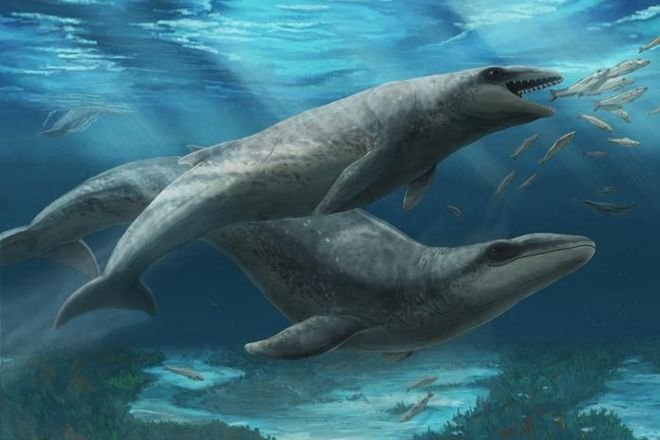
Picture the warm, shallow seas off ancient Australia some 26 million years ago. Among the schools of fish, a small but formidable predator lurks. Its huge eyes are scanning for movement, its mouth bristling with razor-sharp teeth.
This was Janjucetus dullardi, a compact hunter about the size of a dolphin, now known from a remarkably well-preserved fossil unearthed along Victoria’s Surf Coast.
Scientists at Museums Victoria’s Research Institute have officially described the new species in a study published in the Zoological Journal of the Linnean Society. The find offers rare insight into the early evolution of baleen whales, the filter-feeding giants that now glide peacefully through our oceans.
An Ancient Whale Fossil in the Sand
The story began in June 2019, when local resident Ross Dullard spotted a curious fragment on the beach near Jan Juc, a popular surf hotspot alongside Australia’s southeastern coast. The fossil turned out to be a partial skull with ear bones and teeth, an extraordinary discovery that Dullard handed to Museums Victoria for further investigation.
“This kind of public discovery and its reporting to the museum is vital,” said Erich Fitzgerald, senior curator of vertebrate paleontology at Museums Victoria Research Institute and senior author of the study, in a press statement. “Ross’ discovery has unlocked an entire chapter of whale evolution we’ve never seen before. It’s a reminder that world-changing fossils can be found in your own backyard.”
Read More: How an Ancient Fossil Found in Egypt May Explain Whale Evolution
A Baby Whale With a Bite
Despite belonging to the same lineage as modern baleen whales, Janjucetus dullardi was no gentle giant. Just 7 feet long, it was a juvenile member of an extinct group called mammalodontids, early whales that lived only during the Oligocene Epoch, between about 30 million years and 23 million years ago.
With a short snout, forward-facing eyes and sharp teeth, it was built for speed and precision hunting.
“It’s essentially a little whale with big eyes and a mouth full of sharp, slicing teeth,” said Ruairidh Duncan, Ph.D. student and lead author of the study, in the press release. “Imagine the shark-like version of a baleen whale – small and deceptively cute, but definitely not harmless.”
Additionally, analyzing the still-intact, delicate inner ear structures using micro-computer tomography helped scientists understand how J. dullardi hunted, communicated, and navigated their watery world.
Studying the Ancient Past
The fossil-rich Jan Juc Formation, where the fossil was uncovered, dates back to a period when Earth’s climate was warmer and sea levels were on the rise. Among mammalodontids this find is particularly rare: it’s the third species identified in Victoria, the fourth known globally, and the only one preserving both its teeth and the intricate structures of the inner ear.
Fitzgerald noted that the fossil offers an unprecedented glimpse into how ancient whales developed and adapted to marine life. He added that understanding how these animals thrived in warm oceans millions of years ago could shed light on how modern marine species might respond to today’s rapidly changing climate.
“This region was once a cradle for some of the most unusual whales in history, and we’re only just beginning to uncover their stories,” Fitzgerald said. “We’re entering a new phase of discovery. This region is rewriting the story of how whales came to rule the oceans, with some surprising plot twists!”
The species name, dullardi, honors the sharp-eyed local who found it. Museums Victoria’s CEO and Director Lynley Crosswell summarized in the press statement: “Discoveries like Janjucetus dullardi remind us that our collections are not just about the past – they’re shaping the future of science.”
Read More: These Ancient Whales Lived Like Modern Manatees 40 Million Years Ago
Article Sources
Our writers at Discovermagazine.com use peer-reviewed studies and high-quality sources for our articles, and our editors review for scientific accuracy and editorial standards. Review the sources used below for this article: