
Ancient Bees Found Nested Inside Fossilized Bone — A Behavior Never Seen Before
When paleontologists examined fossils from a cave on Hispaniola, they found more than the remains of extinct animals. The bones also preserved evidence of an unusual behavior — insects nesting inside fossils.
That behavior has left behind the first known evidence of bees nesting inside pre-existing fossil cavities, a new study in Proceedings of the Royal Society B reports. The discovery shows how environmental pressures shaped insect behavior — and how those adaptations were preserved alongside the fossils themselves.
Giant Barn Owls and the Making of a Fossil Archive
The fossils come from a limestone cave in the southern Dominican Republic known as Cueva de Mono. Evidence from the site suggests it served for many generations as a nesting and feeding ground for giant barn owls, which carried prey into the cave to feed their chicks.

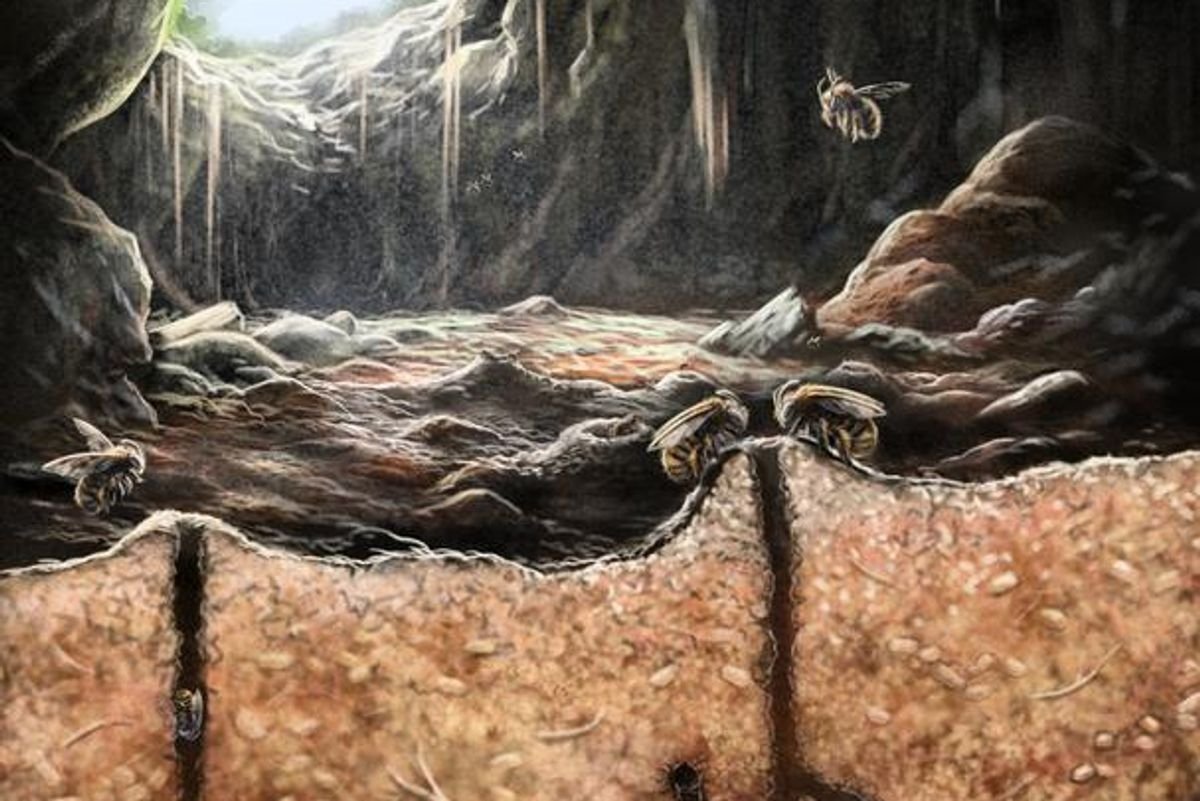
Illustration of ancient bees found in a cave on the Caribbean island of Hispaniola, nesting inside pre-existing fossil cavities.
(Image Credit: Jorge Machuky/CC BY)
Among the remains are thousands of bones from hutias — large Caribbean rodents that are otherwise scarce in the island’s fossil record. Outside the cave, hutia fossils appear only occasionally, often as isolated teeth or jaw fragments. Inside the cave, they are abundant.
By repeatedly hunting in the same areas and returning to the same roost, the owls gradually concentrated the remains of their prey inside the cave. Some animals were likely brought in whole, while others were eaten elsewhere and later regurgitated as compact pellets.
As bees later tunneled through fine, clay-rich sediment, some encountered fossilized remains. Instead of abandoning those sites, the insects appear to have used hollow spaces within the bones — including empty tooth sockets — as ready-made nesting chambers.
Read More: Bumblebees and Ants Battle in Violent Nectar Wars, Leading to Death and Food Shortage
How Burrowing Bees Turned Fossils into Nests
Burrowing bees typically dig narrow tunnels in exposed soil that lead to small underground chambers where eggs develop. Nesting inside caves is rare, and using pre-existing fossil cavities as nesting sites had never been documented.
Researchers identified smooth-lined cavities inside hutia jaws and vertebrae recovered from the cave, as well as within the pulp cavity of a sloth’s tooth. The interiors lacked the rough texture of bone and instead showed signs of deliberate lining.
Many burrowing bees coat the inside of their nests with a waxy secretion produced by specialized glands. The coating waterproofs the chamber and leaves behind a smooth inner surface, a feature that distinguishes bee nests from those made by wasps or other insects.
CT scans showed that some of the cavities had been reused multiple times. In one hutia jaw, a single tooth socket contained six stacked nesting chambers, each placed inside the previous one. This pattern suggests that bees returned to existing cavities rather than excavating new tunnels once earlier occupants had emerged.
There is no evidence that the insects drilled into or reshaped the fossils. Instead, they made use of hollow spaces that already existed and closely matched the size and geometry of their nests. What remains is not the bees themselves, but physical traces of their behavior — an ichnofossil preserved within the remains of much larger animals.
Why Environmental Pressure Changed Bee Nesting Behavior
Environmental constraints likely shaped the bees’ unusual nesting behavior. Much of Hispaniola is dominated by sharp limestone karst, which holds little of the fine, stable soil burrowing bees typically need to build nests.
Caves offered a rare alternative. Sediment accumulated in sheltered pockets, and fossilized bones and teeth provided protected cavities that closely matched the size and shape of the bees’ nesting chambers.
The evidence points to a sequence driven by availability rather than preference. Predators concentrated animal remains in the cave, sediment accumulated around them, and much later, insects exploited both the soil and the hollow spaces preserved within the fossils.
Read More: Leeches Didn’t Always Suck Blood — Ancient Fossils Reveal They Swallowed Prey Whole
Article Sources
Our writers at Discovermagazine.com use peer-reviewed studies and high-quality sources for our articles, and our editors review for scientific accuracy and editorial standards. Review the sources used below for this article: