
Ancient African Workshop Reveals Ironworking Tradition That Was Used for Nearly Eight Centuries

The Iron Age sparked a crucial evolution for civilizations in Europe, Asia, and Africa, revolutionizing agriculture and warfare. But while key Iron Age dates and developments across Eurasia are generally accepted by scholars, the situation is much more complex in prehistoric sub-Saharan Africa. The origins of ironworking practices on the continent, which remain largely unclear, continue to spur academic debate.
A new study published in the journal African Archaeological Review has added new evidence to the mix, unearthing a 2,400-year-old metalworking workshop in Senegal. Remnants of iron-smelting indicate that this site was used for nearly eight centuries, and since the workshop operated for so long, it could help to piece together how iron production developed in West Africa.
Read More: 5 of the Most Unique and Luxurious Bronze Age Artifacts
From Bronze to Iron
The Iron Age began in the wake of the Late Bronze Age Collapse around 1200 B.C.E., when preeminent civilizations were wrecked by invasions, drought, and political instability. Even before this transition, iron was used on occasion. One notable example is a gold-and-iron dagger found in the 14th-century B.C.E. tomb of the Egyptian pharaoh Tutankhamun. However, these pre-Iron Age artifacts were made from metallic iron found in meteorites, not from smelted iron.
It wasn’t until after the Late Bronze Age Collapse that iron-smelting techniques emerged in Near Eastern and Mediterranean societies and soon spread to Europe. Throughout sub-Saharan Africa, though, it’s not nearly as clear when and how ironworking took root.
Ironworking practices are believed to have spread from Europe to the ancient city of Meroë (in modern-day Sudan) via trade routes after 800 B.C.E. According to EBSCO, this led to Meroë becoming Africa’s first industrial city, a hub where iron smelting became integral to society.
However, iron production likely didn’t go down the same route across all of sub-Saharan Africa. It may have also arisen independently in the Nok culture of Nigeria around 750 and 550 B.C.E., based on evidence of furnace sites, according to a 2022 study in Vegetation History and Archaeobotany.
Crafting Iron Tools in West Africa
While there are no easy answers to the debates over Iron Age Africa, several archaeological sites dated to the first millennium B.C.E. have provided important clues. The workshop detailed in the new study, located at the site of Didé West 1 (DDW1) in eastern Senegal, has added to researchers’ understanding of iron production in prehistoric West Africa.
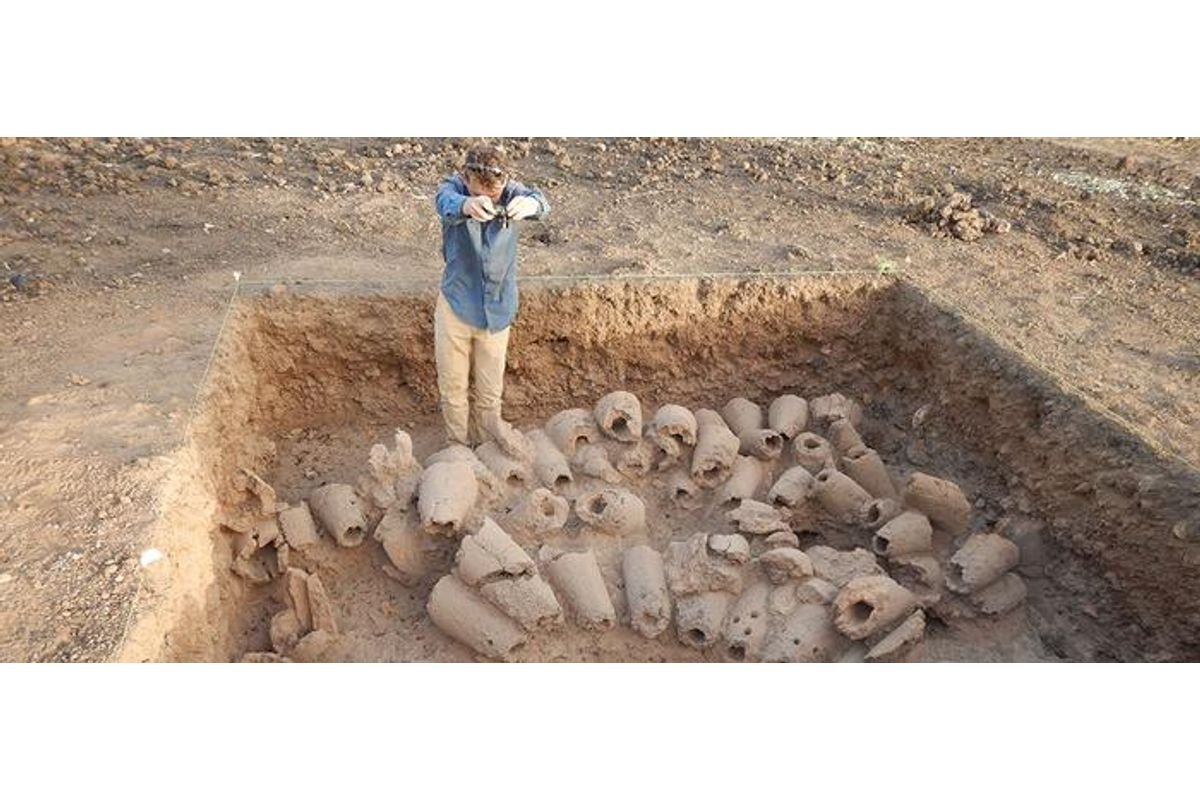
Evidence at DDW1, which was in use from the 4th century B.C.E. to the 4th century C.E., includes a large heap containing about a hundred tons of slag (a byproduct of iron smelting); thirty used “tuyères,” clay pipes that channel air into a furnace; and 35 circular furnace bases that each measure approximately a foot deep. The iron and steel produced here likely went toward local needs, like crafting agricultural tools.
“Thanks to its exceptional state of preservation, its age, the length of time it remained in use, and its distinctive technical features, this site is truly unique. It offers a rare opportunity to study the continuity and adaptation of an iron smelting technique over the long term,” said study lead author Mélissa Morel, a postdoctoral researcher at the University of Geneva, in a statement.
A Long-Lived Tradition
According to the researchers, the evidence at DDW1 corresponds to a unique ironworking tradition, known as FAL02, that didn’t change much over time. This classification is characterized by small circular furnaces with a removable chimney and by the tuyères, which have multiple small openings connected to a main channel via perpendicular side ducts, allowing air to be distributed to the bottom of the furnace.
FAL02 workshops also use palm nut seeds as packing material at the base of furnaces, a practice that hasn’t been documented before.
While DDW1 may offer insight into iron smelting in Africa, the research team plans to examine other sites in Senegal to see how techniques emerged and potentially spread throughout the region.
Read More: 6 Iconic Ancient Artifacts That Changed History Around the World
Article Sources
Our writers at Discovermagazine.com use peer-reviewed studies and high-quality sources for our articles, and our editors review for scientific accuracy and editorial standards. Review the sources used below for this article: