
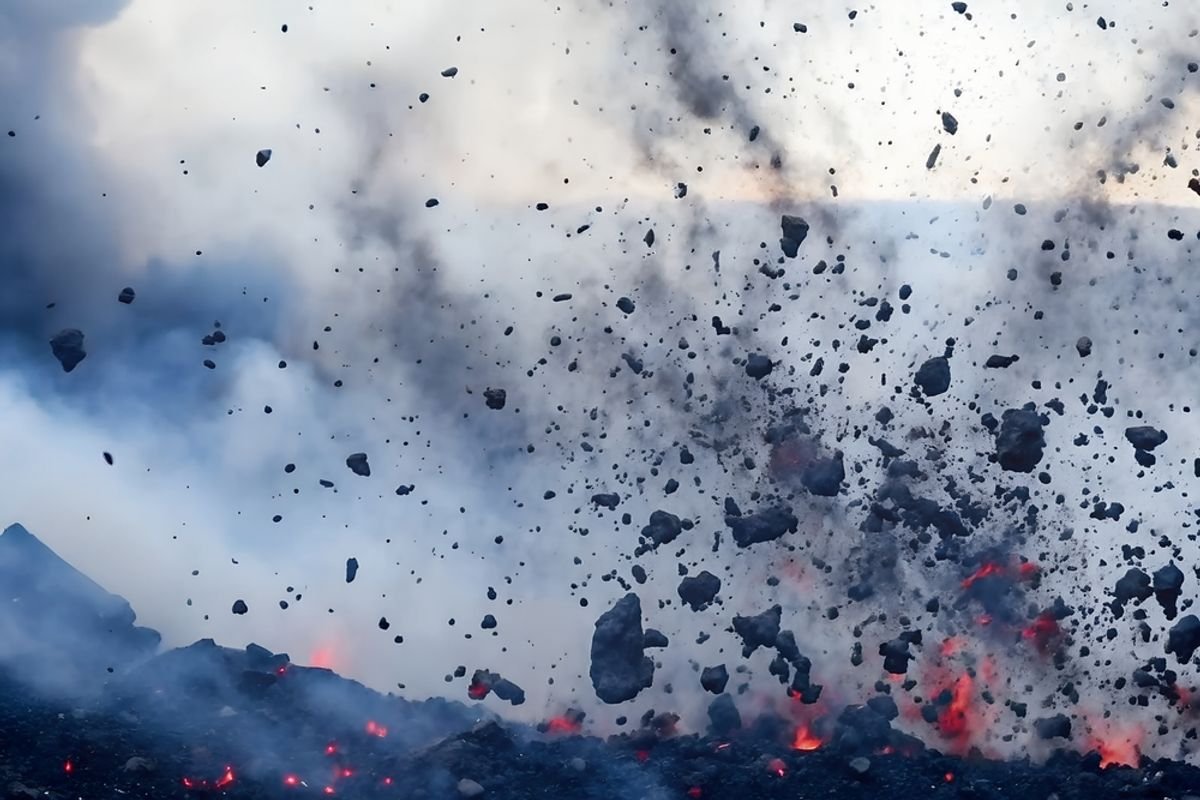
An Ethiopian Volcano Has Erupted with an Explosion of Ash, Awakening After 12,000 Years of Quiet

After nearly 12,000 years in dormancy, a volcano in Ethiopia has erupted and hurled ash over unsuspecting communities. It’s assumed that Hayli Gubbi, located in the Afar region of northeastern Ethiopia, hasn’t erupted at all during the Holocene — the ongoing geological epoch that started 11,700 years ago.
The volcanic eruption happened around 8:30 a.m. local time on Sunday, November 23, 2025, and explosive activity continued for several hours before coming to an end. While no casualties have been reported by local authorities, there is concern over the ash that has covered villages and started to drift toward the Arabian Peninsula.
Read More: One of Alaska’s Most Famous Volcanoes May Be Waking Up
Volcano Raised From Dormancy
Hayli Gubbi is the southernmost volcano of the Erta Ale range, a chain of mostly shield volcanoes that lies above the East African Rift.
Erta Ale itself is the most active volcano in Ethiopia, erupting continuously since at least 1967, according to Oregon State University. Despite its unique features, including a lava lake in its summit crater, much is still unknown about Erta Ale. This is mostly because of how inhospitable the surrounding area is, with scorching temperatures that regularly exceed 100 degrees Fahrenheit and low average rainfall.
Hayli Gubbi, on the other hand, hadn’t experienced any eruptions in recorded history until now. However, just like with Erta Ale, information on the history of Hayli Gubbi is limited due to its remoteness and harsh conditions.
Hayli Gubbi’s recent eruption is reported to have sent an ash plume some 45,000 feet into the air. The Toulouse Volcanic Ash Advisory Center was the first to catch the event and warned that air travel might be impacted by ash clouds drifting over Yemen, Oman, Pakistan, and India. Observations of the eruption have also shown that a cloud of sulfur dioxide was released by the volcano, according to Volcano Discovery.
The Volcanic History of Eastern Africa
Hayli Gubbi sits in a region where volcanic activity has been occurring since ancient times. The volcano is a product of the East African Rift (EAR), an approximately 4,000-mile-long system that initially formed during the Miocene epoch, approximately 25 million years ago, according to the Geological Society.
The EAR likely formed as heat flow caused the Earth’s crust to stretch and fracture. This created a “horst and graben” topography, defined by alternating raised (horst) and lowered (graben) blocks of crust. The result is a landscape with deep valleys and highlands throughout Ethiopia and Kenya.
The EAR is a divergent plate boundary, where tectonic plates are currently moving apart. Underneath the surface of Eastern Africa, three plates are pulling away from each other: the Arabian plate and two parts of the African plate, the Nubian and Somali plates. In Ethiopia’s Afar region, where Hayli Gubbi and other volcanoes lie, the three plates intersect at what’s known as a “triple junction.”
Volcanism is frequent along the EAR, where colossal mountains rise from the Earth. The highest peaks in Africa exist here, including Mount Kilimanjaro in Tanzania and Mount Kenya. Mount Kilimanjaro, which last erupted around 360,000 years ago, is considered a dormant volcano. Mount Kenya is an extinct volcano, having last erupted over 2 million years ago, and will never erupt again.
Tectonic Consequences
Volcanic eruptions may start to become a more common sight for Ethiopians in the future, considering the tectonic activity taking place in Eastern Africa. Ethiopia is thought to contain around 50 volcanoes that have been active during the Holocene. The only countries with more Holocene volcanoes are the U.S. (165), Japan (118), Russia (107), Indonesia (101), and Chile (90), according to the Smithsonian Institution National Museum of Natural History Global Volcanism Program.
According to the British Geological Survey, over 46 percent of Ethiopia’s population lives within 100 km (62 miles) of a Holocene volcano and are exposed to volcanic hazards. Ethiopia also experiences earthquakes frequently because of tectonic activity; from late 2024 through early 2025, several earthquake swarms — a series of small earthquakes in a local area — hit near the Fentale and Dofan volcanoes in Ethiopia’s Awash National Park.
For now, the aftermath of Hayli Gubbi’s recent eruption is still being reviewed — especially its effects on livestock and local herders reeling from the ash that has fallen from the sky.
Read More: AI Reveals What Was Behind Those Santorini Earthquakes in Early 2025
Article Sources
Our writers at Discovermagazine.com use peer-reviewed studies and high-quality sources for our articles, and our editors review for scientific accuracy and editorial standards. Review the sources used below for this article: