
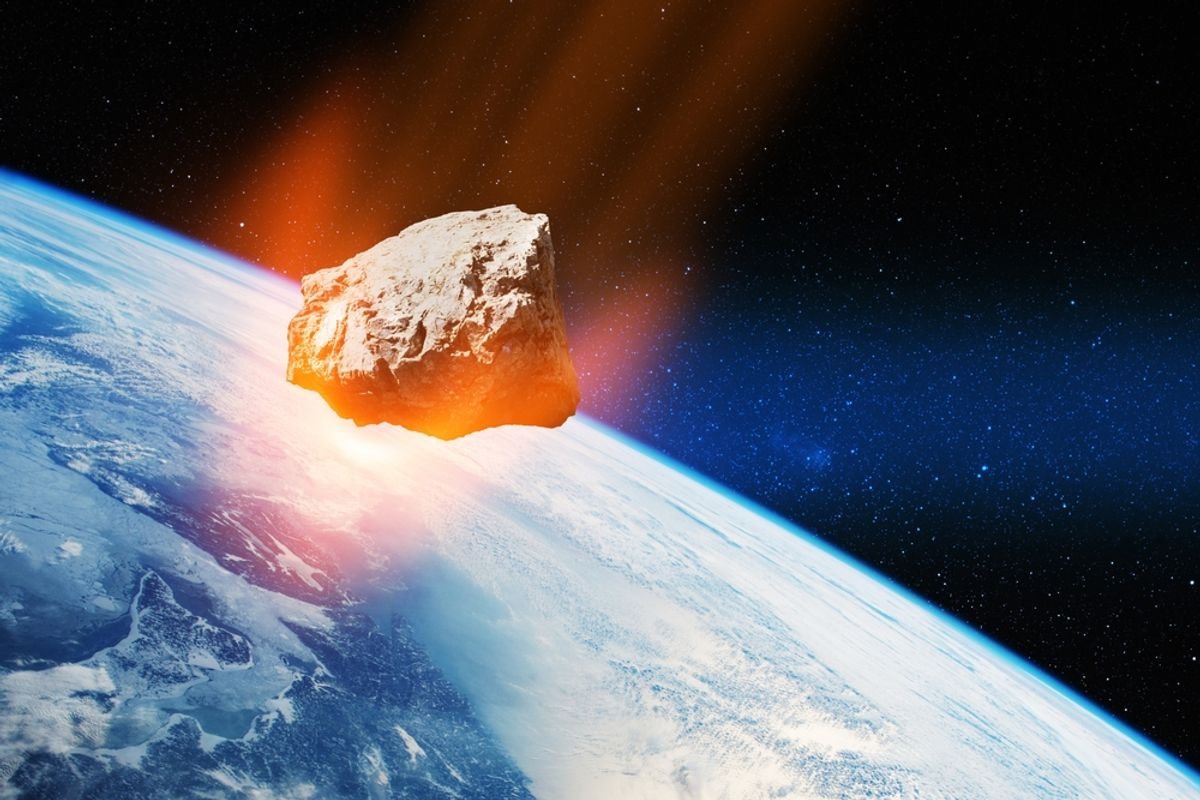
An Asteroid Just Streaked Over Antarctica, Becoming the Second Closest Flyby Ever Recorded

One week ago, an asteroid flew so close to Earth that it nearly broke the record for the closest asteroid approach ever.
This space surprise came to astronomers’ attention on Wednesday, October 1, 2025, when the Catalina Sky Survey in Arizona spotted an asteroid named 2025 TF a few hours after it had passed Earth. Flying over Antarctica, the asteroid came a mere 428 kilometers (266 miles) from Earth’s surface. For reference, the International Space Station orbits our planet at a similar altitude, approximately 370 km to 460 km (254 miles).
Asteroid 2025 TF may have only amounted to a near miss, but keeping tabs on near-Earth objects like this — even if most miss Earth — is a never-ending responsibility for astronomers.
Read More: Asteroid Mining Gives Companies Hope in the Search for Rare Metals
Asteroid 2025 TF Flyby
While it may sound like we’ve narrowly avoided a fate seen in many disaster blockbusters, 2025 TF never posed any danger to Earth. The asteroid is 1 meter to 3 meters (3.3 feet to 9.8 feet) wide, meaning that at most, it would’ve produced a fireball in the sky had it approached any closer to Earth.
Asteroids that are smaller than 25 meters (82 feet) usually burn up if they enter the Earth’s atmosphere. There’s always a chance, though, that these asteroids could fragment and scatter meteorites on the surface.
One example of this scenario occurred in February 2023, when a small asteroid named 2023 CX1 (at just under a meter, or 3 feet, in diameter) disintegrated over the coast of Normandy, France. Astronomers were quick to notice the asteroid, discovering it 7 hours before it entered the Earth’s atmosphere. It became the seventh asteroid to ever be successfully detected before impact with the planet.
As it went up in flames in the atmosphere, the asteroid produced a bright double flare. It then fractured violently, releasing 98 percent of its kinetic energy in the blink of an eye and sending more than a hundred meteorite fragments across Normandy.
As intense as this sounds, most smaller asteroids don’t cause much damage if they enter the Earth’s atmosphere. Even if 2025 TF had come any closer to Earth, it wouldn’t have been disastrous for us.
The Top Two Closest Asteroid Approaches
2025 TF passed by Earth at an altitude much lower than many satellites — low Earth orbit (LEO) satellites, for example, are located anywhere from 160 km to 2000 km above the surface. As a result, it has become the second closest asteroid approach without impact ever observed. The only other asteroid to be recorded at a closer distance is 2020 VT4, which passed 370 km (230 miles) above Earth’s surface in November 2020.
2020 VT4 is somewhat larger than 2025 TF at around 5 meters to 10 meters (16 feet to 32 feet) in diameter. Still, even at this size, 2020 VT4 would’ve likely disintegrated had it entered Earth’s atmosphere.
Keeping an Eye on Asteroids
2025 TF wasn’t the only asteroid to make a close approach to Earth in the first week of October. On Thursday, October 2, astronomers at the Mount Lemmon Observatory in Arizona observed another asteroid, 2025 TQ2, passing over Canada at an altitude of 4,851 km (3,014 miles).
Astronomers keep track of a multitude of asteroids and other near-Earth objects (NEOs) every month, as close approaches are relatively common. Unlike 2025 TF, some other asteroids that approach Earth are much larger, although they haven’t come nearly as close. In July 2025, an airplane-sized asteroid (2025 OW) passed 393,000 miles from Earth, and in September 2025, a skyscraper-sized asteroid (2025 FA22) passed 520,000 miles from Earth. Neither of them, luckily, was deemed to be dangerous.
As for 2025 TF, it won’t revisit the outskirts of Earth until its next close approach in April 2087, according to NASA’s Jet Propulsion Laboratory.
Read More: Airplane-Sized Asteroid Will Fly Past Earth Next Week, Sparing Us From an Impact
Article Sources
Our writers at Discovermagazine.com use peer-reviewed studies and high-quality sources for our articles, and our editors review for scientific accuracy and editorial standards. Review the sources used below for this article: