
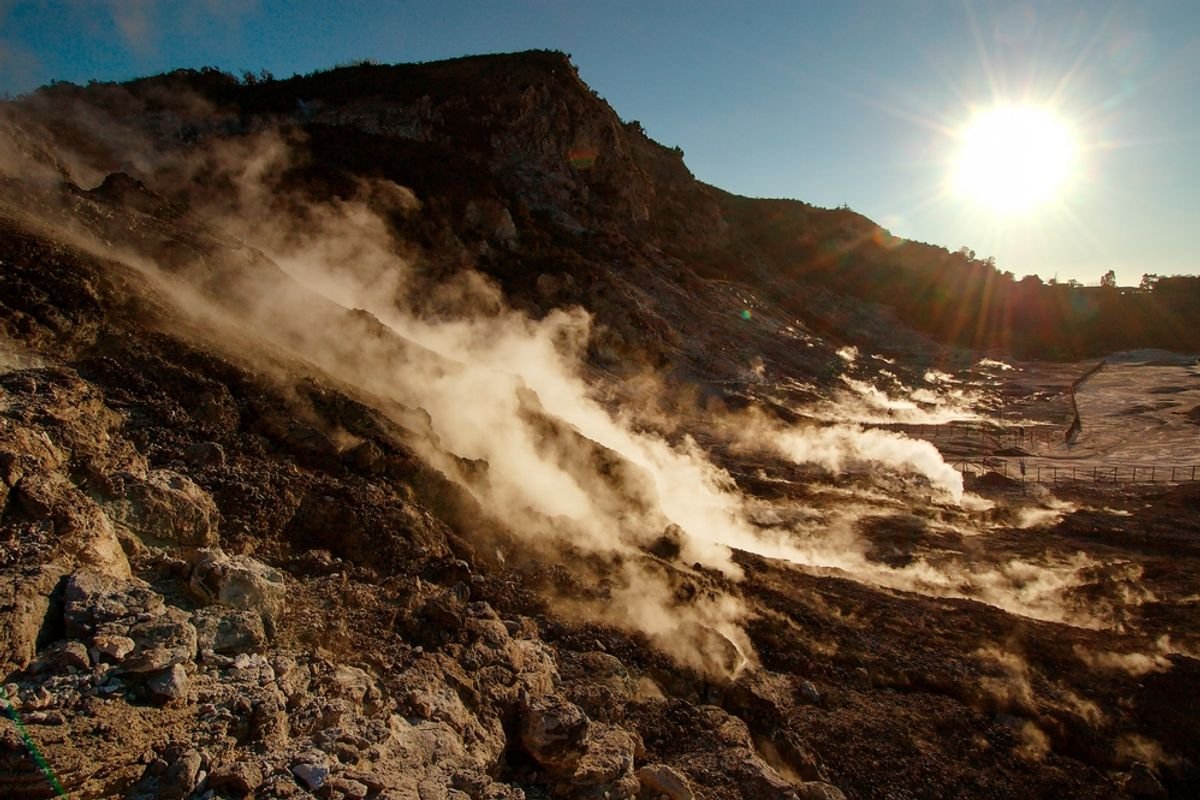
AI Identifies Four Times More Quakes at Italy’s Campi Flegrei Than Traditional Methods

Researchers are using artificial intelligence (AI) to expose hidden earthquakes and unknown fault lines in Italy’s Campi Flegrei – identifying four times as many earthquakes as traditional models.
“There’s some stuff to iron out but the gain of information is so tremendous that there’s really no going back,” said co-author Greg Beroza, a geophysics professor in the Stanford Doerr School of Sustainability.
Campi Flegrei Eruption
On September 29, 1538, the vents of Campi Flegrei opened, releasing a torrent of ash, pumice and volcanic gasses that engulfed the surrounding areas, including the ancient Roman town of Tripergole. This was the start of a week-long eruption, so powerful that it resulted in the formation of an entirely new volcano – Monte Nuovo.
The event did not appear out of the blue. There had been warning signs: strings of small to moderate sized quakes occurring in rapid succession (also known as seismic swarms), a retreating shoreline (caused by volcanic uplift) and unusual activity emanating from the volcano’s vents (called fumaroles). There were even reports from residents of the nearby settlement Pozzuoli of new land rising from the sea a whole two decades prior to the eruption.
Five hundred or so years after the eruption, experts’ ability to monitor seismic activity has increased drastically. So has the local population. Over half a million people reside inside the caldera itself. Meanwhile, the city of Naples, home to one million individuals, is just a half hour drive away. In short, an eruption of the scale of 1538 would be devastating.
This is particularly concerning because after centuries of inactivity, the volcano is showing signs of unrest. There have been four bursts of increased activity since the 1950s. The most recent – still ongoing – started in 2005. Over the last few years, activity has intensified even further: thousands of earthquakes have been recorded every month since August 2023. Five have been a magnitude four or greater.
Now, scientists writing in the journal Science have employed AI to improve the sensitivity of seismic monitoring systems. The machine learning model aims to provide near real time information on earthquake location and magnitude.
Read More: What Can We Learn from Campi Flegrei’s Explosive Past?
Monitoring an Eruption with AI
The model was trained on a large database of earthquake and waveform data collected by analysts before they applied it to data recorded between January 2022 and March 2025.
Unlike traditional tools, AI picked up incredibly subtle signals, which indicated tiny earthquakes of magnitudes one and smaller. Where the seismological laboratory of the Institute of Geophysics and Volcanology (INGV) in Italy had manually located 12,083 earthquakes between 2022 and 2025, the model detected 54,319.
The model also identified two previously unknown faults meeting under Pozzuoli.
“The length of the faults is thought to limit the maximum size of earthquakes on them,” said Beroza. “So for assessing the hazard, that’s really critical information.”
Taken as a whole, the AI model has provided volcanologists monitoring Campi Flegrei with a much richer understanding of the fault system in which it operates – meaning if there is any change in seismic activity, it is more likely to be caught early, said Beroza. In terms of the possibility of an imminent eruption, there’s no sign of magma moving towards the surface, suggesting it’s less likely in the short term.
Other Seismic Activity
As with all new technology, there are elements to smooth over. Researchers cannot rule out the possibility that some quakes are false positives, for example. Beroza sees it working in tandem with more traditional methods: “If you see something that looks anomalous then that’s when the human experts come in and they look through the data to confirm what they’re seeing is in fact a real geophysical phenomenon.”
The AI model remains operational in Campi Flegrei and could be applied to other areas of high seismic activity, such as Santorini, Greece, to enhance monitoring systems there.
“There will be a lot of progress in getting a clearer view of what’s underneath us, much in the same way as with the Webb Space Telescope we can get a clearer view of star systems,” said Beroza. “It is an exciting time in seismology.”
Read More: Campi Flegrei Had a Massive Eruption 40,000 Years Ago – Could a Supermassive Volcano Happen Soon?
Article Sources
Our writers at Discovermagazine.com use peer-reviewed studies and high-quality sources for our articles, and our editors review for scientific accuracy and editorial standards. Review the sources used below for this article: