
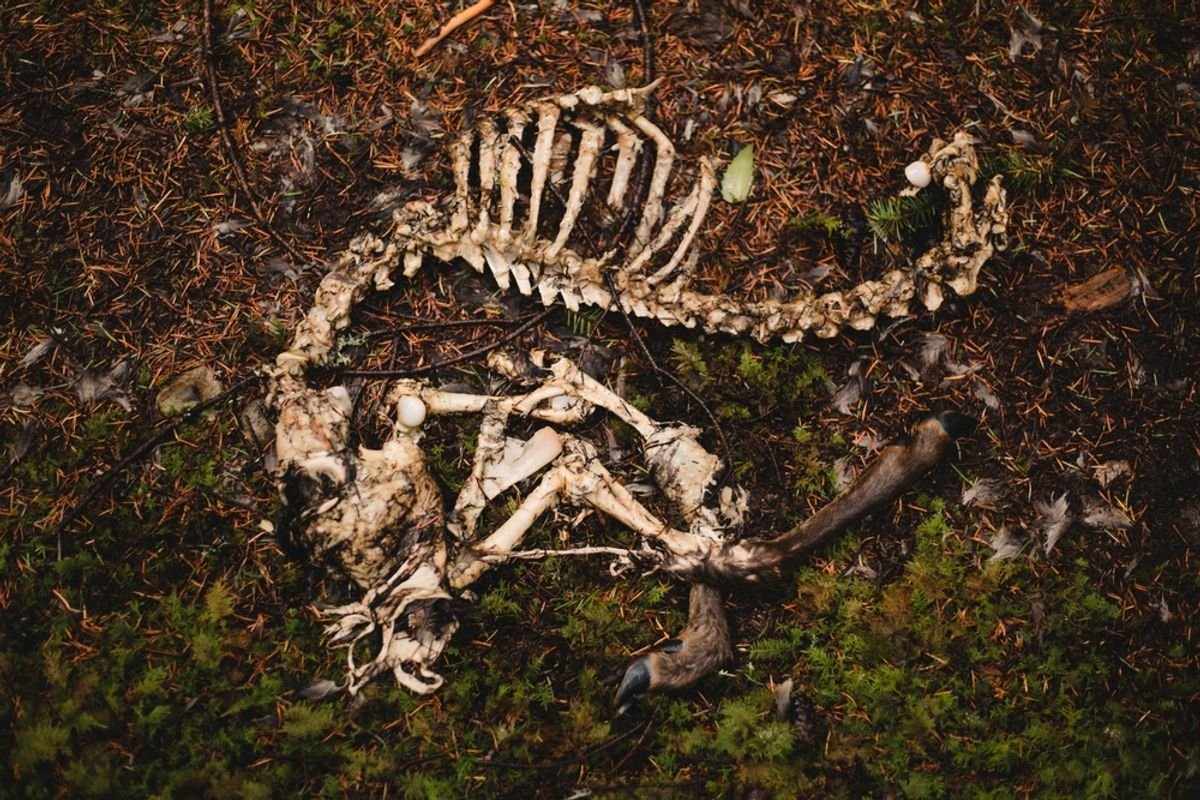
After Death, the Necrobiome Helps Drive the Circle of Life

Eric Benbow and some colleagues were having a few beers when Benbow came up with a new term for what they studied: the necrobiome. Though it sounds rather Lovecraftian, the necrobiome simply refers to all the organisms associated with a decomposing organism.
That includes everything from microbes to insects, nematodes, and vertebrate scavengers, both avian and terrestrial, explains Benbow, an ecologist at Michigan State University who studies the necrobiome.
What is the Necrobiome
When an animal dies — and that includes you, dear reader — members of the necrobiome, both inside and outside, start to decompose the body. The first ones to start munching are the microbes that live inside you, especially in your gut. While you’re alive, these microbes are kept in check by your immune system. But once you’re dead, the immune system no longer functions.
That’s when, “they turn on us and start digesting us from the inside,” says Jennifer DeBruyn, an environmental microbiologist at the University of Tennessee who studies decomposition and biodegradation.
Our cells are no longer getting oxygen (because we’re no longer breathing), so they die and release macromolecules such as carbohydrates, proteins, and lipids. Microbes use these macromolecules as food and energy sources, she explains.
Because there’s no oxygen in the body’s internal cavity, this process is a type of anaerobic fermentation. And that produces a lot of gases, often causing dead bodies to bloat. That’s why they have that uniquely awful smell. When you’re hiking in the woods and smell a dead animal, you’re basically smelling microbe farts.
Soon, though, the internal microbes are joined by decomposers from the outside. These are mostly bacteria and fungi.
“A dead body is a fantastic resource for them because it’s full of nutrients and moisture,” says DeBruyn. Eventually, insects and vertebrate scavengers, such as vultures, foxes, and raccoons, join the feast.
The necrobiome decomposes plants, too. That’s what’s going on in your compost pile or in the leaf litter in the woods.
Read More: Worms Can Smell Death, and It Strangely Alters Their Fertility and Fitness
Hanging Out in the Goop
One of the interesting research questions for DeBruyn is what happens to those internal microbes after they’ve finished digesting what was once their home. Her initial hypothesis was that gut microbes don’t last very long in the outside world. On the inside, they had very favorable conditions. The temperature was always 37 degrees Celsius (98.6 degrees Ferenheight), there was a steady supply of nutrients, and no oxygen.
“So they had this pretty cushy life,” she says. “My hypothesis was that once they got out into the soil environment, it’s like the Wild West. There are huge swings in temperature, moisture, pH that they don’t normally see.”
But when she started investigating, she was surprised. In one study, she and her team tracked the DNA of a human gut microbe in the soil as a body was decomposing. This particular bacterium needed an oxygen-free environment to live. However, they found that it lasted for many months in the soil. She suspects the microbe survived by staying inside the pools of fats and grease made by the body as it decomposes.
This “gooey mess,” as DeBruyn puts it, would cause the soil to become anoxic in that area. In a later experiment, she showed that the gut microbes are not dormant in that gooey mess; they are still active and involved in decomposition.
Microbes Can Assist Detectives
Not only does the necrobiome recycle, it also provides a lot of information. Experts can get a good idea of how long a body has been dead by examining the insects that colonize it, particularly their number, type, and the stage of their life cycle. This information has been used in courts worldwide, Benbow says.
The succession of bacteria and fungi on a dead body is also informative. Benbow and colleagues have shown that analyzing a swab from a dead organism can show how long the organism has been dead. This method has yet to be used in court, however. Getting to that point would require more studies, including studies on humans, to develop robust models for the method. That may take time, because there aren’t many people doing this kind of research, says Benbow.
The necrobiome can also tell you if a body has been moved after death. Bacteria might be helpful in this regard. The soil at the site of a killing might reflect microbial activity associated with human decomposition, even if the body has been moved to another location, explains Benbow.
Circle of Life
Whether it’s an animal dying of natural causes or an unfortunate murder victim, the necrobiome changes the local environment. The composition of the soil changes, much like when dead plant matter turns into humus.
Vertebrate scavengers play a role here, too. Birds, for example, will often defecate on and around a dead body. If they’ve recently eaten seeds from another area, they’re essentially planting those seeds. If the soil acidity and nutrients are right, the plants might become established. Entire plant communities can change because the carcass has attracted a scavenger that brings these seeds, says Benbow.
Though we tend to see death as a tragic event, for nature, it’s just part of the cycle of life and death. And without the necrobiome to keep the cycle going, we would be “covered in dead stuff,” says DeBruyn. “Decomposers are so essential and so underappreciated.”
Read More: Why Don’t We See More Dead Animal Remains While Strolling in the Woods?
Article Sources
Our writers at Discovermagazine.com use peer-reviewed studies and high-quality sources for our articles, and our editors review for scientific accuracy and editorial standards. Review the sources used below for this article: