
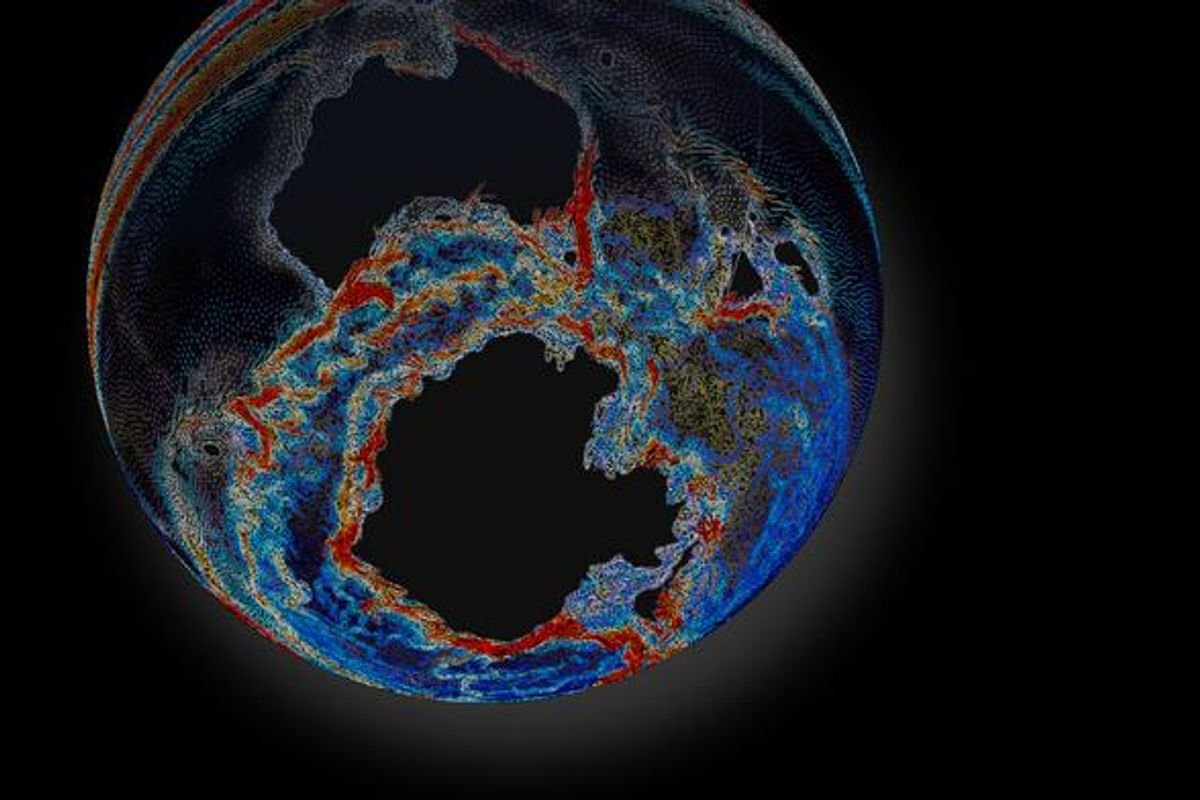
About 34 Million Years Ago, Earth’s Most Powerful Ocean Current Emerged and Reshaped the Climate

One of the world’s currents carries more than 100 times the water of all the world’s rivers combined and flows without ever hitting land.
The Antarctic Circumpolar Current circles Antarctica, shaping global climate as it moves uninterrupted around the southern continent. Researchers have been working to understand how this current first formed and what role it played in turning Earth into a colder, ice-covered world.
Now, in a new study published in Proceedings of the National Academy of Sciences, a team has reconstructed how the current developed. Their findings show it did not simply appear once ocean gateways opened. Instead, it took a combination of shifting continents, strengthening winds, and evolving ice sheets before the current took shape and began influencing the climate system we see today.
“In order to predict the possible future climate, it is necessary to look into the past with simulations and data to understand our Earth in warmer and more CO2-rich climate states than today,” said Hanna Knahl, lead author of the study, in a press release.
How the Antarctic Circumpolar Current Formed
During the transition into the Oligocene, a period that began about 34 million years ago, Earth underwent a major climate shift. The planet moved from a warm “greenhouse” state, with little to no permanent ice, to an “icehouse” climate, where large ice sheets began to build at the poles.
At the same time, the continents were moving. Australia and South America were drifting away from Antarctica, opening ocean pathways that would eventually allow water to flow all the way around the continent. Researchers have linked these openings to the formation of the Antarctic Circumpolar Current. The timing, however, did not quite line up.
Even after those ocean gateways opened, evidence pointed to the current not being fully developed yet. That raised the question of what else was needed to get it moving.
Read More: Sea Turtle Shells Hold a Hidden Timeline of Ocean Change — and Reveal How the Seas Are Shifting
Winds, Water, and a Missing Piece
To figure it out, the research team ran detailed climate simulations using a reconstruction of Earth as it looked 33.5 million years ago, during this early stage of the transition. They combined models of the ocean, atmosphere, land, and early Antarctic ice sheets, then compared the results with geological data.
What they found points to a missing ingredient: wind.
Only after Australia had moved farther north, creating a wider gap known as the Tasman Gateway, could strong westerly winds push water all the way around Antarctica. Without those winds lining up with the opening, the current remained incomplete.
“There were already indications that the wind in the Tasman Gateway played an important role in the formation of the ACC. Our simulations can clearly confirm this,” Knahl explained.
The models also showed that instead of one continuous, powerful flow, the early Southern Ocean may have been split into two very different regions. While the Atlantic and Indian sectors showed strong currents, the Pacific side remained relatively calm.
Why This Ancient Current Still Matters
The formation of the Antarctic Circumpolar Current did not just rearrange ocean circulation. It helped reshape the planet’s climate.
By isolating Antarctica and strengthening ocean circulation, the current likely increased the ocean’s ability to absorb carbon dioxide from the atmosphere. That drop in greenhouse gases may have helped push Earth into the long-lasting cool period known as the Cenozoic Ice Age.
Today, that system is still in place, influencing everything from ocean temperatures to global weather patterns.
By combining high-resolution climate models with geological evidence, the study offers one of the clearest pictures yet of how the current evolved and why it matters. It also highlights how different Earth’s climate system once was, even under conditions that may resemble those we are heading toward.
Read More: A Hidden Rock Layer Beneath Bermuda Explains a Mysterious Swell in the Ocean’s Crust
Article Sources
Our writers at Discovermagazine.com use peer-reviewed studies and high-quality sources for our articles, and our editors review for scientific accuracy and editorial standards. Review the sources used below for this article: