
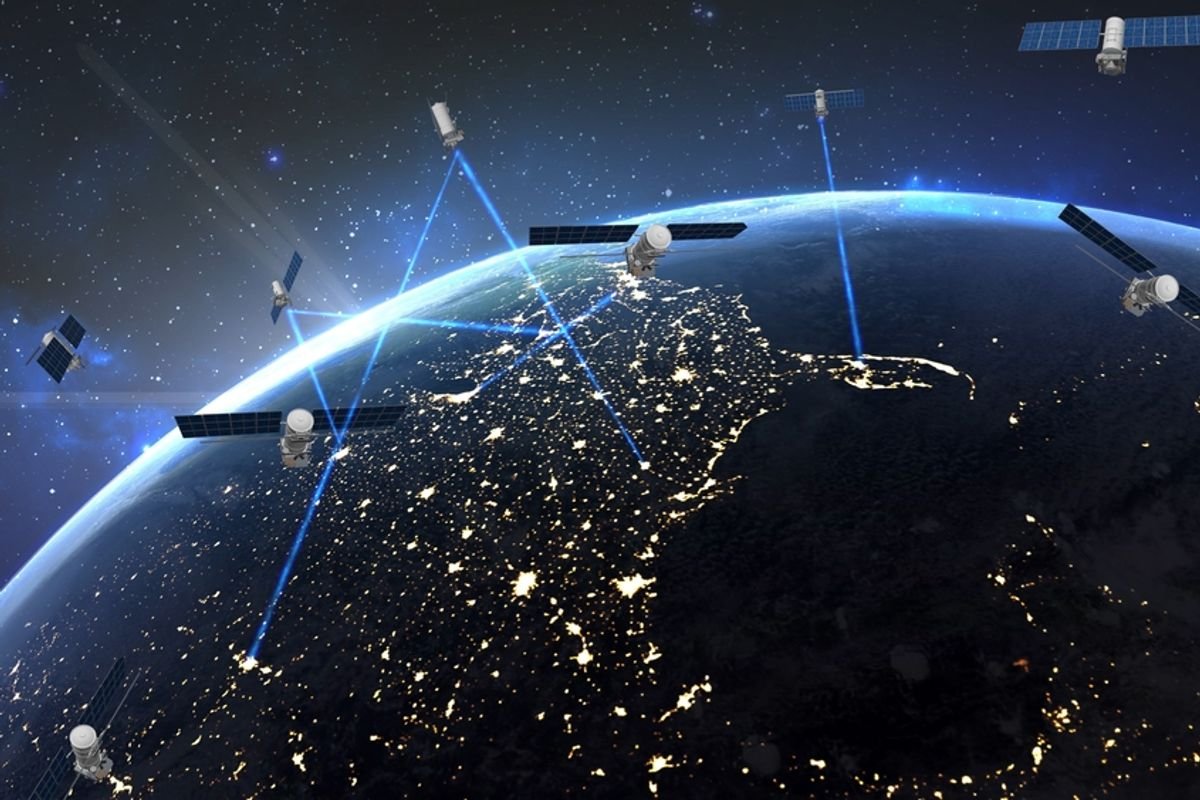
About 15,000 Satellites Are Circling Earth — And They’re Disrupting the Sky

Key Takeaways on How Many Satellites Circle Earth
- There are about 15,000 artificial satellites currently circling Earth, with most residing in Low Earth Orbit (LEO).
- The satellites circling Earth are changing the skies in various ways. They reflect sunlight, which can disrupt astronomers; they create pollution during launch and reentry, and they can cause dangerous debris to fall back to Earth.
- Satellites are essential to modern life, so researchers are developing methods to reduce their number and enhance their safety and efficiency.
If you’re lucky enough to find a place away from light pollution, you’ll see a night sky ablaze with starlight. Well, starlight and light from satellites. Mostly stars, yes. According to European Space Agency (ESA) tracking by early 2025, approximately 15,000 artificial satellites orbit Earth — active and inactive combined — and counting. Most of them are in Low Earth Orbit (LEO), a region defined by NASA as an altitude of 2,000 km (1,200 miles) or less above Earth’s surface.
Satellites are essential to modern life. They help meteorologists predict the weather and track hurricanes. Satellite telescopes help astronomers study outer space. GPS — a satellite-based navigation system — helps airplanes, ships, spacecraft, and travelers navigate. And, of course, satellites are essential for modern telecommunications. We rely on them.
However, all those satellites roaming the skies pose a few potential problems — even potential disasters, explains Aaron Boley, astronomer at the University of British Columbia. While acknowledging the importance of satellites for communication, scientific research, and Earth imaging, Boley, who is also the director of the Outer Space Institute, a global network of experts that addresses the challenges facing the use and exploration of space, points out that the problem is “the kind and the number of satellites, how different groups are competing in an area that is ultimately a finite resource.”
Satellites Create Pollution
Some of the problems start when satellites are launched. Most satellites are placed in orbit by rockets, and those rockets produce black carbon, which absorbs solar radiation. Although newer fuels produce less black carbon, the dramatic increase in the number of satellites offsets this advantage.
A 2022 study published in Journal of Geophysical Research: Atmospheres found that emissions from rocket launches warm the stratosphere — the layer of Earth’s atmosphere just above the troposphere (where we live). This additional heating can cause potentially hazardous changes in the dynamics of the upper atmosphere and contribute to damage to the ozone layer.
How Are Satellites Changing the Sky?
Satellites don’t last forever — in fact, the average lifespan of a satellite in LEO is about five to eight years, according to NASA. When satellites burn up during re-entry, they can create additional problems. A 2023 study in PNAS found that about 10 percent of sampled aerosol particles in the stratosphere contained aluminum and other metals traced to satellites or parts of rockets that burned up during re-entry. These metals, the study found, can cause changes in the aerosol layer of the stratosphere.
“So you pollute it on the way up, and you pollute it on the way down,” as Boley puts it.
The parts that don’t burn up and make it all the way to Earth pose a different sort of danger. In 2024, debris from a SpaceX Dragon spacecraft was found on a hiking trail near Asheville, North Carolina, according to a report from the New York Times. The same year, a chunk of a NASA spacecraft crashed into the roof of a house in Naples, Florida, making a hole that went all the way through the subfloor, according to a legal claim. Luckily, no one was harmed in either incident.
“While any person’s individual risk of being hit by space debris is very small, the collective risk around the planet of somebody getting hit is not small anymore,” Boley notes. “It’s in the neighborhood of two to four percent per year and growing.”
Satellites can wreak havoc with science as well, explains Boley. They reflect sunlight — a problem for astronomers.
“When the sky becomes blanketed in satellites, that becomes a distraction and a [light] pollution problem,” he says. “That’s why astronomers are really trying to draw attention to this so that we don’t get to the point where the sky is excessively polluted by satellite brightness.”
Making Satellites Safer and More Efficient
Addressing these problems is not as easy as it might sound, says Boley. “Understanding how to operate in a commons is an old question that [humanity] has been dealing with in many different circumstances,” he says. “Sometimes we get it horribly wrong, and sometimes we do get it right.”
Right now, with this issue at least, we seem to be somewhere between getting it horribly wrong and getting it right. “We’re taking action,” Boley says, “but there’s a lot of room for improvement.”
He points out that large-scale collective action against climate change has largely failed, but locally there have been many successes. He is cautiously optimistic.
We’ve had global success in the past, even during times of geopolitical stress, including the Cold War. In 1987, the Montreal Protocol, an international treaty that phased out ozone-depleting chemicals, was adopted.
Calling the agreement “a model of cooperation” and “a monumental achievement,” President Ronald Reagan said in 1988, “The protocol is the result of an extraordinary process of scientific study, negotiations among representatives of the business and environmental communities, and international diplomacy.”
Similar approaches involving multiple stakeholders might work for regulating satellites, and recent work regulating fisheries might provide a model, Boley says. Satellite companies could agree to quotas on the number of satellites launched or on the amount of light pollution produced.
Those quotas could be tradable with some sort of cap-and-trade arrangement. Of course, Boley points out, for this to work, there would have to be appropriate guardrails, but paired with, say, deposits paid on launches that are repaid only upon successful, controlled re-entries, they just might work.
“Those are all options that we’re exploring at the moment,” he says.
Read More: A Growing Weak Spot in Earth’s Magnetic Field May Cause More Satellites to Short Circuit
Article Sources
Our writers at Discovermagazine.com use peer-reviewed studies and high-quality sources for our articles, and our editors review for scientific accuracy and editorial standards. Review the sources used below for this article: