
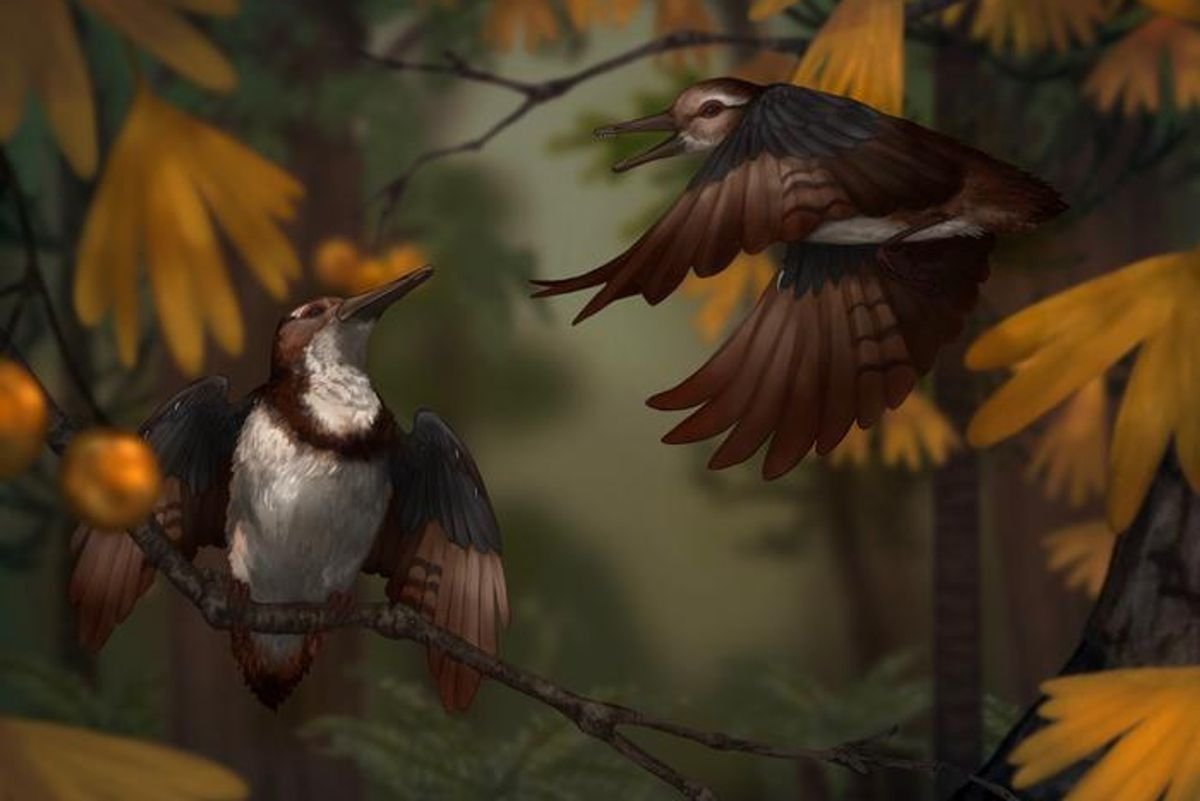
A Tiny Dinosaur Swallowed Too Many Stones, Died — and Left Behind a 120-Million-Year Mystery
In the early Cretaceous, a palm-sized bird made a fatal mistake. Its fossil shows a tight mass of tiny stones jammed in its throat — a snapshot of a creature caught in its final moments. The cluster includes more than 800 rocks, far more than any known bird uses for digestion, and packed so high in the throat that scientists say the animal likely choked.
The fossil belongs to Chromeornis funkyi, a newly identified dinosaur species described in Palaeontologica Electronica that offers a window into early-bird evolution. CT scans showed its throat stones weren’t used for digestion, suggesting the fossil preserves an unusual moment that hints at the quirks and vulnerabilities of this now-extinct lineage.
“It’s pretty rare to be able to know what caused the death of a specific individual in the fossil record. But even though we don’t know why this bird ate all those stones, I’m fairly certain that regurgitation of that mass caused it to choke, and that’s what killed that little bird,” said Jingmai O’Connor, the associate curator of fossil reptiles at Chicago’s Field Museum and lead author of the study, in a press release.
Newly Identified Species
The fossil’s stones weren’t what caught O’Connor’s eye at first. The bird itself was small — sparrow-sized — but carried the kind of end-of-beak teeth typically seen in larger early birds such as Longipteryx. The combination of features didn’t match any known specimen in enantiornithines, the most prominent group of birds at the time. That mix of traits suggested the fossil represented a new species.
Only after identifying its distinctive anatomy did the oddity in the throat become impossible to ignore. Modern birds like chickens sometimes swallow small stones to help grind food in a muscular stomach called a gizzard; these stones, known as gastroliths, collect deep in the digestive tract.
But the stones in this fossil sat far higher, crowded near the neck bones. No other enantiornithine has been found with gastroliths of any kind, let alone in the throat.
Read More: The Smallest Dinosaur Ever Was Just 11 Inches Long, and Had Beautiful Tail Feathers
Scanning a Fossil’s Final Moments
To make sense of the stones, the team used CT scanning to map every particle inside the fossil’s throat. They compared these measurements to earlier work that quantified the number, volume, and overall size of gizzard stones in other fossil birds known to use them. Those birds showed clear, repeatable metrics — small groups of stones held deep in the digestive system.

800 tiny rocks were found in this fossil bird, visible as the gray mass next to the left of its neck bones.
(Image Credit: Jingmai O’Connor)
Chromeornis didn’t fit any of those benchmarks. Its scans revealed hundreds of tightly packed stones and claylike pellets crowded high in the throat, forming a mass unlike anything seen in another fossil bird. The unusual size, composition, and location of the stones pointed to a behavior outside normal feeding.
Linking One Bird’s Fate to a Mass Extinction
With digestion ruled out, the team considered behaviors that might produce such an overloaded cluster. The most likely explanation involved stress or illness: modern birds sometimes swallow unusual objects when unwell.
“When birds are sick, they start doing weird things,” said O’Connor. “So we put forth a tentative hypothesis that this was a sick bird that was eating stones because it was sick. It swallowed too many, and it tried to regurgitate them in one big mass. But the mass of stones was too big, and it got lodged in the esophagus.”
The fossil’s significance captures an unusual behavior in a group that once dominated the Cretaceous but vanished entirely at the end of the era when the asteroid hit.
“During that environmental disaster, the enantiornithines went from being the most successful group of birds to being wiped out,” she added. “Understanding why they were successful but also why they were vulnerable can help us predict the course of the mass extinction we’re in now. Learning about Chromeornis and other birds that went extinct could ultimately help guide conservation efforts today.”
Read More: Eggshells Fill a 30-Million-Year Fossil Record Gap for Dinosaur Migration
Article Sources
Our writers at Discovermagazine.com use peer-reviewed studies and high-quality sources for our articles, and our editors review for scientific accuracy and editorial standards. Review the sources used below for this article:
- This article references information from the recent study published in Palaeontologica Electronica: A new small-bodied longipterygid (Aves: Enantiornithes) from the Aptian Jiufotang Formation preserving unusual gastroliths