
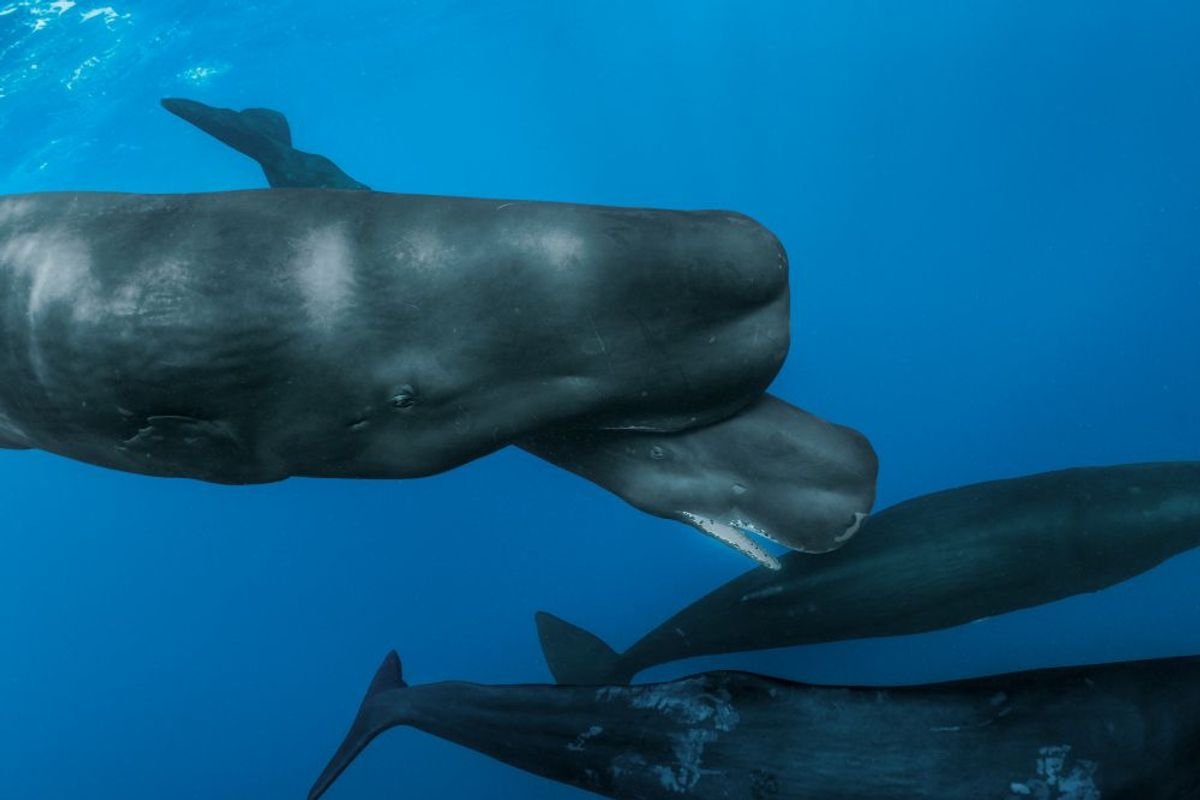
A Sperm Whale Is Born — Rare Footage Reveals Social Care During the “Most Vulnerable Moments of Life”
Researchers with the Project Cetacean Translation Initiative (CETI) have long been studying sperm whales, and recently, they captured something amazing.
Publishing their findings in two studies, one in Science and the other in Scientific Reports, the team recorded the most comprehensive footage of sperm whale birth and some of the first-ever evidence of cooperative birth assistance seen among non-primates.
“These findings fundamentally reshape how we understand whale society,” said David Gruber, National Geographic Explorer, founder and president of Project CETI, and distinguished professor of Biology at the City University of New York, in a press release. “What we’re seeing is deeply coordinated social care during one of the most vulnerable moments of life.”
Sperm Whales Supporting Mothers and Newborns
For these studies, the research team analyzed over six hours of drone footage and underwater audio captured off the coast of Dominica in July 2023. From the recordings, the team identified a sperm whale unit with related and unrelated females, including grandmothers, mothers, daughters, and sisters. The recordings show the unit supporting the new mother and calf through labor, delivery, and the first few moments of the calf’s life.
The team observed that the whales engaged in coordinated lifting efforts, caregiving behaviors, and other forms of physical support. Whales, both related and not related to the calf, offered some type of care. A rare feat, as researchers have only recorded births in about 10 percent of cetacean species.
The Science paper used aerial drones to capture video of the group working together. The team even used newly developed software for their analysis and compared the results with historical data of this social group. The Scientific Reports paper focused on audio data collected during birth and noted distinct vocal shifts at specific moments. The team also noted that some of the vocalizations contained vowel-like structures. This adds another perspective to Project CETI’s work on whale communication.
Read More: Drone Footage Reveals Sperm Whales Head-Butting — Echoing Tales That Inspired Moby Dick
An Ancient Instinct
From their observations, the team suggests that this type of behavior has ancient evolutionary roots. A phylogenetic analysis — comparing evolutionary relationships using existing behavioral and evolutionary data — found that the collective lifting behavior of the calf may predate toothed whales’ common ancient ancestor by more than 36 million years.

Sperm whale calf, Aurora, swims alongside her mother, Lady Oracle.
(Image Courtesy of Brian J. Skerry/National Geographic)
The behaviors observed at birth may reinforce social bonds between whales, fostering a world of social trust and collaboration.
“This is the most detailed window we’ve ever had into one of the most important moments in a whale’s life,” said Shane Gero, biology lead for Project CETI, scientist in residence at Carleton University, and National Geographic Explorer, in the press release. “Because this family unit has been studied for decades, we could see what the grandmother was doing, how the new big sister acted, and how each helped mom and newborn, placing this rare birth within a deep social and behavioral context.”
Researchers have been following members of this sperm whale unit for years. The mother of the new calf, Rounder, has been on the team’s radar since 2005. She was with her mother, Lady Oracle, and her daughter, Accra, during the birth, marking three generations of whales together.
The Importance of Teamwork
The studies were made possible by a group effort and decades of fieldwork. Researchers from multiple organizations teamed up to capture these groundbreaking recordings. And because of them, we know a little bit more about sperm whale collaboration today than we did yesterday.

Female sperm whales hold the newborn sperm whale calf above water until it is able to swim on its own.
(Image Courtesy of © Project CETI.)
“This work speaks to the fact that longitudinal studies are critical. When you’re as familiar with the individual animals as the CETI team is with this unit of whales, the trust these whales have in their team is unique. I’m not sure this unit would tolerate observers being so close in any other instance,” said Diana Reiss, professor in the Animal Behavior and Conservation Program in the Department of Psychology at Hunter College, CUNY, in a press release.
Read More: Elusive Beaked Whales May Dive Over 3,000 Feet to Forage Near the Seafloor
Article Sources
Our writers at Discovermagazine.com use peer-reviewed studies and high-quality sources for our articles, and our editors review for scientific accuracy and editorial standards. Review the sources used below for this article: