
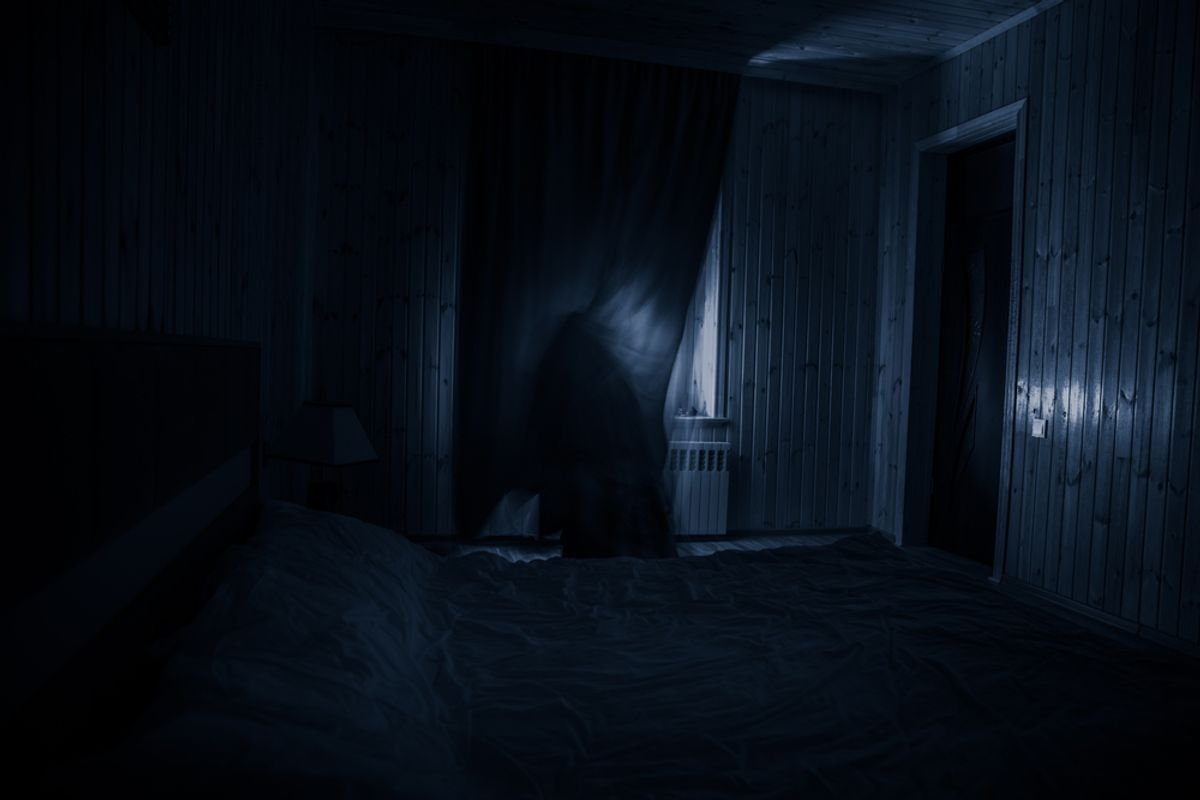
A Sensed Presence May Be More Than Just an Eerie Figment of the Imagination

Many people know this eerie feeling well. You pop down to the basement to fold laundry or check on the fuse box. Suddenly, you feel as though you aren’t alone. Completely unnerved, you rush up the stairs, slam the door, and shudder.
Scientists have a name for that spooky basement feeling — sensed presence. It tends to happen in moments of sensory deprivation, like standing in a poorly lit basement. Researchers are learning more about this psychological effect and why some people might be more prone to it.
What Is Sensed Presence?
Humans have long looked over their shoulder after sensing someone or something was behind them. Social scientists began considering it as a phenomenon in the early twentieth century. Sensed presence (AKA felt presence; feeling of presence) is typically described as the feeling someone experiences when they perceive another entity is near.
For some people, sensed presence may be neuropsychological and related to a sleep disorder, brain injury, or a disease like Parkinson’s that can cause hallucinations. But for most people, sensed presence can also be a normal part of life in which a person simply gets the heebie-jeebies from time to time.
Some scientists attribute sensed presence to predictive processing. Normally, the brain tries to make predictions based on environmental cues. Sensory deprivation, like a dark room, leads to uncertainty and then a feeling of discomfort.
But not everyone goes into an unfinished basement, sees a shadow in the corner, and thinks, ‘That is totally a killer clown.’ Researchers have experimented with sensory deprivation and uncertainty and found that some people are more prone to sensed presence than others.
Read More: The Origins of Ghost Stories and Creepy Urban Legends
Prone to Presence
In a 2025 study in Religion, Brain & Behavior, 126 participants agreed to sit alone in a dark room with their eyes covered and their ears plugged for 30 minutes. To add an element of uncertainty, some participants were told that someone might enter the room, even though no one would actually do so.
All participants completed questionnaires that included measurements about two psychological traits — imaginative suggestibility and proneness to fantasy.
“I thought [these traits] might help to understand why not everybody has the same vividness and intensity of sensed presences,” says Jana Nenadalová, the lead author on the study and a faculty member at Masaryk University in Brno, Czech Republic.
Just a Trick of the Imagination?
The psychological literature typically classifies people with fantasy proneness as creative and imaginative.
“People with this disposition tend to daydream a lot, and their fantasies can be so strong that they experience them like reality,” Nenadalová says.
After completing the questionnaire, participants sat in the room for 30 minutes and pressed a button on a handheld device if they sensed a presence. Afterwards, interviews revealed that some participants not only sensed someone in the room, but even felt a form of physical contact.
In 10 instances, participants reported hearing faint sounds through their earplugs, and they believed that someone had come into the room and was pacing around. In eight instances, the participant reported that someone had entered the room and touched them. One person thought the person had shaken her chair. Another said she felt a “fleeting touch.” Only one participant said she could see through her mask. She saw a doorway, a shadow, and then a person walking through.
Surprisingly, the participants who demonstrated fantasy proneness didn’t overwhelmingly sense a presence or feel a touch. The researchers suggested their brains may be in the habit of sensing uncertainty and then turning to fantasies.
“I can only speculate why, but perhaps because such people just dive into their fantasies when they are alone in the dark, which makes them feel safe and not attentive to the outside environment,” Nenadalová says.
This would mean that people who aren’t daydreamers would be more likely to focus on the uncertainty around them and then experience a sensed presence as their brain tries to make sense of it all.
Read More: Why The Paranormal And Supernatural Continue To Fascinate Us
Article Sources
Our writers at Discovermagazine.com use peer-reviewed studies and high-quality sources for our articles, and our editors review for scientific accuracy and editorial standards. Review the sources used below for this article: