
A Rare Split of the World’s Largest Known Chimpanzee Group Turned Former Allies Into Enemies

A group of chimpanzees once groomed each other, traveled together, and shared the same territory. After splitting into two, some are now hunting and killing former allies.
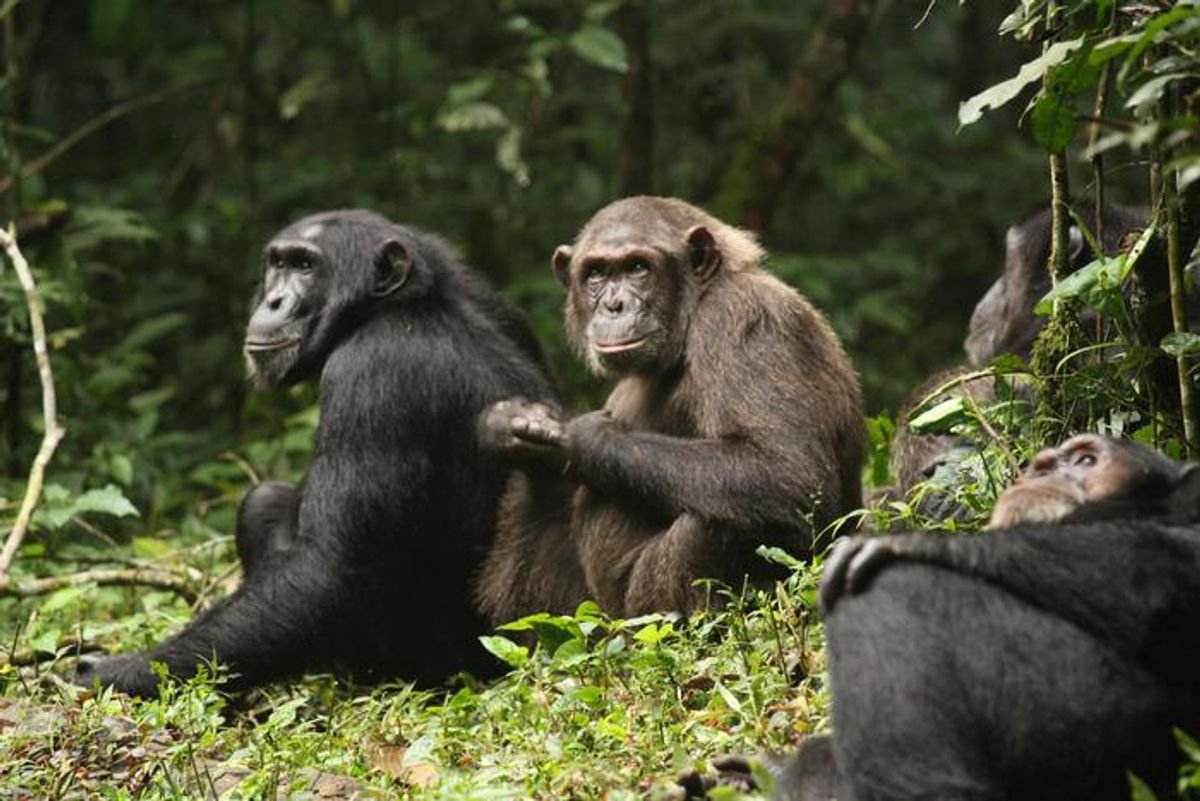
In a study published in Science, researchers analyzing nearly 30 years of observations of the Ngogo chimpanzees in Kibale National Park, Uganda, document a permanent split in a once-unified group. By 2018, the community had divided into two separate groups that no longer mixed, followed by years of coordinated, lethal attacks, a pattern some researchers say resembles a form of chimpanzee “civil war.”
“What’s especially striking is that the chimpanzees are killing former group members,” said Aaron Sandel, the study’s lead author, in a press release. “The new group identities are overriding cooperative relationships that had existed for years.”
Chimpanzee Group Split Leads to Deadly Conflict
For most of the study, the Ngogo chimpanzees functioned as a single, cohesive community. Individuals moved between flexible subgroups, maintaining social ties across the population, a pattern typical for chimpanzees.
That began to change around 2015. Two clusters within the group, known as the Western and Central subgroups, started spending more time apart and interacting less. The shift followed a period of instability, including changes in the male dominance hierarchy and the deaths of several adult males that may have helped hold the larger group together.
Over time, the separation deepened, and by 2018, the split was complete. The chimpanzees no longer mixed, and each group occupied its own territory.
As the division solidified, aggression escalated. Between 2018 and 2024, researchers observed or inferred multiple attacks, including seven targeting adult males and 17 involving infants. Some individuals disappeared without explanation, hinting at the true toll being higher.
Read More: Bonobo Kanzi Plays Pretend Like a Child, Showing Ape’s Capacity to Imagine
How Social Ties Alone Can Fracture a Group
Permanent splits like this rarely happen in chimpanzee communities. Evidence suggests they may occur only once every 500 years. The only comparable case, observed in the 1970s at Gombe Stream National Park, has remained debated in part because the chimpanzees there were provisioned with food. At Ngogo, the animals were never given food.
The findings point to a key driver: shifting social relationships. As alliances changed and key individuals disappeared, bonds that once held the group together fell apart. Over time, familiar individuals became members of opposing groups.
Chimpanzees do not rely on language, ideology, or cultural identity in the way humans do. Yet once the split took hold, cooperation gave way to coordinated aggression.
“I would caution against anyone calling this a civil war,” Sandel said. “But the polarization and collective violence that we have observed with these chimpanzees may give us insight into our own species.”
What Chimpanzee Violence May Reveal About Ourselves
The study challenges the idea that human conflict is driven primarily by cultural differences such as ethnicity or belief systems. Instead, it points to changing relationships being enough to divide groups and fuel violence.
“If relational dynamics alone can drive polarization and lethal conflict in chimps without language, ethnicity, or ideology, then in humans, those cultural markers might be secondary to something more basic,” Sandel said in the press release.
The work also underscores the importance of long-term field research. Without decades of continuous observation, the slow buildup to the split and the violence that followed would have been easy to miss.
At Ngogo, the transformation did not happen all at once. It unfolded gradually, through small shifts in behavior that eventually reshaped the entire community.
As Sandel noted, that process may carry a broader lesson. If division can emerge from changing relationships, then efforts to maintain connections may play a role in preventing it.
Read More: Bonobos Send the Noisiest Fertility Signal in Primates — Males Still Have to Decode It
Article Sources
Our writers at Discovermagazine.com use peer-reviewed studies and high-quality sources for our articles, and our editors review for scientific accuracy and editorial standards. Review the sources used below for this article: