
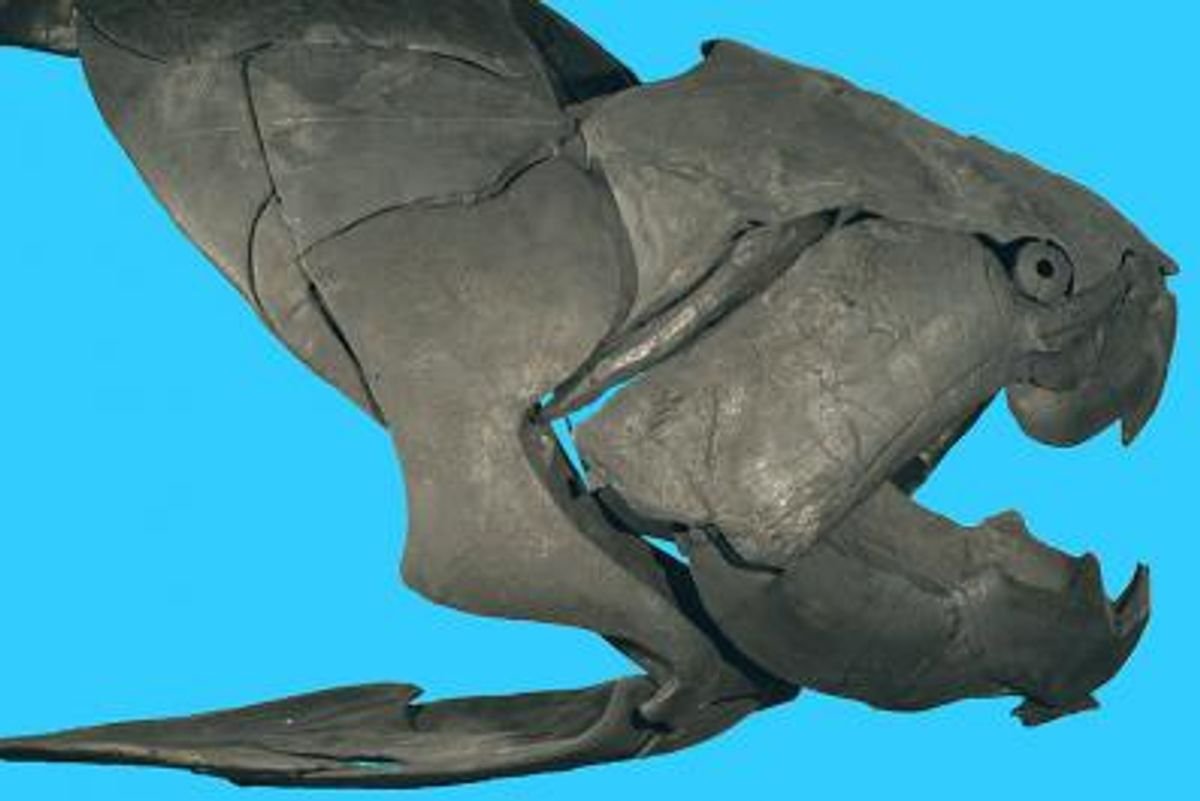
A Prehistoric Sea Monster Wielded Bone Blades to Terrorize the Ocean 360 Million Years Ago
Around 360 million years ago, a ferocious sea monster tore through oceans with bone blades in place of teeth. This sharp weaponry wasn’t the only thing that made Dunkleosteus terrelli a force to be reckoned with; its bony armor and strong jaw muscles also helped it rule prehistoric waters. And new details about the anatomy of this creature — affectionately nicknamed “Dunk” by scientists — are still coming to light.
A new study published in The Anatomical Record has provided insight into a variety of traits that redefine Dunk’s image; these include a cartilage-heavy skull, shark-like jaw muscles, and bone blades inside its mouth. These blades hint at Dunk’s unique hunting tendencies, which helped it stand out from the underwater crowd.
Read More: Pivotal Ancient Fish Fossils Mark a Key Turning Point in a Slow Evolution
A Prehistoric Apex Predator

Newly described muscle anatomy (right) and overall jaw anatomy of Dunkleosteus terrelli (center), compared to a more typical arthrodire (left)
(Image Credit: Russell Engelman/Case Western Reserve University)
Dunkleosteus terrelli lived as one of the world’s first apex predators near the end of the Devonian period, a time when diversification of fish had exploded. Two groups of fish developed during this time: agnathans (jawless fish) and placoderms (the first jawed fish). Placoderms also had bony armor that covered mostly their head and necks, according to the National Park Service.
Dunkleosteus was one of the most fearsome arthrodires, the largest group of placoderms. Arthrodires, or “jointed-neck” fish, had a movable joint between the armor of their head and body. This allowed the fish to move their head up while opening their jaws extremely wide, according to the Cleveland Museum of Natural History.
But a few features set Dunkleosteus apart from its arthrodire relatives; according to researchers involved with the new study, the jaw anatomy of the fish has been overlooked for nearly a century. This is likely because only its bony head and torso armor are often preserved, while the rest of its body — made of cartilage, like sharks today — has been lost over time.
“Since the 1930s, there have been significant advances in our understanding of arthrodire anatomy, particularly from well-preserved fossils from Australia,” said lead author Russell Engelman, a graduate student in biology at Case Western University, in a statement. “More recent studies have tried biomechanical modeling of Dunkleosteus, but no one has really gone back and looked at what the bones themselves say about muscle attachments and function.”
Bone Blades and a Suit of Armor
The researchers examined Dunkleosteus specimens from the Cleveland Museum of Natural History, which houses the world’s largest and best-preserved collection of Dunkleosteus fossils.
While the fish could be found around the world when it was alive, it is notable for being the most common vertebrate fossil in the Cleveland Shale, which contains many remains from the Late Devonian, according to Palaeo Electronica.
The researchers’ analysis illuminated a handful of details about the anatomy of Dunkleosteus; nearly half of the creature’s skull was made of cartilage, much more than previously assumed, forming jaw connections and muscle attachment sites. A specific facial jaw muscle was found to be very similar to those in modern sharks and rays. And the bone blades, which sharpened themselves when the fish opened and closed its mouth, replaced its teeth at some point in the evolutionary timeline.
Evolving to Eat More
A closer look at Dunkleosteus’ bone blades has allowed the researchers to understand why the fish is different from other arthrodires that kept their teeth. They say that the bone blades resulted from an adaptation to hunt other large fish; the blades were perfect for tearing chunks out of larger prey.
With this knowledge, researchers now have a better idea of how Dunkleosteus was able to rise to the top of the food chain during the Late Devonian, while other arthrodires took a slightly different route in evolution.
“These discoveries highlight that arthrodires cannot be thought of as primitive, homogenous animals, but instead a highly diverse group of fishes that flourished and occupied many different ecological roles during their history,” Engelman said.
Read More: Ancient Salmon Resembles Aquatic Warthog, Not Saber-Toothed Fish
Article Sources
Our writers at Discovermagazine.com use peer-reviewed studies and high-quality sources for our articles, and our editors review for scientific accuracy and editorial standards. Review the sources used below for this article: