
A New Brown-Spotted Jellyfish Was Named After the Famous Michelin Restaurant Guide

While collecting adult specimens of the common ornamental jellyfish family Malagazziidae in the shallow waters of Nagasaki and Yamaguchi Prefectures in Japan, researchers noticed a feature they had never seen before. Instead of the translucent, single-colored appearance typical of these jellyfish, several individuals displayed unexpected brown spots.
What might at first have seemed like an unusual individual soon appeared repeatedly, puzzling the scientists. The explanation turned out to be simple but exciting: they had discovered a new species, only the second species of this subfamily ever recorded in Japan.
Researchers from Fukuyama University collaborated with the Tsuruoka City Kamo Aquarium and the Saikai National Park Kujukushima Aquarium to culture the jellyfish in captivity and study their complete life cycle. This work ultimately allowed them to formally describe the species in the journal ZooKeys.
Read more: Rare Giant Phantom Jellyfish and a Well-Preserved Whale Skeleton Spotted Off the Coast of Argentina
Spotting an Unusual Jellyfish
After collecting adult animals — known as medusae — from three different locations, the researchers transported them in buckets and bottles filled with seawater to aquariums for closer observation. Some specimens were preserved in formalin seawater solutions, while others were kept alive and fed small shrimp.
To document the full life cycle, some medusae were kept together in tanks so they could produce offspring. This allowed the team to obtain specimens from every developmental stage — polyps, juveniles, and adults — helping them compare the animals with related species and confirm that this was indeed something new.
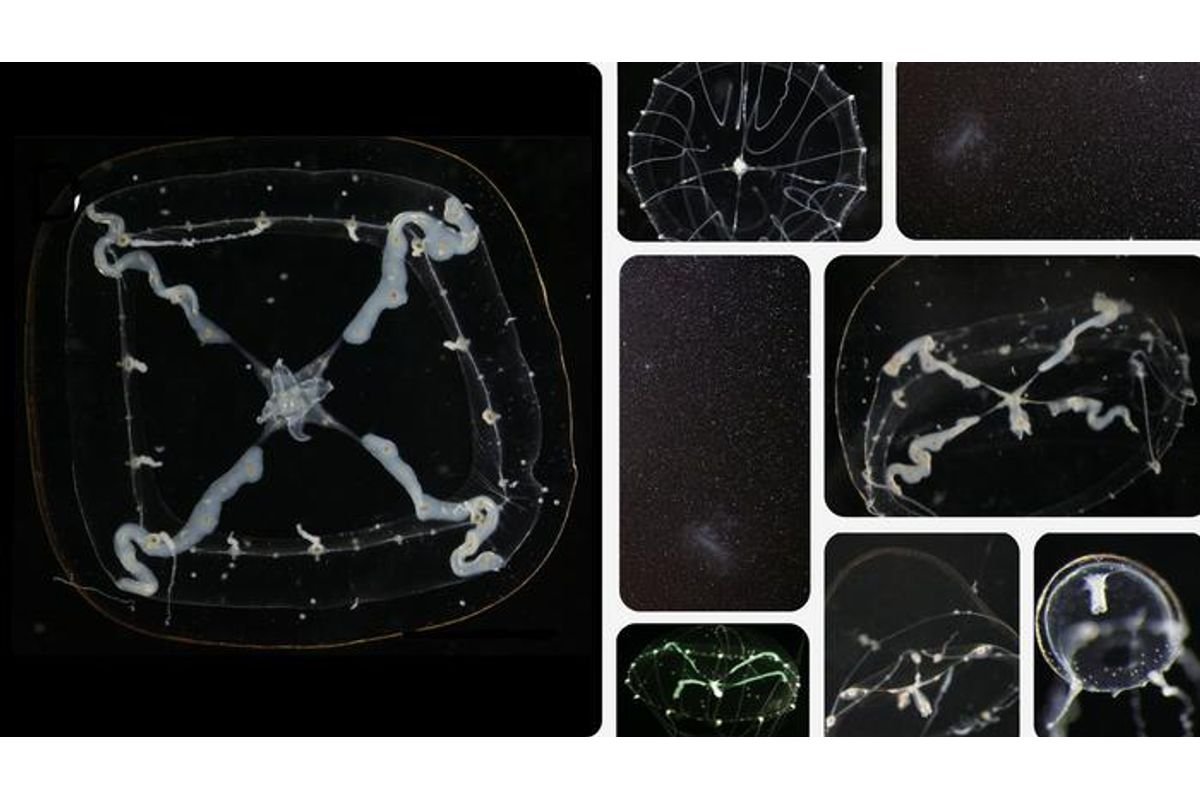
The jellyfish’s bell measures about 0.4 to 0.7 inches in diameter and has the characteristic four-lipped mouth and linear gonads typical of its subfamily, but stands out because of the relatively large brown spots scattered across the reproductive organs and central stomach.
A Jellyfish That Gains “Stars” With Age
DNA analysis eventually confirmed that the spotted jellyfish represents a previously unknown member of the Malagazzia group. Once a species has been formally described, the next step is choosing a name.
Some researchers honor individuals who were involved in the discovery, such as the turtle Elseya irwini, named after Bob and Steve Irwin, while others highlight a defining feature, like Xiphias gladius, the swordfish, whose name refers to its blade-like snout in Greek and Latin. Increasingly, however, scientists are choosing more imaginative names that draw attention to their discoveries.
Here, the research team landed on Malagazzia michelin, inspired by the Michelin Guide. As the jellyfish mature, they develop additional brown spots, or “stars,” reminiscent of the stars awarded to outstanding restaurants. The theme also appears in the Japanese common name ama-no-gawa-kurage, or “Milky Way jellyfish,” reflecting the way the brown spots on the white gonads resemble twinkling stars in a milky galaxy.
Mixing Up Names
According to the press release, the official description of M. michelin also highlights a recurring challenge of marine biology in Japan. A lot of confusion can arise from informal common names, since ornamental jellyfish in Japan are often given descriptive names long before scientists have determined exactly what species they represent.
As a result, this newly described jellyfish had previously been listed in field guides as a member of the genus Laodicea, despite not being closely related. Cases like this underline the importance of careful taxonomic work to ensure species are correctly identified.
The find also demonstrates how aquariums can contribute to scientific research. Because they maintain living specimens and work closely with researchers, public aquariums provide opportunities to study species in detail and help reveal previously overlooked marine diversity.
Read more: Brainless Jellyfish Need Rest Like Humans, and Reveal Sleep’s Evolutionary Purpose
Article Sources
Our writers at Discovermagazine.com use peer-reviewed studies and high-quality sources for our articles, and our editors review for scientific accuracy and editorial standards. Review the sources used below for this article: