
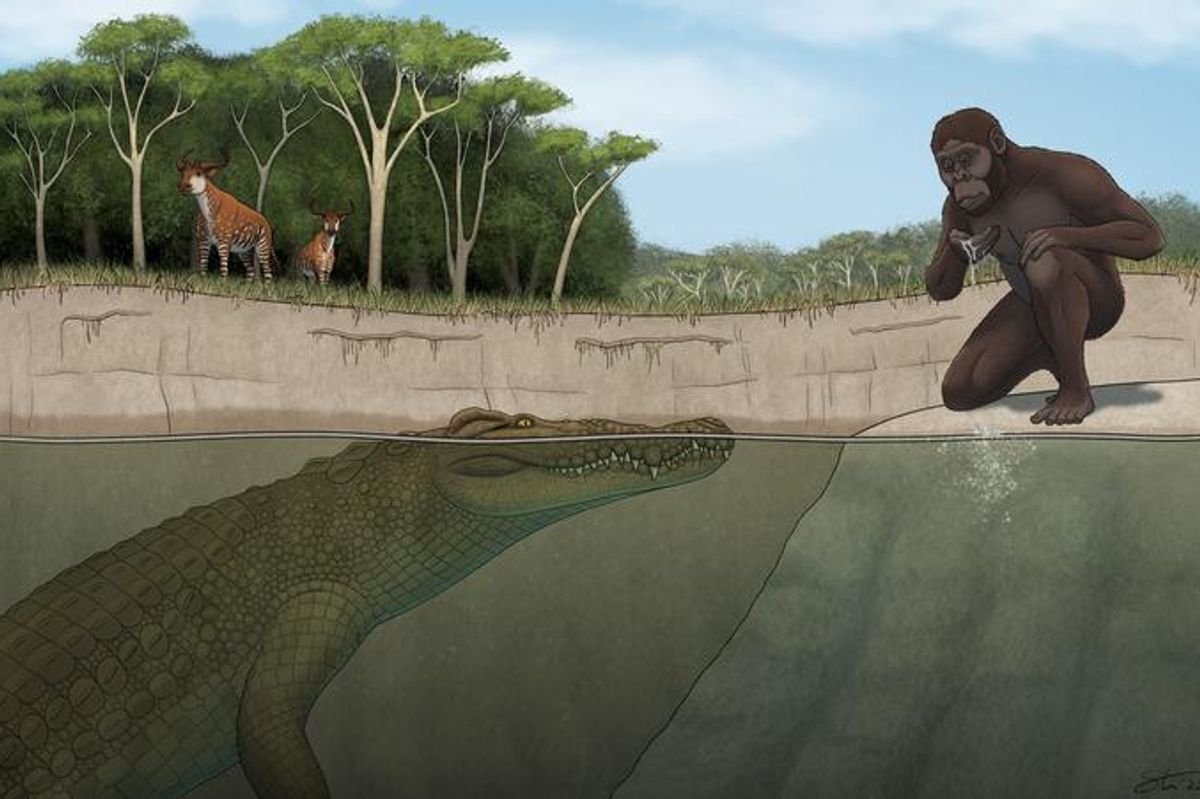
A Massive Pliocene Crocodile May Have Hunted Lucy and Other Early Hominins, 3 Million Years Ago
More than three million years ago, Lucy — the famously complete fossil of an early human ancestor discovered in Ethiopia in 1974 — moved through a landscape of wetlands, rivers, forests, and grasslands. Those waterways supported life across the region, drawing animals large and small to drink. But they may also have concealed one of the ecosystem’s most formidable predators.
In a new study published in the Journal of Systematic Palaeontology, researchers describe a previously unknown crocodile species that lived in the same region and time period as Lucy. The reptile, named Crocodylus lucivenator — meaning “Lucy’s hunter” — lived roughly 3.4 million to 3 million years ago in the Hadar region of Ethiopia. Adults likely reached 12 to 15 feet long (3.6 to 4.5 meters) and weighed between 600 and 1,300 pounds (270 and 590 kilograms), making them the largest predators in the environment.
“It emphasizes that the threats weren’t all from predatory mammals. We’re used to thinking of big cats, hyenas, and wild dogs as being their main threats. This crocodile was the largest threat Lucy and her species encountered,” lead author Christopher Brochu told Discover.
Crocodile Fossils From Lucy’s Landscape
The fossils that revealed Lucy’s hunter were excavated from the Hadar Formation, the same region where Lucy’s skeleton was discovered.

Fossil of the crocodile’s skull.
(Image Courtesy of Christopher Brochu)
During the Pliocene epoch, Hadar contained a network of lakes and rivers surrounded by a mix of habitats that changed over time. These waterways would have created the ideal conditions for ambush predators.
Researchers analyzed 121 fossil remains, including skulls, teeth, and jaw fragments representing dozens of crocodiles. While many of the fossils were fragmentary, together they provided enough information to reconstruct the animal’s anatomy.
For Brochu, the discovery began with a museum visit to Addis Ababa in 2016. “Excitement! I always feel that when I see something that might be a new species! It feels like I’ve opened a box that’s been sealed shut for centuries,” Brochu shared with Discover.
At the time, however, the fossils did not immediately fit into any known crocodile group, prompting a closer look at additional specimens collected from the same region.
Read More: A 25-Inch Crocodile Relative Walked on Two Legs in Late Triassic Forests 225 Million Years Ago
A Crocodile With an Unusual Mix of Features
Part of what made Crocodylus lucivenator difficult to classify was the unusual combination of features preserved in its skull.
“On the one hand, some of the cranial sutures in the Hadar crocodile resemble those of the extinct group (Paleoafrican Crocodylus), and the naris (nose hole) opens slightly to the front and not just straight-up. But it had a hump on the snout normally associated with crocodiles currently living in the Western Hemisphere,” Brochu explained to Discover.
That hump — rising from the middle of the crocodile’s snout — is unusual for African fossil crocodiles. In modern species, similar structures are often used as visual signals during courtship, when males lower their heads to show off the feature to potential mates.
The skull also extended farther forward in front of the nostrils than in Paleoafrican crocodiles, another trait that more closely resembles living species, including the Nile crocodile.
Signs of Crocodile Combat
The fossils also preserve glimpses of behavior. One specimen shows partially healed injuries along the jaw, evidence that the animal survived a violent encounter with another crocodile. Similar bite marks appear frequently in modern crocodiles, which often clash during territorial disputes or competition for mates.
Because the wounds healed, the crocodile lived long enough to recover from the encounter, showing fights between these reptiles were not uncommon.
For Lucy and her relatives, however, the more immediate concern may have been the presence of a powerful ambush predator in the waterways they depended on. The same rivers and lakes that sustained life in the Hadar region may also have been the hunting grounds of Lucy’s hunter.
Read More: Waiting for selection…
Article Sources
Our writers at Discovermagazine.com use peer-reviewed studies and high-quality sources for our articles, and our editors review for scientific accuracy and editorial standards. Review the sources used below for this article: