
A Hidden Iron Bar Has Been Uncovered Inside the Ring Nebula
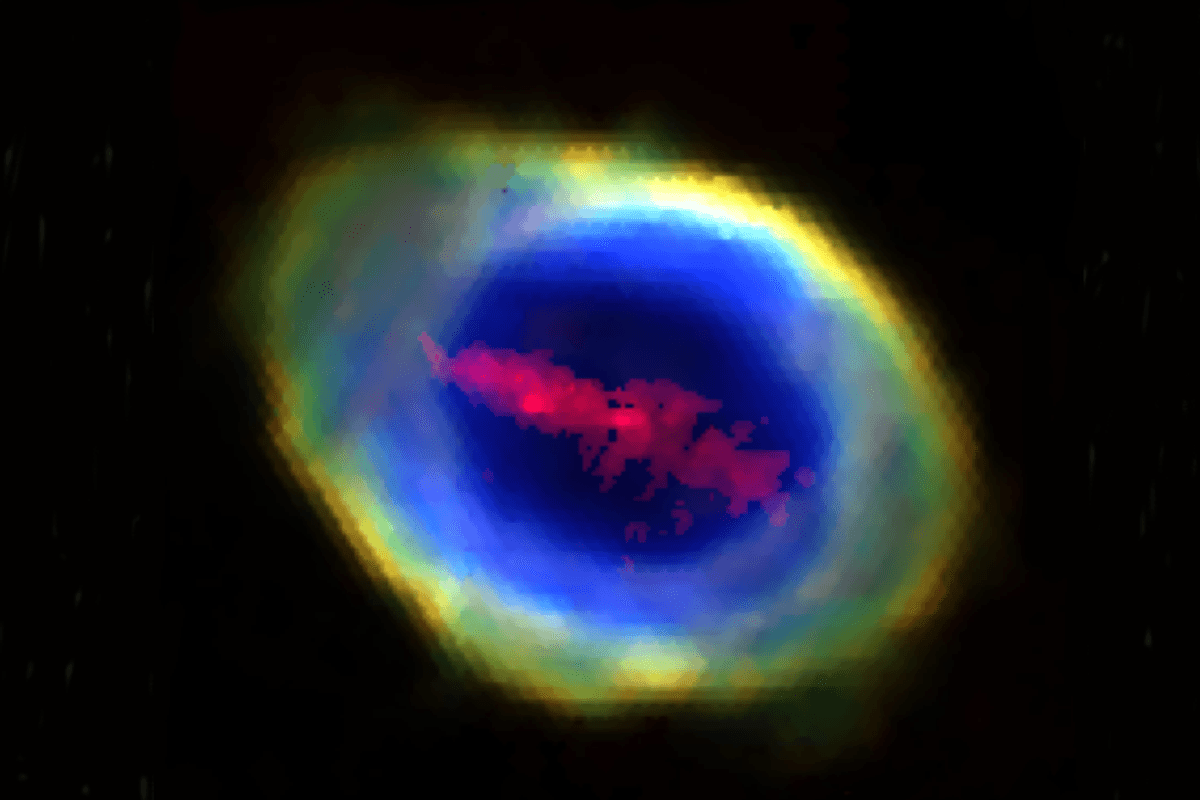
A previously hidden bar of iron has been found inside the Ring Nebula, one of the night sky’s most familiar stellar remnants. The structure, described for the first time in Monthly Notices of the Royal Astronomical Society, stretches across the nebula’s interior over a distance roughly 500 times wider than Pluto’s orbit around the sun and contains an amount of iron comparable to the mass of Mars. Despite decades of close study, it had gone completely unnoticed.
The iron appears as a narrow strip embedded within the nebula’s inner region, separate from the glowing ring of gas that gives the object its name. Its size and placement suggest that the Ring Nebula, often treated as a textbook example of a dying star, still holds unexplained features.
“When we processed the data and scrolled through the images, one thing popped out as clear as anything — this previously unknown ‘bar’ of ionised iron atoms, in the middle of the familiar and iconic ring,” said lead author Roger Wesson in a press release.
Read More: Fastest-Spinning Asteroid To Date Spotted by Vera C. Rubin Observatory
Uncovering the Iron Bar Inside the Ring Nebula

Illustrations of 8 individual WEAVE LIFU emission-line images of the Ring Nebula.
(Image Credit: Roger Wesson et al / MNRAS)
The Ring Nebula formed about 4,000 years ago when a sun-like star ran out of fuel and expelled its outer layers into space. The exposed stellar core now shines as a white dwarf, lighting up the surrounding gas and creating the nebula’s characteristic shape.
What allowed the iron structure to be detected was not a sharper image, but a new way of analyzing the nebula’s light. Instead of sampling small regions, astronomers captured detailed measurements of light across the entire nebula at once. That approach made it possible to map where specific elements are located, rather than seeing only the combined glow of gas.
Because iron does not strongly influence the nebula’s visible appearance, the structure had gone unnoticed in earlier observations, even those taken with powerful space-based telescopes.
Clues the Iron Offers About Stellar Death
The origin of the iron bar remains uncertain, and its presence raises several possibilities. One explanation is that the structure preserves a record of how material was expelled as the star died, revealing an uneven or directional outflow that existing models don’t fully capture.
Another possibility is that the iron could be the remains of a rocky planet that wandered too close as the star expanded late in its life. Extreme heat and radiation could have torn the planet apart, leaving behind a metal-rich cloud trapped inside the nebula. If so, the structure would offer a window into what happens to planetary systems as their stars reach the end of their lives.
At this stage, astronomers cannot yet distinguish between these scenarios. The iron has been detected largely on its own, without clear evidence of other elements mixed in, information that would help reveal whether the material came from stellar debris or planetary remains.
What Astronomers Hope to Learn Next
Follow-up observations are planned to examine the iron structure in greater detail, including whether other elements are present and how the material is moving. Those clues could help determine how the structure formed and whether it behaves differently from the rest of the nebula.
The discovery also raises the question of whether the Ring Nebula is unusual or whether similar structures have simply gone unnoticed elsewhere. As astronomers apply the same techniques to more planetary nebulae, the iron bar may turn out not to be unique.
“It would be very surprising if the iron bar in the Ring is unique. So hopefully, as we observe and analyse more nebulae created in the same way, we will discover more examples of this phenomenon, which will help us to understand where the iron comes from,” said Wesson.
Read More: Supermassive Black Hole Flare Launched Wind and Debris Into Space at 37,000 Miles Per Second
Article Sources
Our writers at Discovermagazine.com use peer-reviewed studies and high-quality sources for our articles, and our editors review for scientific accuracy and editorial standards. Review the sources used below for this article: