
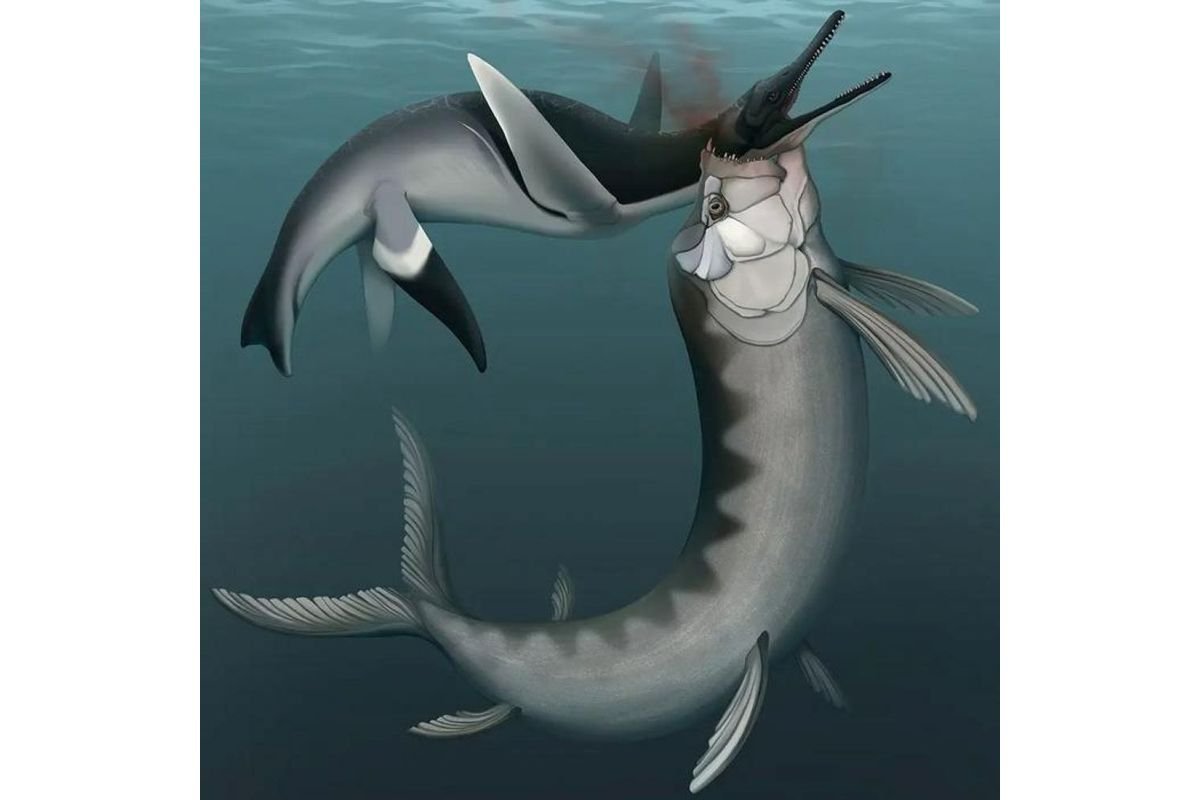
A Hidden Fossil Tooth Reveals How a Giant Predatory Fish Attacked a Plesiosaur in Prehistoric Alabama

In the Western Interior Sea — a vast waterway that once split North America in two during the Cretaceous period — the struggle for survival wasn’t just between hunters and prey, but a literal clash of the titans.
A new study, published in the Journal of Vertebrate Paleontology, revealed an embedded tooth in one of ancient Alabama’s fiercest marine predators. By utilizing high-tech scanning, scientists uncovered this hidden surprise tucked inside a fossil that had been sitting in a museum drawer for decades. The new find is rewriting our understanding of the ancient food chain and proves that even the toughest ocean dwellers had very bad days.
“We sometimes get these fixed ideas in our heads about who the top predator in any given environment is and who might rest a rung or two down on the food chain. This fossil is a good reminder that nature is rarely that cut and dry,” said lead author Stephanie Drumheller in a press release.
Read More: A 66‑Million‑Year‑Old Tyrannosaurus Tooth Embedded in an Edmontosaurus Skull Reveals a Violent Final Encounter
CT Scans Reveal Tooth in Plesiosaur Fossil
The story begins at Chicago’s Field Museum of Natural History, where a four-meter-long Polycotylus — a type of plesiosaur — had been hiding something. Although researchers excavated the fossil from Alabama’s Mooreville Chalk years ago, they didn’t notice the surprise until they examined its neck vertebrae more closely: a massive, crushed tooth embedded directly into the bone.
To identify the attacker without destroying the precious specimen, the team turned to computed tomography (CT) scanning. Two undergraduates from the University of Tennessee virtually dissected the fossil and built a 3D model of the tooth.
This 3D model revealed a surprising culprit — the tooth belonged to Xiphactinus, a massive predatory bony fish.
How Did the Tooth Get Stuck?
While Xiphactinus was the larger of the two species, it likely wasn’t trying to eat the plesiosaur. Many “fish-within-a-fish” fossils show these predators usually preferred to swallow their meals whole.
Instead, the bite may have been the result of a fight, possibly over territory. Regardless of the motive, the location of the bite was catastrophic.
“Plesiosaurs are famous for their long necks, but those necks come at a price,” explained coauthor Robin O’Keefe. “The trachea, esophagus, major arteries and veins, important nerves; all of these organs lie vulnerable to attack. A bite to the neck by Xiphactinus would have certainly proved fatal to this animal, if the Polycotylus was not already dead.”
Whether it was a botched hunt or a scavenged meal, the sheer violence required to lodge a tooth into a vertebra suggests a terrifying level of power.
The Importance of Alabama’s Mooreville Chalk
The Mooreville Chalk has long been a goldmine for paleontologists, offering a snapshot of a dynamic ecosystem where everything was on the menu. From sharks and bony fish to the occasional dinosaur who unfortunately found itself washed out to sea, the fossils excavated here create a picture of a chaotic aquatic world where no species was safe.
This specific find underscores that the Western Interior Sea was a high-stakes area where even the largest predators were constantly looking over their shoulders.
Read More: New Species of Carnivorous Dinosaur Discovered with Crocodile in Its Teeth
Article Sources
Our writers at Discovermagazine.com use peer-reviewed studies and high-quality sources for our articles, and our editors review for scientific accuracy and editorial standards. Review the sources used below for this article: