
A Glow Hidden in the Milky Way’s Core May Reveal Dark Matter After a Century of Searching
For nearly a century, dark matter has remained an unanswered question at the heart of astrophysics. First proposed in the 1930s to explain why galaxies spin faster than their visible mass allows, this unseen material shows up only through its gravitational pull — never in light. Now, new observations from NASA’s Fermi Gamma-ray Space Telescope reveal a halo-shaped burst of gamma rays at the Milky Way’s core — a signal that matches the long-predicted behavior of dark matter particles.
In a new study published in the Journal of Cosmology and Astroparticle Physics, University of Tokyo astronomer Tomonori Totani reported that this gamma-ray signature aligns with what theorists have predicted for nearly a century. If confirmed, the finding could offer the first direct glimpse of dark matter — a breakthrough that would reshape both cosmology and particle physics.
“If this is correct, to the extent of my knowledge, it would mark the first time humanity has ‘seen’ dark matter. And it turns out that dark matter is a new particle not included in the current standard model of particle physics. This signifies a major development in astronomy and physics,” said Tomonori Totani in a press release.
The Difficulty Behind Detecting Dark Matter
Despite its dominant influence on the cosmos, dark matter has remained invisible to all instrument astronomers have pointed at the sky. The particles thought to make it up don’t emit or reflect light, and they don’t interact with electromagnetic forces the way ordinary matter does. Instead, scientists detect it by the extra gravitational glue keeping galaxies intact.
One longstanding theory proposes that dark matter might be composed of weakly interacting massive particles, or WIMPs. These hypothetical particles rarely interact with normal matter, but when two of them collide, they are predicted to annihilate each other and release gamma-ray photons with very specific energies. For years, astronomers have focused on regions where dark matter is densest — especially the center of the Milky Way.
Read More: Space Tornadoes Are Swirling Around the Milky Way’s Core
Why This Gamma-Ray Glow Looks Like Dark Matter
When Totani analyzed the newest data from NASA’s Fermi Telescope, one feature immediately stood out near the Milky Way’s center.

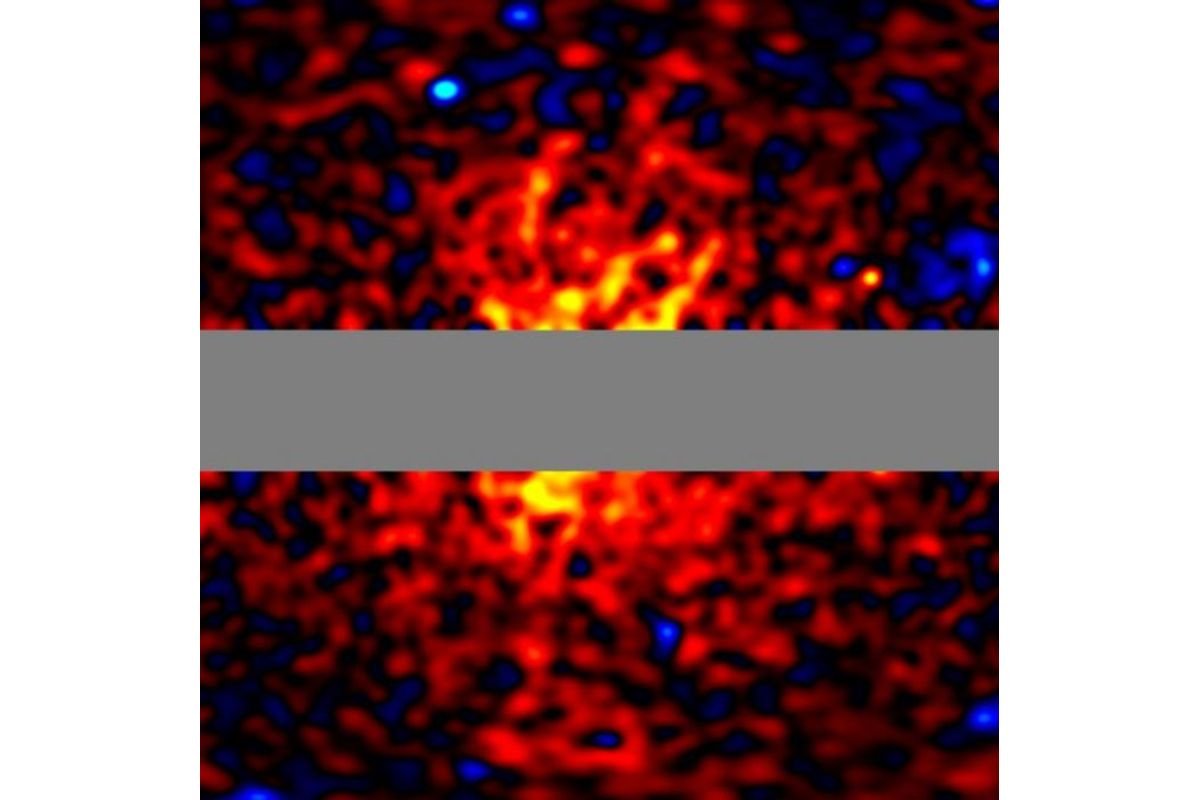
Gamma-ray intensity map that spans approximately 100 degrees in the direction of the Galactic center.
(Image Credit: Tomonori Totani, The University of Tokyo)
“We detected gamma rays with a photon energy of 20 gigaelectronvolts (or 20 billion electronvolts, an extremely large amount of energy) extending in a halolike structure toward the center of the Milky Way galaxy. The gamma-ray emission component closely matches the shape expected from the dark matter halo,” said Totani in the press release.
The pattern of gamma-ray intensities — the energy spectrum — also matched predictions for what happens when two hypothetical WIMPs annihilate each other, a process expected to release gamma rays at these energies. The implied mass of the particles, about 500 times heavier than a proton, falls within standard theoretical expectations, and the estimated rate of annihilation is consistent with long-standing models.
The emission pattern is also difficult to explain using more familiar astrophysical sources. According to Totani, common gamma-ray–producing phenomena don’t match the signal’s shape or intensity, making it a strong candidate for the long-predicted signature of dark matter.
Confirming the Findings
Totani’s results are promising, but they’ll need independent verification. Researchers also hope to see the same 20-GeV gamma-ray signature in other dark-matter–rich regions, such as the Milky Way’s dwarf galaxies. Detecting the same signal there would offer much stronger evidence that Fermi has captured the long-predicted glow of dark matter.
Read More: How Many Suns Exist In The Milky Way? It’s Complicated
Article Sources
Our writers at Discovermagazine.com use peer-reviewed studies and high-quality sources for our articles, and our editors review for scientific accuracy and editorial standards. Review the sources used below for this article:
- This article references information from a new study that was published in the Journal of Cosmology and Astroparticle Physics: 20 GeV halo-like excess of the Galactic diffuse emission and implications for dark matter annihilation