
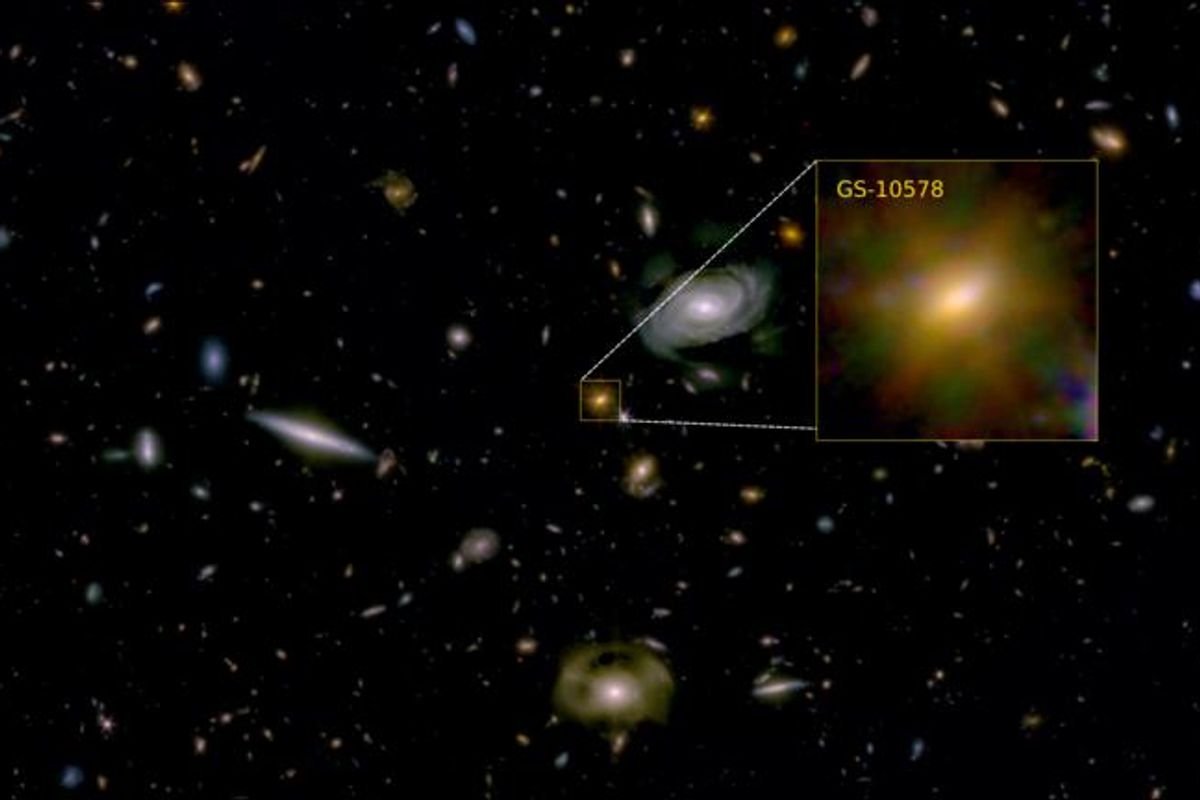
A Dead Galaxy From the Early Universe Succumbed to Starvation Due to its Own Black Hole

Scattered throughout the universe are colossal galaxies that appear to be dead, no longer capable of forming new stars. One of the oldest dead galaxies has just recently been surveyed, confirming that its death sentence was set by a black hole that whittled away at its most important star-making resource.
A new study published in Nature Astronomy has revealed how GS-10578, also known as “Pablo’s Galaxy” after the astronomer who first observed it in detail, went out of commission. The black hole at its center gradually heated cold gas within the galaxy, a necessary element of star formation. Pablo’s Galaxy was starved of this gas over time — a similar outcome could be happening all over the universe, as astronomers are finding more galaxies that look surprisingly old and contain stars that formed not long after the Big Bang.
Read More: Astronomers Looked Back 12 Billion Years, and Found a Galaxy Cluster That Defies Theory
Living Fast and Dying Young
Pablo’s Galaxy was born in the early stages of the universe, with most of its stars forming between 12.5 and 11.5 billion years ago — the Big Bang, for reference, happened 13.8 billion years ago. For an early galaxy, it’s also unexpectedly massive at about 200 billion times the mass of our sun.
But Pablo’s Galaxy is one whose life quickly flickered out, according to the researchers of the new study; they say that it appears to have “lived fast and died young.”
The short-lived life story of this galaxy was captured in data from the James Webb Space Telescope (JWST) and the Atacama Large Millimeter Array (ALMA). Based on their observations, the researchers believe that the supermassive black hole at the galaxy’s core caused it to suffer continuous decline rather than abrupt destruction.
Starved of Star-Making Material
In any galaxy, cold gas is needed to kickstart the formation of stars. But when the researchers went looking for signs of cold gas in Pablo’s Galaxy, they found that it had run dry. Observing with ALMA for nearly seven hours, they couldn’t detect carbon monoxide, which is associated with the presence of cold hydrogen gas.
Further observations with JWST spectroscopy revealed what likely happened to Pablo’s Galaxy: Powerful winds of neutral gas from the galaxy’s supermassive black hole diminished the cold gas supply. The winds, moving at 400 kilometers per second, removed 60 solar masses of gas every year, the researchers say. At this rate, the galaxy’s remaining fuel was depleted in as little as 16 million to 220 million years, something that normally takes upwards of a billion years for other galaxies.
“The galaxy looks like a calm, rotating disc,” said co-first author Francesco D’Eugenio, an astrophysicist with the Kavli Institute for Cosmology, in a statement. “That tells us it didn’t suffer a major, disruptive merger with another galaxy. Yet it stopped forming stars 400 million years ago, while the black hole is yet again active. So the current black hole activity and the outburst of gas we observed didn’t cause the shutdown; instead, repeated episodes likely kept the fuel from coming back.”
The Fate of the Earliest Galaxies
The researchers determined that Pablo’s Galaxy evolved with net-zero inflow, meaning it reached a point where it wasn’t being replenished with fresh gas. They believe that the black hole heated or expelled incoming gas over multiple cycles, depriving the galaxy of the resource it needed to keep making stars.
Pablo’s Galaxy might not be the only galaxy that’s being starved. Many recently discovered galaxies that appear to be massive and old have raised questions for astronomers.
“Before Webb, these were unheard of,” said co-first author Jan Scholtz, an astrophysicist with the University of Cambridge and the Kavli Institute. “Now we know they’re more common than we thought — and this starvation effect may be why they live fast and die young.”
The researchers say that future studies may show that death by starvation could be a common theme for these galaxies that formed early in the universe.
Read More: The Size of Our Galaxy Stretches Tens of Thousands of Light Years Across, But Its Height Is Rather Small
Article Sources
Our writers at Discovermagazine.com use peer-reviewed studies and high-quality sources for our articles, and our editors review for scientific accuracy and editorial standards. Review the sources used below for this article: