
A 3D-Printed Elephant Inside a Living Cell Signals a Bioengineering Breakthrough

Developments in bioengineering keep moving the needle between reality and science fiction. From genetic editing with the CRISPR-Cas system and growing functioning organoids in petri dishes to brain cells on microchips — scientists continue to surprise us with cutting-edge inventions.
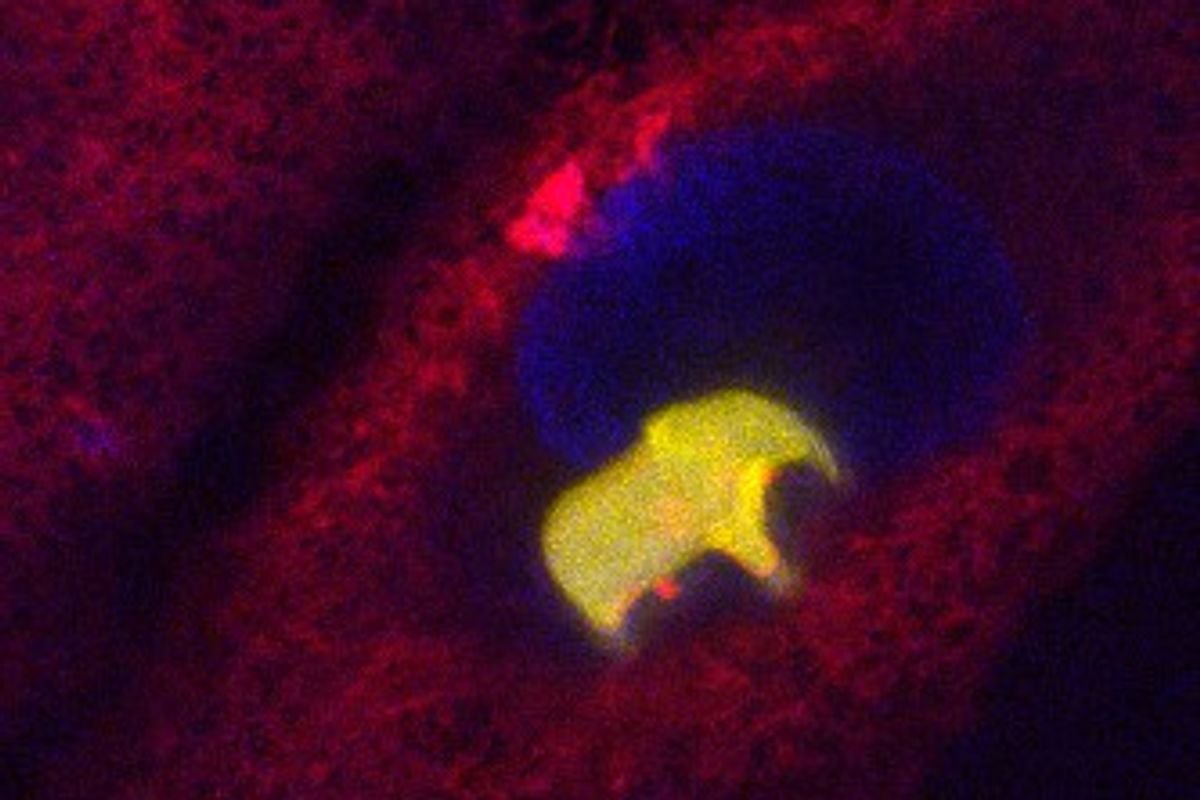
Now, for the first time, researchers from the Department of Condensed Matter Physics at the Jožef Stefan Institute in Ljubljana, Slovenia, established a method to 3D print microscopic structures inside living human cells. To demonstrate the detail and versatility of the technology, they printed a tiny elephant, alongside other microscopic geometric objects and barcodes for cell labeling, into the interior of a cell.
In their study, published in Advanced Materials, the team demonstrated that structures can be printed directly inside living cells — and that the cells remained viable and continued to divide despite containing foreign objects. This proof-of-concept experiment could pave the way for microscopic machines and devices built directly into cells to better understand how they function and even advance cellular properties.
“Our method provides a new tool to manipulate living cells from the inside, enabling a new approach to studying their mechanical and biological responses,” said study co-author Maruša Mur, researcher at the Jožef Stefan Institute, in a press release.
Read More: CRISPR Fulfills Its Promise with First-Ever Personalized Gene-Editing Therapy
3D Printing Microscopic Structures for Cell Biology
Although 3D printing technology emerged in the 1980s, it only gained worldwide traction in the past decade, with some individuals even owning 3D printers in their homes today. Besides private endeavors, 3D printing has turned into an indispensable tool in multiple industries and scientific fields.
In biology, 3D printing is mostly practiced on a microscopic scale. To achieve precise resolutions of printed objects, technicians use two-photon polymerization (TPP), where technicians treat a photo-sensitive resin with a precise laser, producing objects that are down to 100 nm in size.
While researchers have already used this technique to print small scaffolds or objects to support tissue healing, later embedded into cells, no one had ever tried printing directly inside living cells. Therefore, the Slovenian research team saw an opportunity to lay the groundwork for an innovative intracellular bioengineering tool that could be used for countless applications.
3D Printing Inside a Living Cell
The researchers tested their technique on live HeLa cells — human cancer cells that can divide indefinitely, making them very popular in biomedical research. They inserted a droplet of a biocompatible photoresin into the cell and then polymerized the resin into their desired 3D shape using a laser.
The resin that wasn’t transformed slowly dissolved, and the polymerized structure remained within the cell. Using this technique, the team printed various structures, including barcode structures for labeling cells, woodpile-like and other geometric shapes. Notably, they were able to print a 10-micrometer elephant, showcasing the impressive detail of the technology.
After successfully demonstrating 3D printing within live cells for the first time, the team also wanted to check how the objects impact cell viability. They reported how the cells kept the structures within their interior and didn’t reject them, but also how the cells continued to live and even divide, passing the object on to one of the daughter cells.
Upgrading Living Cells in the Future
Despite the early stage of the technique, this proof-of-concept experiment demonstrated what’s possible and may lead to new applications in biomechanics, bioelectronics, and even targeted drug delivery.
Researchers could one day develop the technology to print tiny machines or devices inside living cells to expand our knowledge of biological functions or to create cyborg-like cells with advanced abilities, expanding cell engineering beyond currently known natural limits.
Read More: Mushrooms May Replace Metal in Future Computers — And You Could Build One At Home
Article Sources
Our writers at Discovermagazine.com use peer-reviewed studies and high-quality sources for our articles, and our editors review for scientific accuracy and editorial standards. Review the sources used below for this article: