
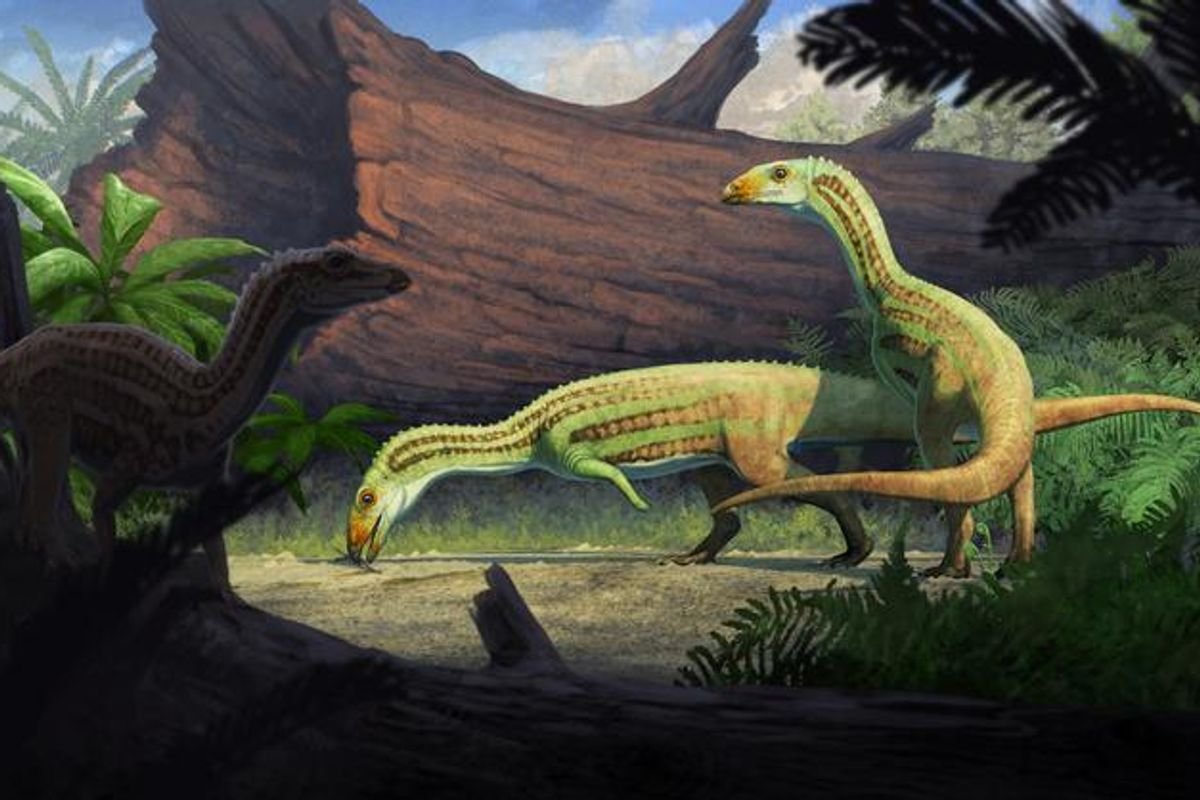
A 25-Inch Crocodile Relative Walked on Two Legs in Late Triassic Forests 225 Million Years Ago

Some animals learn new skills as they grow older. This ancient crocodile relative may have taken that idea to an extreme — starting life on four legs before eventually learning to walk on two.
The unusual reptile, named Sonselasuchus cedrus, lived during the Late Triassic, roughly 225 to 201 million years ago. The reptile likely lived in forested environments that covered much of the region during this time. The species name cedrus references the cedar-like trees that grew in Late Triassic forests. In a study published in the Journal of Vertebrate Paleontology, researchers report that changes in the proportions of the animal’s limbs suggest it gradually shifted from walking on four legs as a juvenile to moving on two legs as an adult.
“Essentially, we think these creatures started out their lives on four legs… they then started walking on two legs as they grew up,” said lead author Elliott Armour Smith in a press release. “This is particularly peculiar.”
Read More: Jurassic Predators Feasted on Baby Long-Necked Dinosaurs 150 Million Years Ago
A Triassic Crocodile Relative That Evolved a Dinosaur-Like Body
Despite belonging to the crocodile branch of the reptile family tree, Sonselasuchus would have looked very dinosaur-like.
The animal stood about 25 inches tall, roughly the size of a small dog, and likely had a toothless beak, large eye sockets, and hollow bones. At first glance, these features resemble those of ornithomimid dinosaurs — long-legged animals sometimes compared to ostriches.
But the resemblance appears to be a case of convergent evolution, when unrelated animals independently develop similar traits.
“Although similar to the ornithomimid dinosaurs, these features would have evolved separately,” explained Armour Smith, “and this similarity was probably due to the fact that croc-line and bird-line archosaurs evolved in the same ecosystems and converged upon similar ecological roles.”
In other words, animals from different evolutionary branches may have evolved similar bodies because they filled similar roles in the same ancient environments.
How This Reptile Shifted From Four Legs to Two
The evidence for the reptile’s unusual movement comes from the proportions of its limb bones.
By comparing the skeleton of Sonselasuchus with those of related reptiles, researchers found that the animal’s hind legs appear to have grown longer and stronger relative to its forelimbs as it matured.
That change may have shifted the animal’s balance toward its back legs, allowing adults to walk upright while younger individuals likely moved on all fours.
The researchers describe this as a differential growth pattern, meaning different parts of the body grew at different rates as the animal developed.
Arizona’s Petrified Forest Fossil Site Yields Thousands of Triassic Bones
The fossils of Sonselasuchus were discovered in Arizona’s Petrified Forest National Park, one of the most important Late Triassic fossil sites in North America.
Excavations at the site began in 2014, and over the past decade, researchers have uncovered more than 3,000 fossil bones, including roughly 950 specimens belonging to the newly identified reptile.
“In addition to Sonselasuchus, the bonebed has yielded fossils of fish, amphibians, as well as dinosaurs and other reptiles. Over 30 University of Washington students and volunteers have been involved over the years. It’s exciting to see that the site continues to produce new and interesting fossils,” said study co-author Christian Sidor.
For researchers, discoveries like Sonselasuchus highlight how diverse ancient reptiles were, and how much we are still learning about the animals that lived alongside the earliest dinosaurs.
Read More: 90-Million-Year-Old Fossil Reveals a Fully Grown Dinosaur That Weighed Less Than 2 Pounds
Article Sources
Our writers at Discovermagazine.com use peer-reviewed studies and high-quality sources for our articles, and our editors review for scientific accuracy and editorial standards. Review the sources used below for this article: