
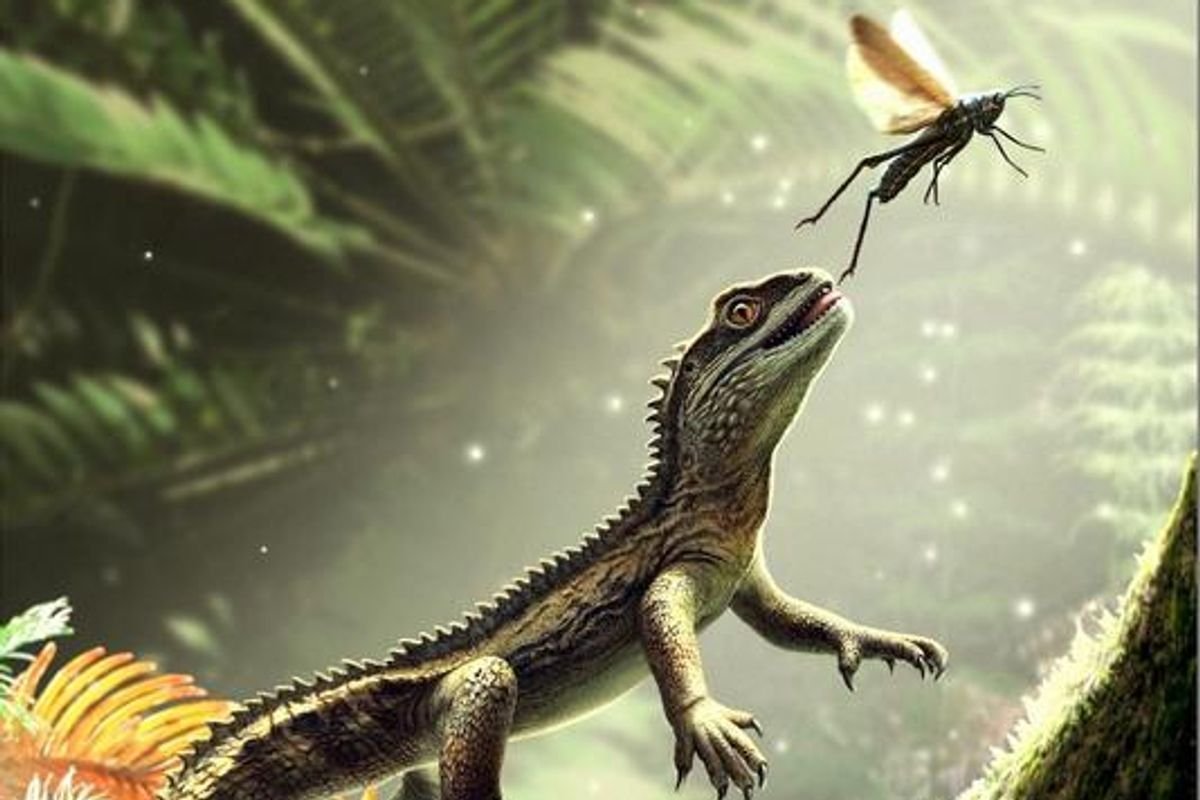
A 242-Million-Year-Old Fossil Has Drastically Altered the Story of Lizard Evolution

A 242-million-year-old fossil found on a beach in Devon, England, is changing what we know about lizard evolution. A new study, published in Nature, details how this ancient reptile is giving scientists new insights into why lizards became the most successful land vertebrates on Earth.
Lizards, along with snakes and New Zealand’s tuatara, are collectively known as Lepidosauria — a classification including over 12,000 known species. Scientists have long been interested in figuring out what allowed lepidosaurs to become so widespread across space and time.
Since so many of these species share similar physical characteristics, it’s fair to imagine that their ancestors would have these characteristics, as well. However, scans of a newly-discovered lepidosaur fossil have surprisingly revealed that to not be the case.
“The new animal is unlike anything yet discovered and has made us all think again about the evolution of lizards, snakes, and the tuatara,” said Dan Marke, from the University of Bristol, in a press release. “This specimen not only provides important information about the ancestral skull of all lepidosaurs but also builds on the growing knowledge that the tuatara, while often called a ‘living fossil,’ belongs to a once-diverse order of ancient reptiles with a rich evolutionary history.”
Read More: The Lizard-Looking Tuatara, That Lives Up to 100 Years, Isn’t Actually a Lizard
What Makes the New Fossil Different?
To understand why the new fossil is so remarkable, you must first know a little bit about lizard anatomy. Most lepidosaurs share common characteristics seen in modern snakes and lizards, like a partially hinged skull and teeth on the roof of their mouth. These are all characteristics that help with survival, allowing lepidosaurs to have the wide mouth necessary to devour large prey and the sharp teeth to latch onto small prey.
A characteristic lost in most modern lepidosaurs is a cheekbone, known as the lower temporal bar. Although absent in snakes and lizards, this trait is still present in tuatara and gives them their unique, ancient look.
When analyzing the new lepidosaur fossil, paleontologists expected to find all three of these characteristics. Shockingly, they only found evidence of one.
“The new fossil shows almost none of what we expected. It has no teeth on the palate and no sign of any hinging. It does, though, have the open temporal bar, so one out of three. Not only this, but it possesses some spectacularly large teeth compared to its closest relatives,” said Marke in the press release.
Mixing Modern Technology With Ancient Fossils
The new species, named Agriodontosaurus helsbypetrae, is extremely tiny. The fossilized skull measures in at less than one inch, and the entire thing could fit into the palm of your hand. Its minuscule size made it extremely difficult to study.
Thankfully, the research team was able to use synchrotron CT scans to get an unprecedented look at the details of the fossil without risking any damage. The use of this technology allowed scientists to see how the skull differed from modern lizards — differences missed when just using standard X-ray scans.
“When you look at the fossil, the whole skeleton sits in the palm of your hand. But after the scans and the hard work of our students cleaning up the scan data, we can see the most amazing detail,” said Michael Benton, Professor of Vertebrate Paleontology at the University of Bristol, in the press release. “The new beast has relatively large triangular-shaped teeth and probably used these to pierce and shear the hard cuticles of its insect prey, pretty much as the tuatara does today.”
Overall, the new fossil shows that lepidosaurs didn’t begin with all of the hallmark traits that define modern lizards and snakes. Instead, their evolutionary adaptability, especially in feeding strategies, helped to make them the successful group they are today.
Read More: Monitor Lizards May Share the Same Mysterious Bone Structure With a Stegosaurus
Article Sources
Our writers at Discovermagazine.com use peer-reviewed studies and high-quality sources for our articles, and our editors review for scientific accuracy and editorial standards. Review the sources used below for this article: