
A 2,000-Year-Old Pleasure Barge Resurfaces in Cleopatra’s Harbor, Telling Us of Life in Roman Egypt
The ancient underwater port of Alexandria still hides treasures from the days of Cleopatra, Julius Caesar, and Mark Antony. Divers know the city’s royal harbor once dazzled the ancient world, but every now and then, something turns up that shows how much remains beneath the waves.
In a recent mission in the Port of the Royal Island of Antirhodos, within the historic Portus Magnus of Alexandria, a team from the Institut Européen d’Archéologie Sous-Marine (IEASM) uncovered a remarkably well-preserved shipwreck dating back about 2,000 years.
The vessel is described as a thalamagos, a pleasure barge that likely hosted prominent figures or took part in ceremonial processions in Roman Egypt.
Read More: These 5 Ancient Treasures Were Discovered at Sea and in Sunken Shipwrecks
A Well-Preserved Luxury Vessel

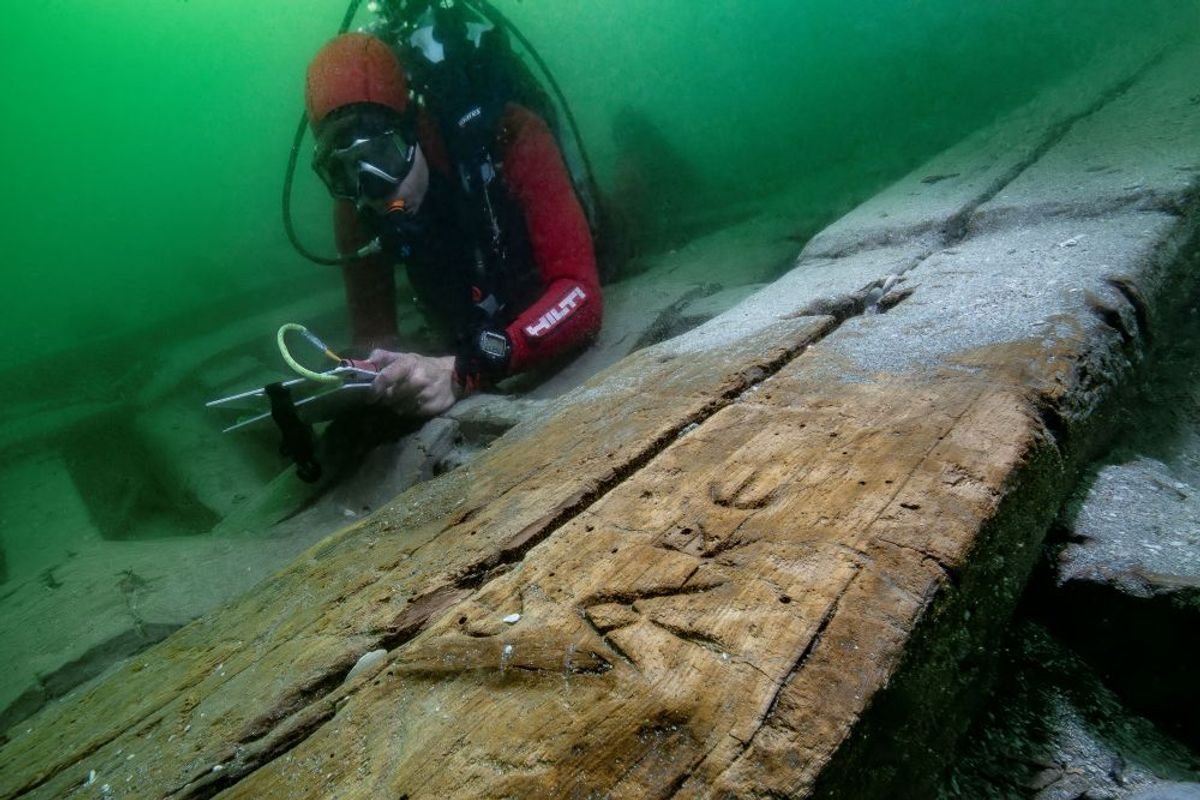
(Image Courtesy of Christoph Gerigk ©Franck Goddio/Hilti Foundation)
So what does a first-century luxury barge look like? Archaeologists found around 90 feet of preserved timbers, representing a ship about 115 feet long and 23 feet wide, as described in IESM’s press release. Its wide beam was designed for a covered space where passengers could dine and glide through Alexandria’s canals in style.
The hull features a flat bottom built for calm inland waterways rather than the open sea. A piece of Greek graffiti carved into the central beam dates the vessel to the first half of the first century A.D., right after Egypt became part of the Roman Empire.
Pleasure barges like this weren’t unusual among the elite: the Ptolemies famously sailed on extravagant thalamagoi, including Cleopatra VII herself, who reportedly used one to show Julius Caesar the sights of Egypt in 47 B.C.E. These ships were floating symbols of luxury, influence, and sometimes ritual devotion.
Barge May Be a Ritual Vessel
There are several theories about the barges’ purpose. The construction style points to a ship built in Alexandria, with a richly decorated cabin and powered solely by oars.
IEASM director Franck Goddio suggested in the news release that the ship may have been tied to a nearby temple of Isis on Antirhodos Island. It could have sunk during the destruction of the temple around 50 A.D., placing it within a dramatic moment in the city’s history.
If so, the barge might not have been just a pleasure craft. It may have been part of the navigatio iside, a ritual in which a decorated vessel “embodied the solar barque of Isis, mistress of the sea,” described Goddio. Each year, this symbolic ship would “sail” the goddess from Alexandria’s harbor to the sanctuary of Osiris at Canopus, another major port of ancient Egypt.
Research on the wreck has only begun, but it promises a glimpse into elite life on the waterways of early Roman Egypt, where luxury, religion, and spectacle blended seamlessly.
The Port That Held Half the Ancient World
The discovery also highlights the extraordinary history of Alexandria’s port. What began as a small fishing village became the glittering heart of the Ptolemaic empire after Alexander the Great founded the city. Under Roman rule, it was the largest trading hub in the world, handling everything from grain shipments to luxury imports.
IEASM, under the direction of Goddio, has spent more than 30 years exploring the submerged remains of the Portus Magnus, according to Goddio, in an interview with the University of Oxford. Their work has revealed palace complexes, temples, and commercial docks on Antirhodos Island and the Poseidium Peninsula — the very places where Caesar, Antony, and Cleopatra once stayed.
Now, thanks to this newly found shipwreck, we get a more intimate glimpse of ancient Alexandria beyond its grand politics, showing the slow, elegant rhythm of life on its waterways.
Read More: 4 Famous Shipwrecks That You Can Visit
Article Sources
Our writers at Discovermagazine.com use peer-reviewed studies and high-quality sources for our articles, and our editors review for scientific accuracy and editorial standards. Review the sources used below for this article: