
A 2.6-Million-Year-Old Jaw Uncovers a Missing Hominin From the Afar Region
One branch of the human family tree had never shown up in one of its most studied landscapes. Despite abundant hominin fossils in Ethiopia’s Afar region, Paranthropus was missing. A newly discovered fossil fills that gap.
Reported in Nature, the 2.6-million-year-old jaw is the first confirmed Paranthropus specimen from the Afar and extends the genus’s known range north by roughly 620 miles (about 1,000 kilometers). The finding suggests Paranthropus occupied a broader swath of eastern Africa than previously recognized.
“If we are to understand our own evolutionary trajectory as a genus and species, we need to understand the environmental, ecological, and competitive factors that shaped our evolution,” said research team lead Zeresenay Alemseged in a press release. “This discovery is so much more than a simple snapshot of Paranthropus’ occurrence: It sheds fresh light on the driving forces behind the evolution of the genus.”
Read More: A 2-Million-Year-Old Skeleton Shows Early Humans Were Still Built for the Trees
Placing Paranthropus Among Early Human Lineages

Comparison of the Paranthropus mandible with other species, including Australopithecus afarensis and early Homo.
(Image Credit: Alemseged Research Group/University of Chicago)
To understand why the Afar find matters, it helps to situate Paranthropus within the broader human family tree. Since the split between the human and chimpanzee lineages roughly seven million years ago, multiple hominin groups have evolved in parallel, each experimenting with different anatomical and behavioral strategies.
Early hominins such as Ardipithecus combined limited upright walking with life in the trees. Later, Australopithecus species became habitual bipeds, spending more time on the ground while retaining some climbing ability. The genus Homo eventually emerged with larger brains, increasingly sophisticated tools, and a commitment to obligate bipedalism.
Paranthropus followed a different path. Like Australopithecus, its members walked upright, but they stood out for their extremely large molars, thick enamel, and facial architecture adapted for powerful chewing. Those features led many researchers to view the group as highly specialized and potentially limited compared with Homo. What made the Afar region so puzzling was that fossils from all these other groups were well documented there, while Paranthropus was not.
“Hundreds of fossils representing over a dozen species of Ardipithecus, Australopithecus, and Homo had been found in the Afar region of northern Ethiopia, so the apparent absence of Paranthropus was conspicuous and puzzling to paleoanthropologists, many of whom had concluded the genus simply never ventured that far north,” said Alemseged.
A Jaw From Afar Extends the Genus’ Reach
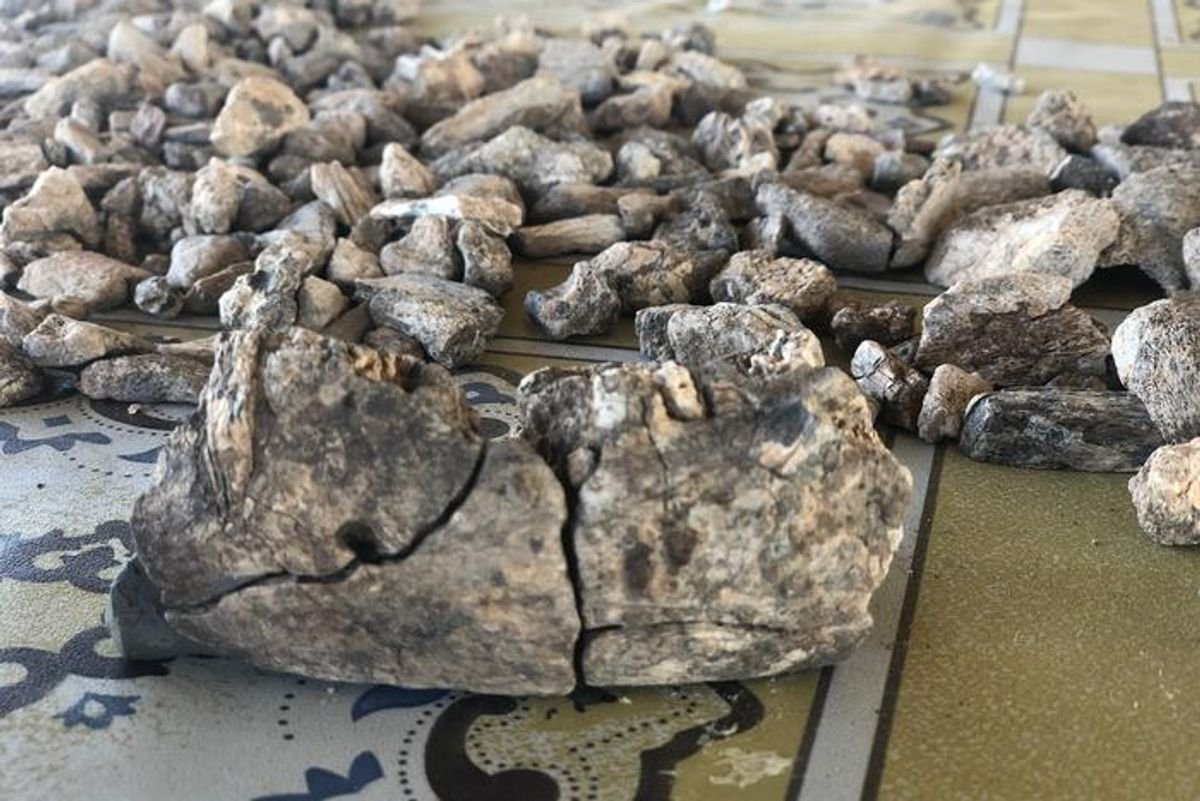
The newly described fossil comes from the Mille-Logya research area in northern Ethiopia and dates to about 2.6 million years ago, placing it near the earliest known appearance of Paranthropus. The specimen consists of a partial lower jaw recovered in fragments and later analyzed using high-resolution micro-CT scanning to examine its internal structure.
“It’s a remarkable nexus: an ultra-modern technology being applied to a 2.6-million-year-old fossil to tell a story that is common to us all,” Alemseged said.
The find shows that Paranthropus occupied the Afar at roughly the same time as early members of Homo were emerging elsewhere in eastern Africa. Its presence suggests the genus spread across a range of environments, and that its apparent absence from the Afar reflects gaps in the fossil record rather than a true biological boundary.
What the Find Suggests About Competition
The Afar fossil challenges the idea that Paranthropus was geographically restricted or unable to compete with early members of Homo. The genus has long been labeled a “nutcracker” hominin because of its large teeth and powerful jaws, reinforcing assumptions that it occupied a narrow dietary niche.
“While some experts suggested that dietary specialization restricted Paranthropus to southern regions, others hypothesized that this could have been the result of Paranthropus’ inability to compete with the more versatile Homo,” Alemseged said. However, “neither was the case: Paranthropus was as widespread and versatile as Homo and the new find shows that its absence in the Afar was an artifact of the fossil record,” Alemseged concluded.
Read More: Homo Ergaster: The Early Human Who Looked Almost Like Us
Article Sources
Our writers at Discovermagazine.com use peer-reviewed studies and high-quality sources for our articles, and our editors review for scientific accuracy and editorial standards. Review the sources used below for this article: